
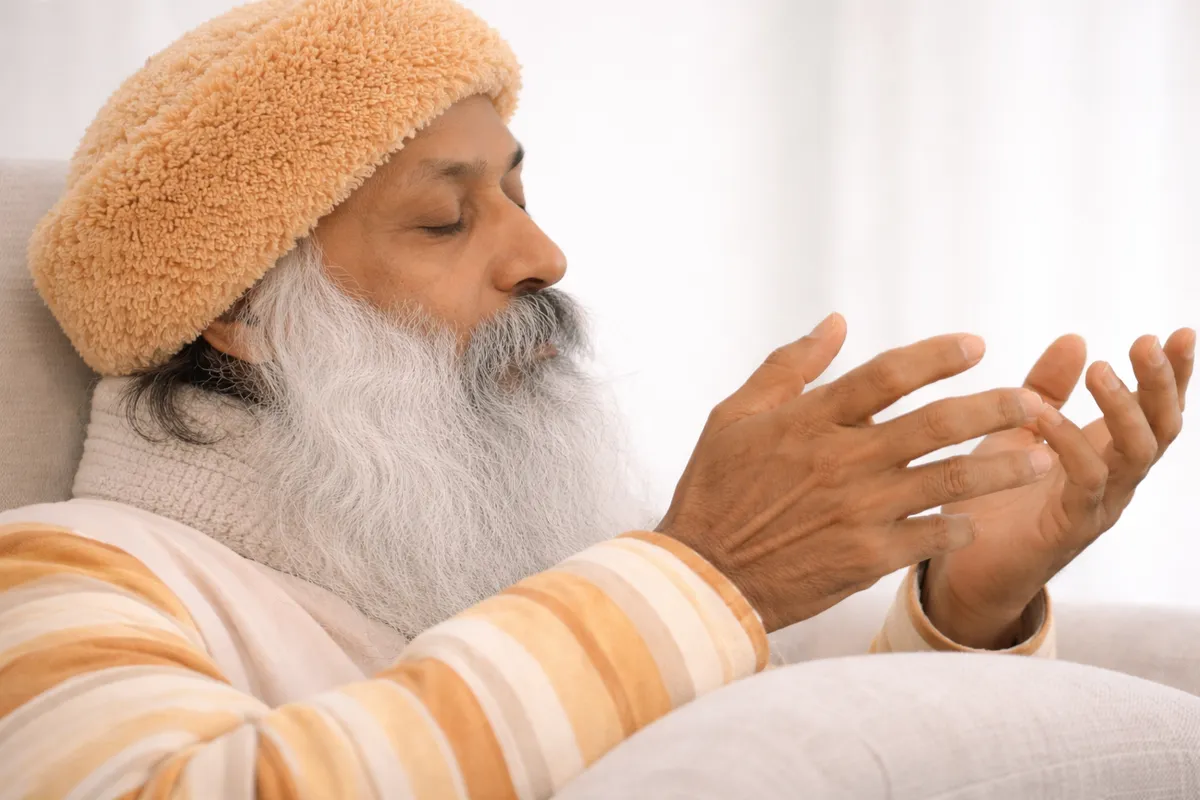
According to Osho, Devageet is a simple, innocent disciple who fearlessly voices the 'meaningless' questions everyone hides. As the group's mouthpiece, he brings repressed confusion to light so it can heal, even if it looks crazy. Osho encourages him because his naivety, obedience, and playfulness become a device to expose egoic sanity and catalyze collective transformation.
He’s the innocent guy who asks the silly questions for everyone so our hidden mess comes out and we can grow.
From the Discourses
Passages where Osho speaks to this question — each links to the complete discourse.
Deva means divine, anupa means unique. And each individual is unique; they are not a repetition of anybody else. And one should not ever imitate. Learn but never imitate. Learn from the whole existence, but never try to become a carbon copy. That is the only way to reach to god. Only when you are yourself can you reach. If you are somebody else, then it is impossible to make contact with the divine. Only an authentic person can have the contact. And authenticity means: one should insist on remaining oneself. [Osho gives sannyas to a small child and speaks to the mother.] Deva means god, rupo means the form -- in the form of god. Each child comes fresh in the form of god. Children have to be respected immensely; they have to be loved.
Veet means beyond, marga, in Sanskrit, means the way... beyond the way. The outward journey needs a way, the inward needs no way at all. If you want to go to the moon, there is distance, and the distance has to be covered by a way. But if you want to go into your own being there is no distance at all; you are already there. So it is not a question of travelling, it is only a question of recognising that 'I have already arrived.' Truth is beyond all paths because truth is already the case. It is not a question of achievement, it is only a question of remembrance: just a little more awareness and one is back home. And then the whole thing looks so absurd! How had you been missing it for so long?
Deva means divine, shobhana means beauty -- divine beauty. Existence is utterly beautiful. If we cannot see it that simply proves that we are blind. And to see beauty is to see god. The search for truth never goes so deep as the search for beauty, because the very word 'truth' is of the head. Beauty stirs the heart. And unless the heart starts becoming wakeful nothing is possible. Only through the wakefulness of the heart does one arrive. And then each and everything, the total existence, takes on such radiance, such infinite grace, that no poetry has been able to depict it, no painter has been able to catch hold of it. It remains elusive, it remains mysterious. One can feel it, one can be it but one cannot say it. That is the meaning of the word 'shobhana'.
Deva means divine, tarshito means thirst for -- thirst for god. God is possible only when it becomes a thirst for each cell of your being, when one is afire, when it is not only curiosity. Because if it is curiosity it remains only in the head -- it never reaches to the heart; it is superficial. It gains depth only when it is not curiosity but when one's life is in danger without god... when it is a question of life and death. It is as if one is lost in a desert and is thirsty -- that is tarshito, that thirst when one is dying. When one is dying for god, prayer is born. There comes a moment of ultimate thirst when you are simply thirst and nothing else... when you reach to the climax of your longing, when the passion is pure fire.
Deva means divine, sahaja means simplicity, naturalness, spontaneity. Simplicity is living a life without any idea about how to live it, without any ideology. Ideology brings complexity into life. Animals are simple, no animal is ever complex because no animal is burdened by any ideology. There is no "should"; the animal simply lives the way it feels. It has no goal to achieve, nowhere to go, but just to live the gift of life that has been given to it. Simplicity is animal-like -- the same purity, the same innocence. One should not live through "shoulds," one should drop all "oughts." The isness of life is enough; nothing else is needed. Life has no goal. It is enough unto itself. Life is not a means to some end. It is the means and it is the end; it is both. And when you are simple, you are naturally natural.