
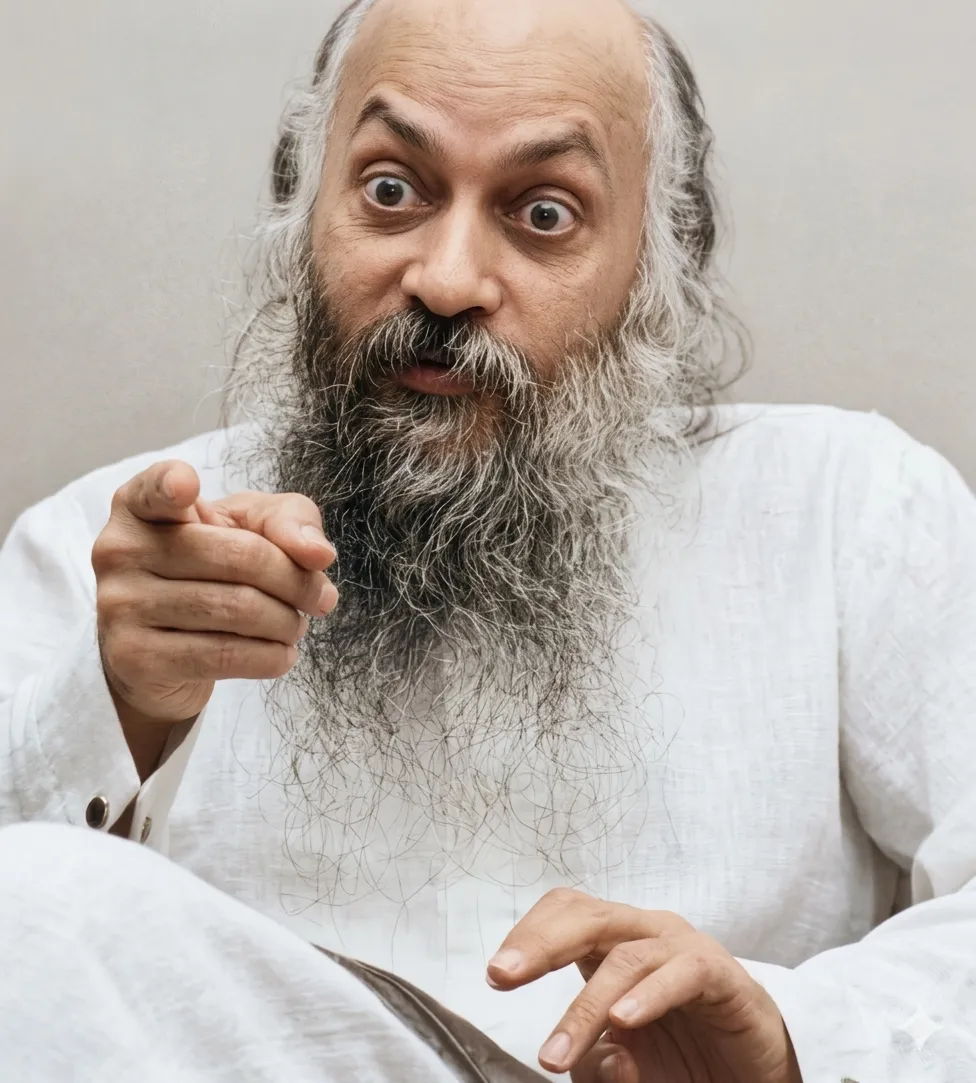
A Baul is someone who stops chasing perfect holiness or a faraway heaven and simply lives joyfully and wholeheartedly right now, singing and dancing with life.
From the Discourses
Passages where Osho speaks to this question — each links to the complete discourse.
Who is a baul? Please tell us the definition.
IT should have been asked in the beginning; now this is going to be last. But in a way, it is good. If in the beginning you had asked about the definition of a Baul, it would have been almost impossible to say anything. Not that now I can define, but at least now I can say it is indefinable. The Baul is not a metaphysics, the Baul is a mystique. I can invite you to participate in that mystery, but definition is not possible. So I am not going to define. Instead, I will tell you a story. Maybe that will give you a definition; but you will have to find it yourself. I have heard.... Once upon a time, an angel came to earth to see man and his world, because he had heard so many stories of man's splendor that he could not resist his curiosity. The…
Who has originated bauls? Please explain.
PEOPLE LIKE BAULS ARE NEVER ORIGINATED. Religions like the Baul religion are more like happenings. Who originated the roses? Who originated the songs that the birds go on singing every morning? No, we never ask that question. It has always been there. Philosophies are originated; you can find the originator. 'Isms', dogmas, creeds are originated. The Baul is not a creed, it is a spontaneous way of life. People have always lived that way. People who have ever lived have always lived that way. People who have ever been alive have been alive in no other way. Whether they were known as Bauls or not is immaterial. The name may have some origin somewhere; I'm not concerned with it. The word simply means 'the madman': madly in love with existence, madly in love with life -- but this madness has always been there. And it is good that a few…
Only a connoisseur of the flavours of love can comprehend the language of a lover's heart, others have no clue. The taste of lime rests in the core of the fruit, and even experts know of no easy way to reach it. Honey is hidden within the lotus bloom -- but the bee knows it. Dung-beetles nestle in dung, discounting honey. Submission is the secret of knowledge.
Bauls belong more to the Tantras than to the Vedas. There is only one improvement on Tantras; that is the only difference. Tantra is all-inclusive, more feminine than male. The Vedas are more male-oriented, the Tantras are more feminine. Of course, woman is more inclusive than man. Man is included in woman, but woman is not included in man. Man seems to be a sort of specialization. Woman seems to be more general, more fluid, more round. Tantra is the way of the feminine, just like Tao. But the Bauls have improved upon Tantra also. Tantra is too technical. The very word 'Tantra' means technique. It is a little harsh, more scientific. Bauls are more poetic; Bauls are more soft -- singers and dancers. Tantra uses sex to rise higher than it, but it uses it. Sex becomes instrumental. Bauls say that is not very respectful: "How can you USE…
What really is the difference between a baul, a tantrika, a bhakta, and a sufi? Do they all belong to the path of love? They seem to be intermingled. Please enlighten.
THE boundaries are overlapping. They are all on the path of love, but still there are subtle distinctions. Even with overlapping boundaries they have something special: a Tantrika, a Baul, and a Bhakta. Sufi is not different from Bhakta. Sufi is the Bhakta on the Mohammedan path; Bhakta is the Sufi on the Hindu path. There is no difference between a Bhakta and a Sufi, so we will not discuss that The difference is only of terminology. The Sufis use the Mohammedan terminology, the Bhakta uses the Hindu terminology. The difference is not of any importance; it is just language. But these three: a Baul, a Tantrika and a Bhakta have to be understood. Love has three possibilities: sex, the lowest; love, higher than sex; and prayer, the highest. The Tantrika remains sex-oriented. The Tantrika in fact avoids love, because love will become an entanglement. He remains a pure technician…