
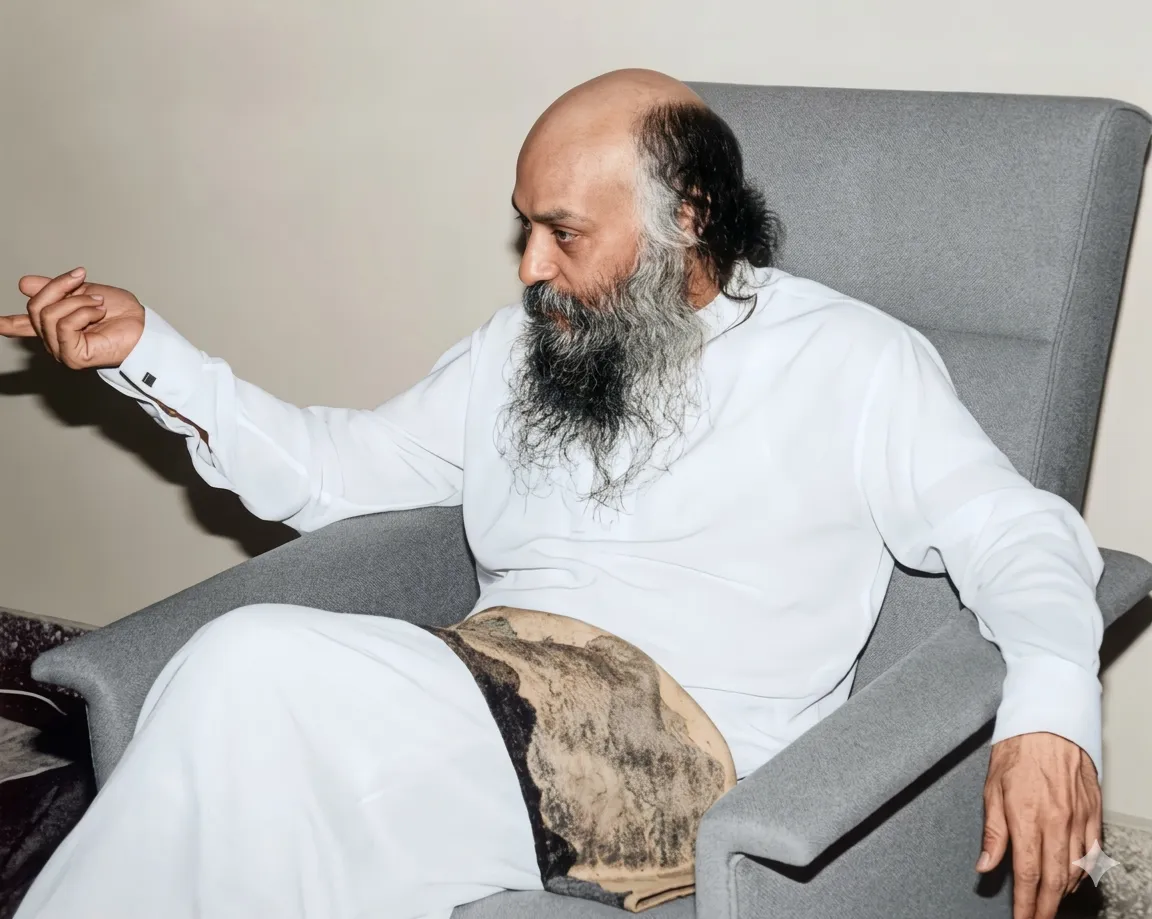
According to Osho, a sannyasin has no fixed daily routine; routine itself harms naturalness. He lives by the body’s inner wisdom: sleep when sleep comes, wake when it’s over; eat when hungry, refrain when not. Because rhythms and needs are unique, each seeker experiments and discovers personal timings, keeping strict freedom from borrowed schedules and egoic prescriptions.
Listen to your body and live naturally—sleep, eat, and act when it truly feels right for you, not by a one-size-fits-all timetable.
From the Discourses
Passages where Osho speaks to this question — each links to the complete discourse.
Osho, what would be the daily routine of your sannyasin?
How much to eat, what to eat, what to wear, how to wear it, how to sleep—these can be discussed in very general terms, but a routine cannot be made. You have to set your own routine—individual to individual. Each person must decide for himself. At least keep that much freedom. The worldly may not be able to; a sannyasin can. In fact, a sannyasin must—strictly—that whatever is comfortable, peaceful, blissful for him, he will live that way. Only keep one thing in mind: that it should not cause hurt, pain, or trouble to anyone—anyone at all. Live like that; such a guideline is enough. I would have to go into detail with you, because generalities can be said—what to eat or not—but nothing can be made rigid. Now, we see a man smoking. The whole world is against him, yet he keeps smoking. Doctors explain he will get sick.…
Questioner: what would be the daily routine, the discipline of your sannyasin?
Even the duration of one's sleep has to be determined individually. For someone, five hours sleep can be sufficient, while another person might need seven hours sleep each day. And there are a few people who do with just three hours sleep and it goes well with them. But this person who completes his sleep in three hours can prove to be dangerous for others. He will think himself a pious person and call all those who sleep long hours idlers and good-for-nothings. He will sermonize that three o'clock is the best time to get out of bed, and say that those who don't conform to this rule will go to hell. Beware of such people There can be no hard and fast rule for things like this. We cannot have set laws about what to wear, about what to eat and how much to eat, about when to sleep…
The second question is: Osho, if Lao Tzu says, “Do nothing,” then what becomes of effort?
Do you think that doing nothing is some petty effort? Doing nothing is the greatest effort in this world. The power of non-doing is the highest mastery there is. Doing—children can do that. There’s no great effort in doing; it’s something quite natural and ordinary. Animals are doing too. Non-doing is something very great. So don’t think that when Lao Tzu says “don’t do,” inaction, effort comes to an end. Surrender is the greatest resolve. Now this is very upside-down; it doesn’t occur to us, does it? We feel that surrender—placing one’s head at someone’s feet—means we are finished. But know that to place your head at someone’s feet is not within the capacity of an ordinary person! And to truly put your head at someone’s feet, to let go of yourself completely, is only possible for one who is utterly his own master. How will you let go? Simply…
Beloved Osho, what is sannyas?
Sannyas is rebellion against all slavery; it is living life in absolute freedom. To live life in absolute freedom, without traditions, without conventions, without religions, without philosophies, without ideologies -- political, social, and others -- to live unburdened is sannyas. But it will look crazy to the whole world. Freedom looks crazy because everybody is living an imprisoned life. To prisoners, the person who escapes from the prison looks crazy, because for them prison is comfortable, convenient, secure, safe. A Hungarian secret police colonel was inspecting a strip of the border. "Too many people have been slipping across at this point," he informed the guards. "I have been ordered to test your security precautions." After deploying the guards at strategic points, the colonel began creeping on all fours toward the barbed wire. "Can you see me now?" he called out. When they cried back "Yes," he started again. On the…
Beloved Osho,what are the qualities of a sannyasin?
In the early morning he went back, fell at Buddha's feet and said, "Sir, excuse me, forgive me. I could not sleep the whole night." And Buddha laughed, and he said, "You fool! Why? I slept perfectly well. Why should you get so disturbed about such a small thing? It has not hurt me. You see my face is as it was before. Why did you get so worried?" And the man said, "I have come to become your disciple. Initiate me. I want to be with you. I have seen something unique, superhuman. But first, forgive me." And Buddha said, "This is nonsense. How can I forgive you? -- because I have not even taken any note of it. I was not angry, so how can I forgive you?" Twenty-four hours had passed, and they were sitting on the bank of the Ganges. And Buddha said, "Look at how…