
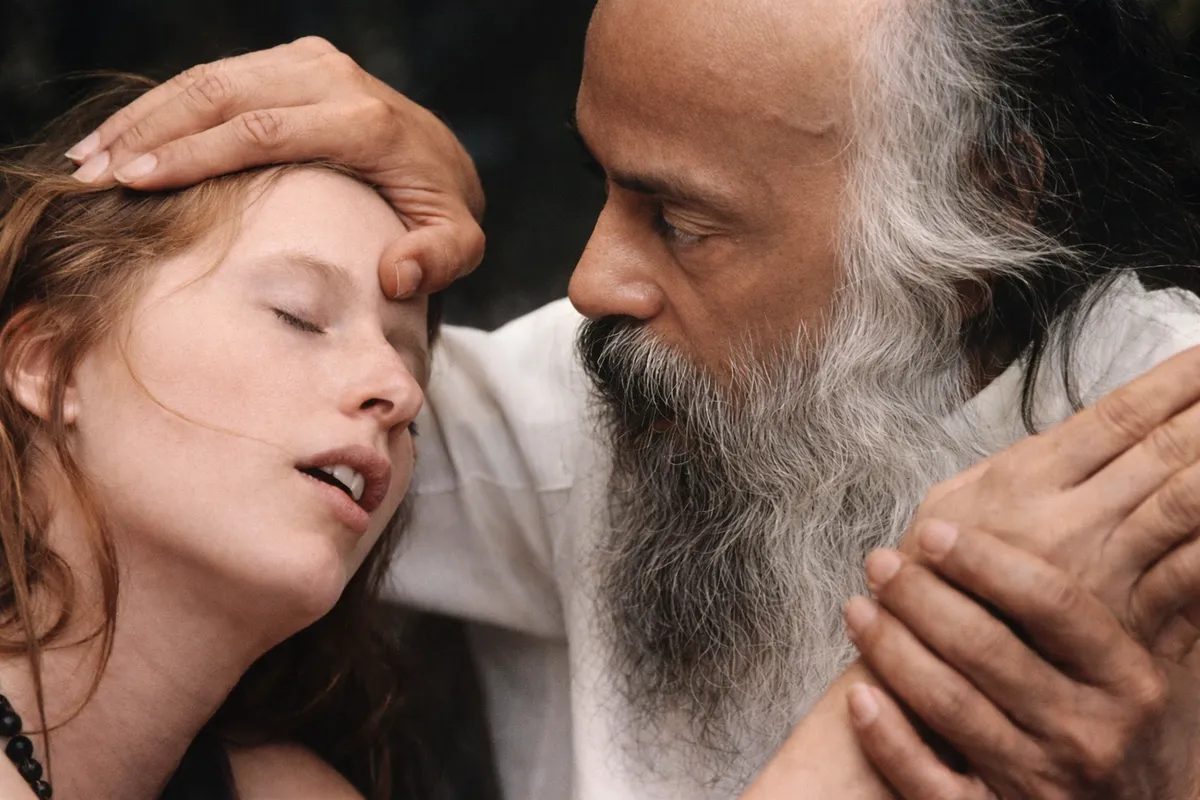
It’s your own true self, which appears when you stop trying to grab it and simply rest quietly.
From the Discourses
Passages where Osho speaks to this question — each links to the complete discourse.
Beloved master, it is about this feeling that it has always been there, and as soon as I feel it, it seems so far away -- but what is this "it"?
But remember one thing very very significant: that you have to be possessed by it to understand it. And we are very much afraid of being possessed -- it seems as if we are losing control, it seems as if we are dissolving. "Who knows where it will land us? Who knows whether I will be able to come back from it or not?" All these fears arise and you shrink back. And that is the moment you create the distance. The distance is your creation. Otherwise, it is always here, it is always now. Don't create the distance, don't bring fear in. In all the languages of the world there are words for religious people like 'God-fearing' -- ugly words, absolute lies, because a religious person is not a God-fearing person at all. A religious person is a God-loving person, not a God-fearing person. But the priest depends on…
Beloved Osho, for the past seven years I have heard you speaking about truth. But this is still an empty word for me. Often you say that one knows truth when one is silent inside. I know this delicious feeling that takes me over when I close my eyes and become quiet inside, but what is truth to do with that?
That is the truth. Truth is not an object that you will find somewhere when you are silent. Truth is your subjectivity. Just try to understand. You are there, and the whole world is there. Whatever you see is an object, but who is seeing it is the subject. In silence all objects disappear -- and the word `object, has to be remembered; it is the same word as `objection.' `Object' means that which prevents you. So all preventions, all objects, all objections, disappear; you have the whole infinity, and just silence. It is full of consciousness, it is full of presence, of your being. But you will not find anything as the truth -- that will become an object. And truth is never an object. Truth is subjectivity. To discover your subjectivity -- unhindered, unobjected to by anything, in its total infinity and eternalness -- is the truth. "The…
Beloved Osho,sometimes while just sitting, the question comes up in the mind: what is truth? But by the time I come here I realize that I am not capable to ask. But may I ask what happens in those moments when the question arises so strongly that had you been nearby I would have asked it. Or if you had not replied, I would have caught hold of your beard or collar and asked, "what is truth, Osho?"
When you fall in love with a woman there is some truth -- if you have fallen absolutely unaware, if you have not 'done' it in any way, if you have not acted, managed, if you have not even thought about it. Suddenly you see a woman, you look into her eyes, she looks into your eyes, and something clicks. You are not the doer of it, you are simply possessed by it, you simply fall into it. It has nothing to do with you. Your ego is not involved, at least not in the very, very beginning, when love is virgin. In that moment there is truth, but there is no interpretation. That's why love remains indefinable. Soon the mind comes in, starts managing things, takes possession of you. You start thinking about the girl as your girlfriend, you start thinking of how to get married, you start thinking…
Butei, the emperor of ryo, sent for fu-daishi to explain the diamond sutra. On the appointed day fu-daishi came to the palace, mounted the platform, rapped on the table before him, then descended and, still not speaking, left. Butei sat motionless for some minutes, whereupon shiko, who had seen all that had happened, went up to him and said, "may I be so bold, sir, as to ask whether you understood?" the emperor shook his head sadly. "what a pity," said shiko. "fu-daishi has never been more eloquent."
I have heard that Wittgenstein, a great Western philosopher, who comes nearest to the Zen attitude, used to say that he did not solve philosophical problems -- he dissolved them. And he used to say: "We leave things as they are but perhaps for the first time we come to see them as they are." Nothing can be done about things as they are. All that can be done is to help you to see them as they are. "We leave things as they are but perhaps for the first time we come to see them as they are." And again: "Philosophy simply puts everything before us, and neither explains nor deduces anything -- since everything lies open to view, there is nothing to explain." Yes, life is a mystery, and there is nothing to explain -- because everything is just open, it is just in front of you. Encounter…
Beloved Osho, so very close just because it's so very close, you cannot get this truth out of your own eyes. When you open your eyes it strikes you, and when you close your eyes it's not lacking either. When you open your mouth you speak of it, and when you shut your mouth it appears by itself. But if you try to receive it by stirring your mind, you've already missed it by eighteen thousand miles.
It is such a rejoicing to see Ta Hui coming closer and closer to reality, to the truth, and to his awakening. Just a step more and the old Ta Hui will be no longer there; and the new Ta Hui is naturally going to speak the language of all the awakened ones without exception. This sutra is one of the most important that we have come across up to now. The greatest difficulty with the human mind is that whatever is available from the beginning it tends to forget, it takes it for granted. There is no gap between you and your truth because you are the truth. This is such a tremendous phenomenon, but one goes on missing it for the simple reason that every search leads you away from it, every question misguides you, every answer is going to be wrong. If truth was separate from you,…