
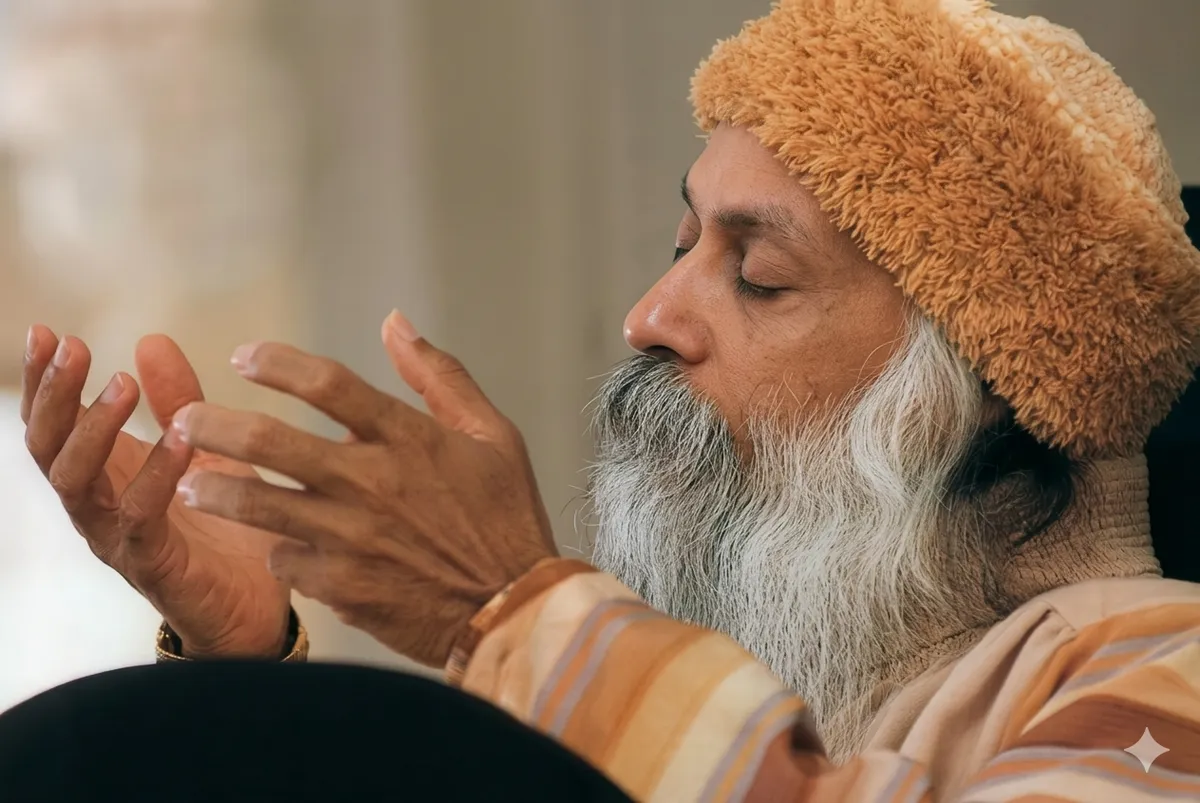
According to Osho, the time gap is entirely up to you: it can stretch across lifetimes or disappear this very moment. There is no fixed waiting period—fulfillment can happen in a single instant when your urgency, intensity, depth, surrender, and resolve are total. Postponement is only hesitation; say a wholehearted yes now, and sannyas begins now.
If you truly want sannyas and say yes totally, you can take it right now; delay only happens if you hold back.
From the Discourses
Passages where Osho speaks to this question — each links to the complete discourse.
Question: First question: Osho, I want to take sannyas; when should I take it? When there is readiness, understanding happens in an instant. You don’t have to work it out; it is seen, it is a direct seeing. He saw the truth of it: “He’s right. I have spread a net of words for nothing; I know nothing, I have no experience. I argued, I defeated the pundit, but neither he knows nor do I. Tomorrow someone else may come and defeat me. My life has no foundation. I am entangled in verbiage; I have wasted so much time.” Like lightning in the dark, everything was illuminated—clear in a single flash. Not that he went through a chain of reasoning—no. In one instant it was all seen. He placed his head at the master’s feet and said, “You ask, ‘When?’ The moment to do it is now.
Sannyas is a quantum leap, a jump into the unknown, a great courage to become discontinuous with your own past. It is a rebirth. It is a change so great... as if the old dies, and dies utterly and totally and the new comes into being from nowhere, from nothingness, out of nothing. If the new comes from the old it remains the old. If the new is continuous with the old then it is only a modification of the old -- maybe a little bit colored and decorated and changed, with a new dress, with a new mask, but it is not a revolution, it is not a conversion. And sannyas to be true has to be a revolution so total that the old identity is simply dropped -- just as the snake slips out of the old skin and never looks back.
Question: Second question: Osho, for the past fifteen years I have been coming to your satsang, and from the very beginning I have been wholly devoted to you. Yet to this day I have not been able to gather the courage to step into sannyas. Ever since you began giving sannyas, the longing for it has been alive in my heart. At that time, when I told my friends, “Come, we’ll enter sannyas,” they weren’t ready. But some of them later took sannyas and drowned in you, and I remained as I was. Even my robes are stitched and ready, but I lack courage. Nor is there any lack in my dedication to you. If anyone starts saying anything against you, I immediately grapple with him, or my eyes fill with tears. I enjoy the company only of those who have drowned in your love.
Osho, why does pratikraman—the return home—feel uneasy, difficult, almost impossible to us?
Hence whenever a living Master appears, those who uphold old scriptures become his opponents, because because of him people begin to set scriptures aside. When scriptures are set aside, the pandits are set aside, the whole business is set aside. It becomes hard. The pandits become enemies. Then when this Master dies, the same pandits who were his enemies gather at the cremation ground—to offer homage. They then make scriptures out of him. Their enmity was with the living, not with scripture. So they themselves make the scriptures. It is amusing: Mahavira was a Kshatriya, but all his ganadharas were Brahmins! Strange—what is this? The moment Mahavira died, the Brahmins rushed in: “Good opportunity—now we can make scriptures again.” At once they set up scriptures. Jainism got constructed. Now if once again someone brings living religion, the scholars, the pandits, the worshipers of scripture, are in trouble again; their business…
Osho, I am eager to take sannyas, yet I have been hesitating for a year. I also have this doubt in my mind: what will happen by taking sannyas?
You are still living. Breath still moves. The heart still beats. The blood still runs. However many days may have been wasted, much is still left. The as-yet-unarrived is still there; the future remains. Live this future in a new way, Krishnaraj! Will you keep beating the same old track? Just as you think, “What will happen by taking sannyas?” now think this: what will happen by not taking sannyas? Until now you have not been a sannyasin. What has happened so far? One thing is certain: at least sannyas will be a new experiment. Whether anything happens or not, a new path will be cut. Who knows—what didn’t happen on the old path may happen on the new! Walk with at least that much curiosity. Who knows! The old path is familiar; will you keep circling on it? And not think even once that after so many rounds nothing…