
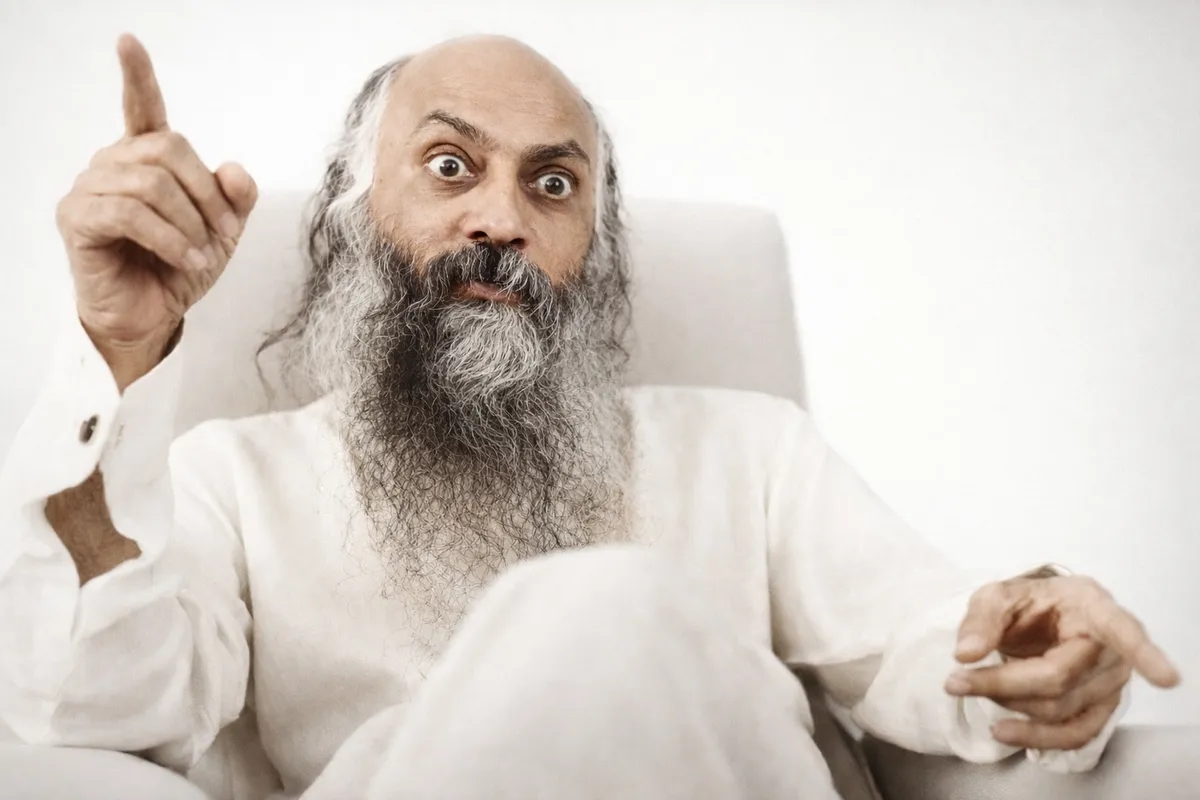
Touching feet only means something if it comes naturally from real thankfulness inside; doing it to get blessings does nothing.
From the Discourses
Passages where Osho speaks to this question — each links to the complete discourse.
Another friend has asked something related. He says, Osho, when you get up—someone folds their hands to you, someone touches your feet—I feel very puzzled. He has written that he feels very surprised. Why should anyone touch someone’s feet? Why should anyone fold their hands to someone?
And then it is worth asking: someone else is bowing, and some third person is getting upset! If they were bowing and they themselves were troubled, it would be understandable. But one person bows at someone’s feet and another person gets disturbed. What a strange disturbance! Why are you disturbed? Why should I be disturbed? Two people are loving—and I become disturbed! I grow restless: why are two people loving? What does my restlessness reveal? One person is giving another respect, reverence, thanks—and I get upset. Why am I disturbed? There can be two or three reasons. One: seeing others bow, my inner ego, which never knows how to bow, gets badly hurt. If no one bows, it relaxes. If someone bows, it feels wounded. Like this: three men are walking and a beggar stands before them. One of the three takes out money and gives it, and the other…Read the full discourse →
Osho, please explain the occult and spiritual meaning and significance, in the context of kundalini energy, of these practices: full prostration, placing one’s forehead at the feet of the divine or touching the feet with the hands, bowing one’s head in sacred places, the divine touching a seeker’s head or back in blessing, and the Sikh and Muslim custom of covering the head when entering a gurdwara or a mosque.
A promise kept after a buddha’s death In Tibet—though that place has since fallen into difficulty—there was a spot where Buddha’s promise has been fulfilled continuously for twenty-five hundred years. There is a small council of five hundred lamas. When one lama dies, only with great difficulty does another gain entry; their number cannot exceed five hundred, nor be less. Only when one dies does a place become vacant. And when one dies and another is to be admitted, it must be with the unanimous consent of all the rest—even a single dissent prevents admission. This council gathers on Buddha Purnima on a particular mountain. At the appointed time—which is part of the pact—Buddha’s voice begins to be heard. But this will not happen on just any mountain, nor before just anyone; it happens in exact accord with the agreement. It is like this: you go to sleep in the…Read the full discourse →
A friend has asked: Osho, I forbid people to touch my feet! But why do I forbid it?
But behind whom? Defeated by whom? Bowed to whom? Bowed to the Infinite—such people are raised up, lifted. Defeated by the Infinite—such people have won; now there is no possibility of defeat. So of course I say: do not bow at my feet. Because this “mine-and-thine,” this “my feet” feeling, is itself the obstacle to bowing. Where mine and thine disappear, bowing begins—bowing arrives. So do not be upset. Some friends said to me, “Whatever you say… we will still touch your feet!” In our land, habits are strange. If someone says, “Don’t touch my feet,” it becomes a clever device for getting one’s feet touched. Tell people, “Keep your distance,” and they come closer. Abuse them, and they will think, “This man is a Paramahansa.” This is our centuries-old wrong habit, and clever people exploit it. It seems that the one who says, “Do not touch my feet,” must…Read the full discourse →
Please explain the significance and meaning of the following with respect to the energy of kundalini: prostrating on the ground in obeisance to a holy person, touching his feet with the head or hands, offering worship at holy places, the blessings of a divine person given by touching the head or back of a seeker, the covering of the head by sikhs and mohammedans on entering the gurudwara or mosque.
But usually temples are not living ones because there are great difficulties in keeping them alive. A temple becoming alive is a great miracle. It is a part of a very profound science. Today, however, there is no one alive who knows this science and who can carry out its various requirements. Nowadays the class of people who run temples as shops has become so large that if there is someone who knows this science he will not be allowed even on the premises of the temple. Temples are now run along business lines, and it is in the interest of the priests that the temple remains dead. Living temples are not beneficial for a purohit, a priest. He wants a dead god in the temple whom he can lock up, and then he wants to keep the key himself. If the temple is connected with higher powers it will…Read the full discourse →
Either say, “Don’t fall at anyone’s feet.” Even if they do understand “don’t fall,” for them it will only mean: don’t touch feet. But that when a person seems to be touching someone’s feet, he may in fact not be touching feet at all—that they can never see. He is doing something entirely different, and they have no idea of it. They cannot possibly know it. It is beyond their imagination. (The audio recording of the question is unclear.)
But they do understand other things. For example, if they get angry—if rage arises—they are ready to break someone’s head, to hit someone on the head with a shoe; and it never occurs to them, “What will come of hitting someone with a shoe?” They are simply expressing a feeling. Or when someone falls in love with someone, he embraces them; he never thinks, “What will come of embracing?” These are expressions of the feelings that arise within us. (The audio recording of the question is unclear.) What is happening inside him is the question—not the feet. Somewhere within him something has arisen, perhaps without his even knowing it, and his head has become joined to someone’s feet. What he is gaining or not gaining is not for someone else to understand. But if, seeing him, someone imitates him and places his head at someone’s feet, he will gain nothing.…Read the full discourse →