
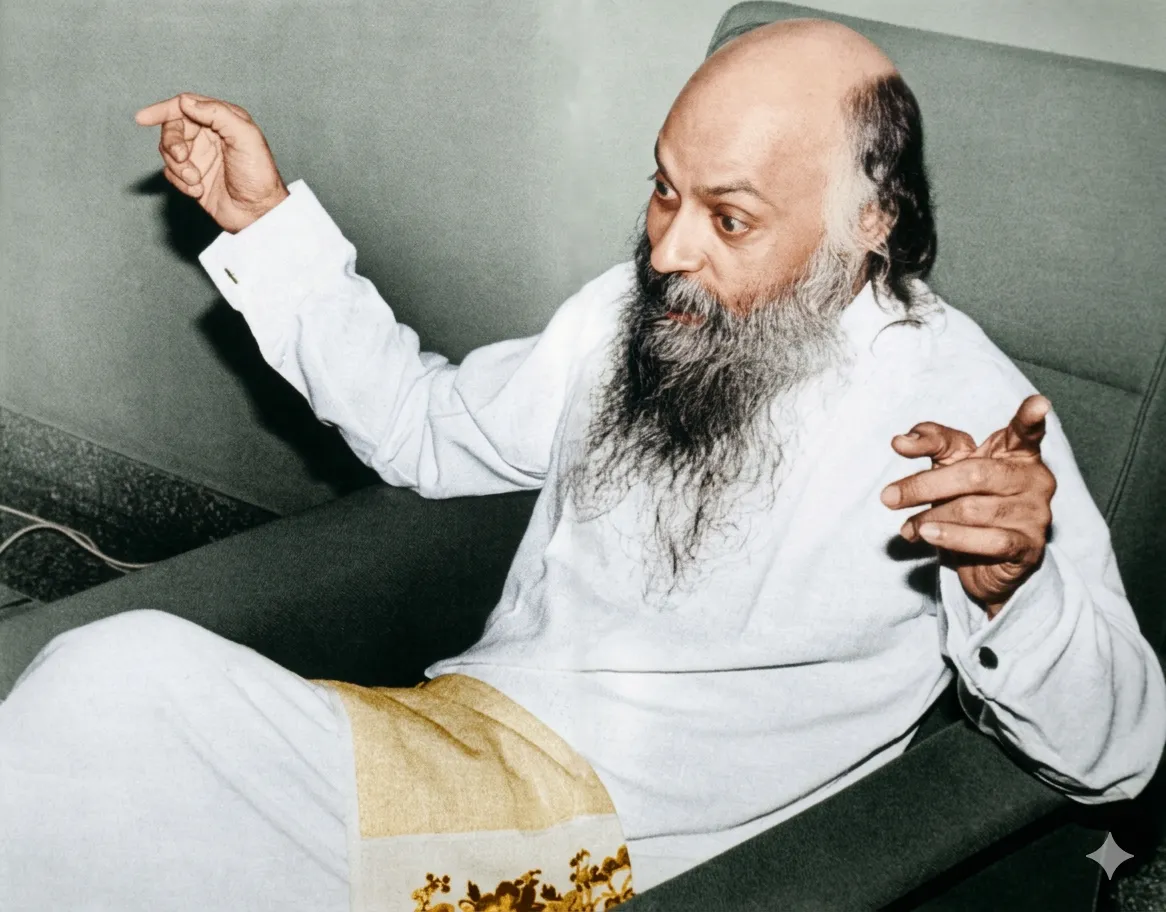
When you accept all parts of yourself, you stop needing to be proud or pretend to be humble, and a quiet, real humility appears by itself.
From the Discourses
Passages where Osho speaks to this question — each links to the complete discourse.
Beloved Osho, what is the difference between the emptiness of the child before the formation of the ego and the awakened childlikeness of a buddha?
Whether you are for it or against it doesn't matter -- your concern shows where your ego is hanging. And I will include the capitalist in it also: his whole concern is how to gather money, hoard money -- because money has power over matter. You can purchase any material thing through money. You cannot purchase anything spiritual, you cannot purchase anything that has any intrinsic value; you can purchase only things. If you want to purchase love, you cannot purchase; but you can purchase sex. Sex is the material part of love. Through money, matter can be purchased, possessed. Now you will be surprised: I include the communist and the capitalist both in the same category, and they are enemies, just as I include Charvaka and Mahatma Gandhi in the same category, and they are enemies. They are enemies, but their concern is the same. The capitalist is trying…
Osho, what is the difference between surrender and blind imitation?
So be careful: the freedom you allow yourself, allow the other too. You have no right to judge another as blindly credulous or as a surrendered being. Drop that concern. You cannot judge anyway—how will you enter another’s heart? How will you know? Think only about yourself. See within whether, up to now, you have lived by blind belief or by surrender. Decide only there; leave worrying about others. Otherwise, all your judgments will be wrong. Jesus said: Judge not; do not set yourself up as a judge in relation to another. To the friend who has asked: if you are asking for yourself, good. Drop worrying about others. Look within and see: whatever I have been clinging to till now—have I ever staked my life to hold it? Have I meditated for it? Have I loved for it? Or am I just clutching what culture, society, civilization handed me?…
चौथा प्रश्न: ओशो, समर्पण और अंधानुकरण में क्या अंतर है?
इसलिए खयाल रखना, जो तुम अपने लिए मौका देते हो, वह दूसरे को भी देना। तुम्हें कोई हक नहीं है किसी दूसरे के बाबत निर्णय करने का कि वह अंधविश्वासी है, या समर्पित हुआ व्यक्तित्व है। तुम इसकी चिंता छोड़ो। तुम कर भी नहीं सकते निर्णय। तुम दूसरे के हृदय में उतरोगे कैसे? जानोगे कैसे? तुम तो अपनी ही सोच लो। इतना ही देखो अपने भीतर कि अब तक तुम अंधविश्वास से जी रहे हो, या समर्पण से जी रहे हो। बस, वहीं निर्णय कर लो, दूसरों की फिकिर छोड़ दो। अन्यथा तुम्हारे सभी निर्णय गलत होंगे। जीसस ने कहा है, निर्णय करो ही मत; दूसरे के संबंध में न्यायाधीश बनो ही मत। तो जिन मित्र ने पूछा है, अगर अपने लिए पूछते हों, तो ठीक। दूसरों की चिंता छोड़ दें। अपने भीतर ही देख लेना है कि अब तक जो मैं पकड़े हुए हूं, उसको पकड़ने के लिए मैंने कोई जीवन दांव पर लगाया है? कोई ध्यान किया है? कोई प्रेम किया है? या सिर्फ संस्कृति ने, समाज ने, सभ्यता ने जो दिया है, उसे पकड़े हुए हूं! दूसरों ने दिया है। …
The so-called religious people are almost always egoistic people. Even if they pretend to be humble, you can see through their humbleness. There is a very beautiful anecdote about a mystic who came to see Socrates.... The mystic used to say that he was the most humble man in the world. He used to wear a gown full of holes -- dirty, rotten, very ancient. When he came to see Socrates, Socrates looked at him and said 'But through the holes of your robe, only ego is looking at me, nothing else.' And he was right! So somebody can cultivate poverty and become very egoistic about it, somebody can cultivate humbleness and become egoistic about it. To me, real humbleness arises as a fragrance of love. It cannot be cultivated, you cannot practise it, there is no way to learn it.
Beloved Osho, the dictionary definition of humble is: "having or showing a consciousness of one's defects or shortcomings. Not proud, not self-assertive, modest." is a rebel humble? Is there more to the definition of humble?
It may appear to egoistic people as assertiveness, that the roseflower is asserting its redness, its fragrance; it is doing a kind of PR job, inviting people to see, inviting people to smell, declaring to the world, "Look, is there any other rose better than me?" But this is your own projection. You are not being kind to the poor roseflower. He is not doing any PR job, it is just his nature. And finally, the dictionary says, "the humble man is modest." But a man without ego -- how can he be modest? Modesty means you have an ego but you have controlled it. You have made boundaries, limits; you have cultured it, you have made it civilized. But it is very thin ... skin-deep. All your so-called modest people, just scratch them a little bit and immediately their barbarous ego will be out. A truly humble man has…
The more in communion with life you are, the more alive. So the more egoistic a person is, the more dead. The really alive person has no ego, because he knows he is not separate; he is joined together with this infinity. And out of this experience and understanding -- that one is part of the whole -- a humbleness arises... without any cultivation, without any practice. Then it is tremendously beautiful. In that humbleness there is love and no ego. Ego and love are diametrically opposite. Whenever there is love, ego disappears. Whenever there is ego, love disappears... Recognise the fact more and more, let the fact sink into your being more and more, that we are not separate. That 'I' is unreal -- 'us' is real... and the 'us' includes the trees, the rivers, the rocks, the stars.