
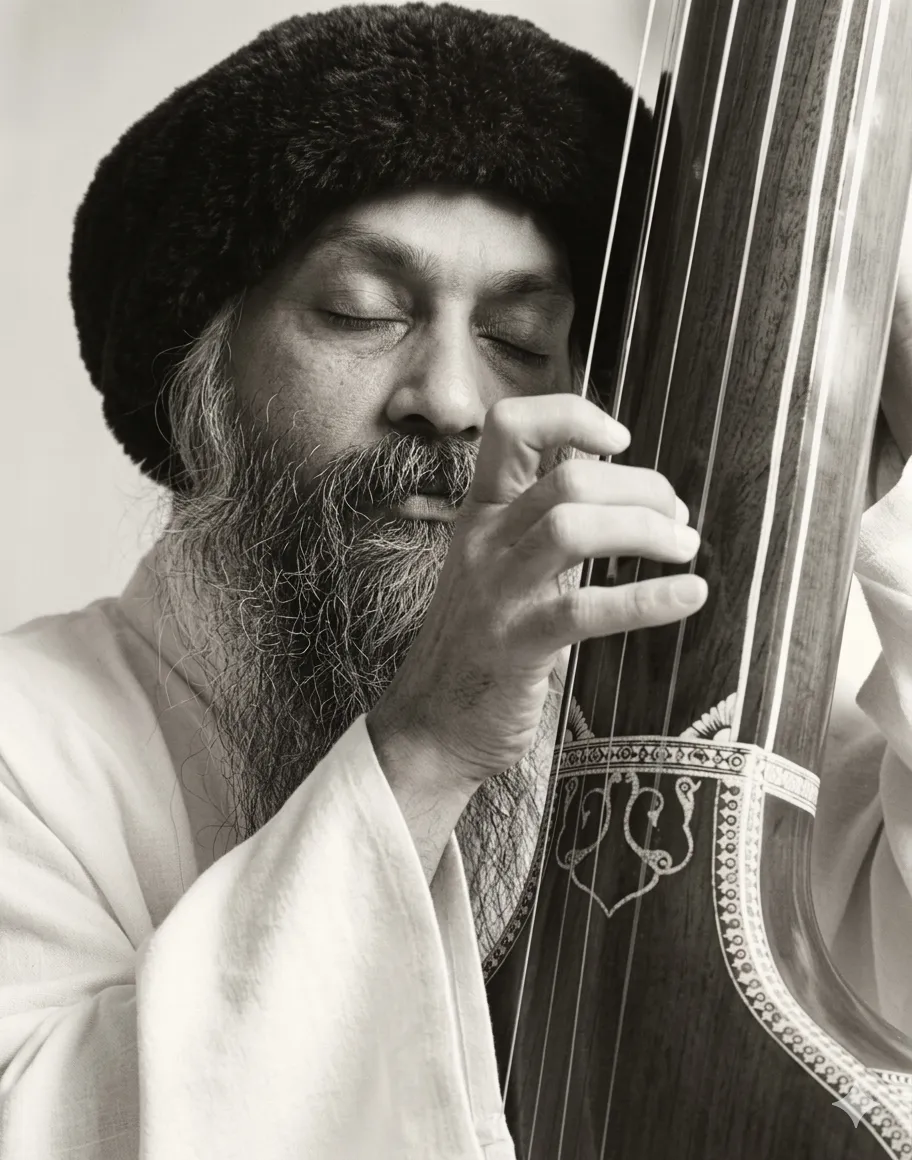
According to Osho, fate is mostly a convenient excuse; your lived experience—night or dawn—depends on your choice, intensity of longing, and alertness. Existence offers the open sky, but it never forces you to fly. By keeping your eyes, ears, and heart open, you meet the inevitable dawn; by closing them, you postpone it indefinitely.
If you open up and truly want the light, you get morning; if you blame fate and stay closed, you stay in the dark.
From the Discourses
Passages where Osho speaks to this question — each links to the complete discourse.
Osho, You who deck the latticed windows of my dreams with flowers—do your dreams hold any place for me, or not? Ask with your eyes and tell me: is there any dawn written in the destiny of my nights, or not?
Has the ego ever given you happiness? Then why do you go on constructing it? Ego is only a thorn, a spike that pricks. Other things that hurt you, hurt only because of the ego. Someone insults you—you are disturbed. If you think you are disturbed because of their insult, your analysis is wrong. If there were no ego, you would not be disturbed. People abused the Buddha. People have always abused Buddhas. But the Buddha was not disturbed. He merely said, “If you have finished, may I go? I must reach the next village; people will be waiting. And if you haven’t finished, don’t worry—on my way back I’ll stop again and hear you out.” They were abusing him. They could not believe there could be such an answer to abuse. One of them said, “What are you saying? We are abusing you—these are not words, these are poison-tipped…
Question: Second question: Osho, is believing in fate always bad? Nothing is absolutely good or absolutely bad in every situation. There are times when even poison is good, because there are illnesses for which poison is medicine. And there are times when even nectar can be harmful, because there can be illnesses in which taking anything into the body is too costly—even nectar. There are conditions in which fasting itself becomes the door to health; at such times, don’t drink nectar either. Nothing in life is fixed and rigid—but that is exactly what we try to make it. We want labels: such-and-such is bad—“fate,” for example. People ask me, say it clearly, is believing in fate right or wrong? Fate can be understood rightly—in which case it is of great value. Fate can also be understood wrongly—in which case it is greatly misused.
Osho, is sannyas in my destiny or not?
No, sannyas has nothing to do with fate. But it seems you want to hide behind fate. You think, “If it is in my destiny, it will happen by itself; and if it isn’t, it won’t.” You want to avoid the issue. It will happen by your choosing it, not by destiny. Destiny is your excuse, your trick, your cover. Don’t deceive yourself. If you don’t want to take sannyas, don’t take it—but know that it is not a matter of fate; it isn’t written. Sannyas means going beyond fate, beyond predetermination, beyond the readymade. “To complain of destiny is meaningless—you simply do not consent to live. That you could not shape your own fate—no one is that helpless.” This gathering is of the lovers of the heart; here we are all drinkers, we are all cupbearers. To go seeking diversion among mere humans is not the custom of this…
Beloved Osho, could you please explain the difference between trusting existence and fatalism?
The difference between trust and fate is very subtle. On the surface it seems they mean exactly the same thing, but in reality they are diametrically opposite experiences. Fate is a consolation. You are poor, and you see others getting richer and richer -- some consolation is needed. You do everything and you do it honestly, truthfully, morally. You never use wrong means; still you are a failure. And you see others being dishonest, cunning, insincere, immoral, criminal, using all kinds of wrong means and succeeding, becoming richer, attaining power, prestige. How to explain it? It is not new. Since the very beginning man has been puzzled by it. And he had to create some idea as a consolation. Fate, kismet, destiny, God -- everything is written in the lines of your hand, in the lines of your forehead; everything is predetermined in your birthchart, you cannot do anything against…
Osho, is my destiny nothing but a long series of sadness and frustration written in advance?
It is in your hands. If you go on writing it, it will remain written. No one else is giving you melancholy; it is your choice. You have chosen it. No one else will give you bliss either—if you choose it, you will have it. What you find, what you choose—that is your destiny. Let us understand a little. The old notion of fate says: it is written—and written by someone else, not by you. I want to tell you: destiny is not already written; it has to be written day by day. And not by someone else—your own hands write it. It may be that you write in such unconsciousness that your own hands seem alien. It may be you write in such unawareness that only after it is written do you realize something got written. You cannot catch yourself red-handed. Your awareness is lacking. But no one else…