
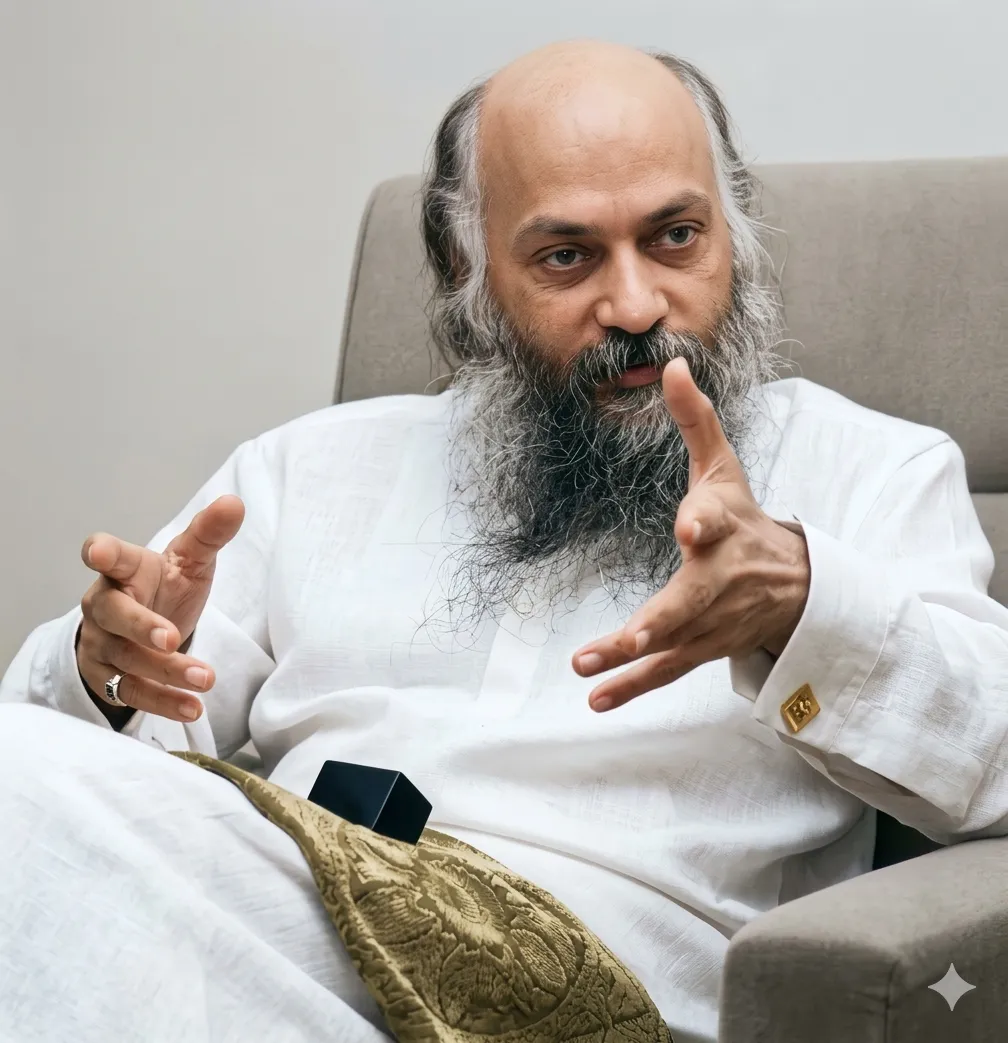
Don’t just follow orders because they sound noble; stay aware inside and let your own clear heart say yes or no.
From the Discourses
Passages where Osho speaks to this question — each links to the complete discourse.
Can you say something more about obedience? Is it not good to serve obediently in a noble cause?
The noble cause was education. It involved three people: the professor, who was the authority figure in charge of the proceedings; the learner or victim; and the experimental subject, who was asked by the professor to act as teacher and to punish the learner each time he gave the wrong reply. Punishment was by electric shocks of growing severity, administered by the teacher on the professor's orders. The learner or victim was strapped into a kind of electric chair. The teacher was seated in front of an impressive shock-generator which had a key-board of thirty switches ranging from fifteen volts to four hundred and fifty volts. There were also verbal inscriptions on the machine ranging from 'slight shock' to 'intense shock' to 'danger: severe shock'. In fact, the whole gruesome set-up was based on make-believe: the victim was an actor, the shock-generator was a dummy. Only the teacher, at whom…
Osho, please talk about surrender and obedience.
And because from the very beginning your father, your mother, your parents, your teachers, your priests are all teaching you, "Do this, don't do that," they all create a certain obedience in you. You become addicted to obedience; it is a drug. So when you come to me you would like.... People go on asking me -- I never answer their questions -- they go on asking me, "Give us detailed instructions what we should do and what we should not. We want clear instructions from you." I give you clarity not clear instructions, because my instructions may be right today and tomorrow they may not be right. My instructions may be a hindrance to your growth tomorrow because nobody knows about tomorrow -- it is unpredictable. So I give you clarity so that you can find your own way of life today and tomorrow and the day after tomorrow.…
Beloved Osho, goethe once wrote in his 'goetz von berlichingen', "poverty, chastity and obedience -- unbearable are they all." what do you think about his statement?
They gathered, but the bishop must have thought it will look foolish to have a protest with a dozen old women; it will be a protest against Christianity, not against me. So hiding somewhere in a small room... We tried to find out where they were meeting, but we could not. Then he gave a declaration to the newspapers that "the concerned people had a secret meeting." And who are these concerned people? -- the old women. I loved the words "concerned people." All these religions are living on poverty. The poor go there because they are suffering; it is unbearable, they need some kind of consolation. The rich don't go there; they are not suffering. And if they are in a certain anguish, these priests are not capable of helping them. The rich people, feeling frustrated, have to search for somebody who can help them out of their anguish.…
What is the difference between waiting for godot and waiting for god?
It is as if the sun has risen in the morning and you are sitting in your room with closed doors and windows, in darkness. Open the doors, you become available to the sun. The sun was already available -- just the meeting happens. You cannot wait for God. All waiting is for Godot. Godot means the one who never comes, who CANNOT come, whose arrival is impossible. And the only impossible thing is that which has already happened -- how can it happen again? You are alive, and you are waiting for life, Now, this is ridiculous. The real man of religion does not think in terms of God. He thinks in terms of life or, even better, of living -- because life can again become an abstract idea. Living, moment-to-moment living. In that very living, one knows what God is, because one knows who one is. Your idea…
Osho! Shri Girija Kumar Mathur, who has given poetry a new mode and a new dimension, is a resident of my village, Ashoknagar. He still lives there. He is interested in you—has read some books and also shows interest in your tape discourses. He says, “I do have the eagerness to meet him once, but I get nervous because his personality is controversial.” If you find it proper, kindly say something.
These are not their questions. But to show others, “Our questions are spiritual. We are not ordinary folk—we are seekers. Anger, lust—these we left behind long ago. Wealth, food—such cravings don’t beset us. In us devotion to God has arisen; we want to taste liberation.” Without annihilation there is no savor of abiding. Until you efface the ego, you will not find God. If you want God, one thing must be erased—you must erase yourself. Until you are annihilated—become a pure zero—you will not know the ecstasy of existence. Such is the paradoxical arithmetic of life: the one ready to vanish finds life; the one who clutches at life finds nothing but repeated death. Truth itself is paradoxical; therefore, how can those who have experienced it be anything but controversial? Their utterances become paradoxical. To speak truth, there is no other way but paradox. And to speak truth, compromises cannot…
पहला प्रश्न: ओशो! कविता को एक नई विधा, एक नया आयाम देने वाले श्री गिरजाकुमार माथुर, मेरे गांव अशोकनगर के निवासी हैं। इन दिनों भी वहीं रहते हैं। आप में उनकी रुचि है। कुछ किताबें भी पढ़ी हैं, टेप-प्रवचन में भी रुचि दिखाते हैं। कहते हैं--एक बार साक्षात्कार की उत्सुकता तो है, परंतु उनका व्यक्तित्व विवादास्पद होने के कारण घबड़ाता हूं। उचित समझें तो कुछ कहने की कृपा करें।
ये प्रश्न ही नहीं हैं उनके। मगर सबको दिखलाने के लिए कि हमारे प्रश्न आध्यात्मिक हैं! हम कोई साधारणजन नहीं हैं, आध्यात्मिक खोजी हैं! क्रोध, कामवासना इत्यादि तो हम कब की पीछे छोड़ चुके! धन, भोजन, इनकी लालसाएं हमें नहीं घेरतीं। हमारे भीतर तो परमात्मा की भक्ति जगी है, मोक्ष का स्वाद लेना है।