
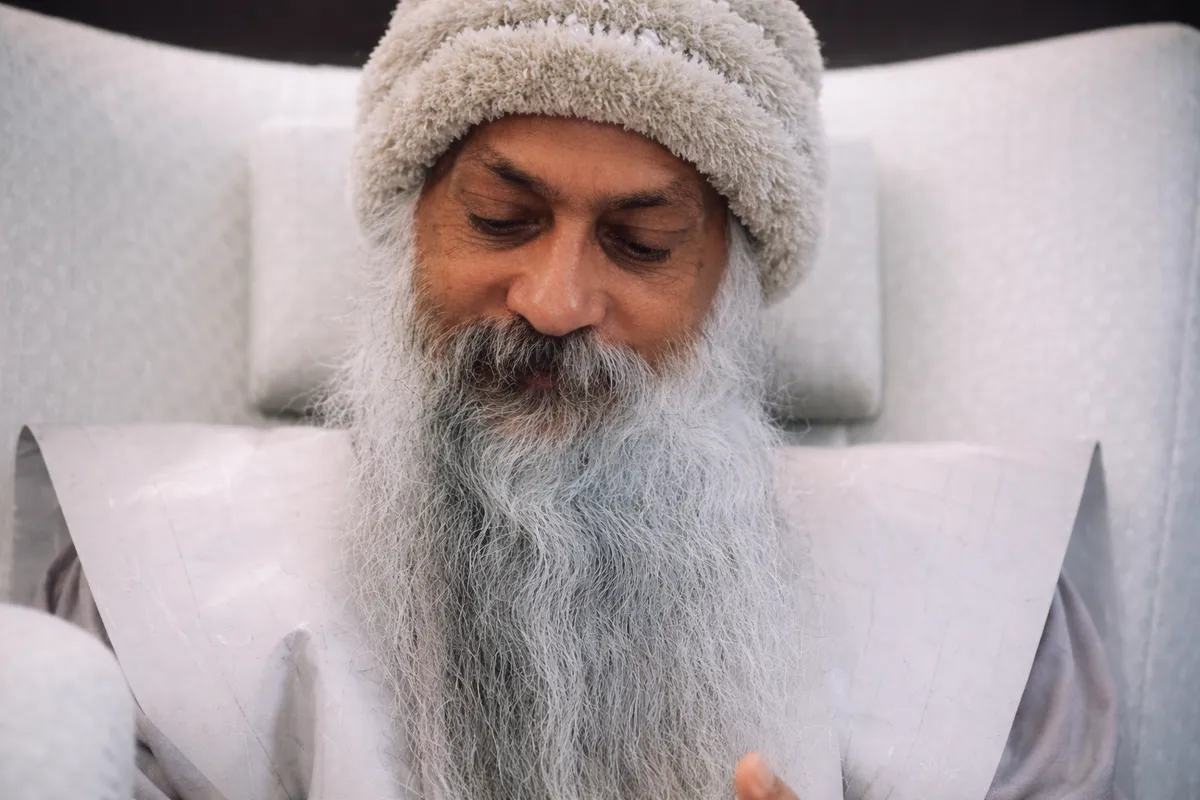
A command is when someone tells you exactly what to do; Osho prefers sharing so you can choose for yourself.
From the Discourses
Passages where Osho speaks to this question — each links to the complete discourse.
Beloved Osho, what is the difference between the emptiness of the child before the formation of the ego and the awakened childlikeness of a buddha?
Whether you are for it or against it doesn't matter -- your concern shows where your ego is hanging. And I will include the capitalist in it also: his whole concern is how to gather money, hoard money -- because money has power over matter. You can purchase any material thing through money. You cannot purchase anything spiritual, you cannot purchase anything that has any intrinsic value; you can purchase only things. If you want to purchase love, you cannot purchase; but you can purchase sex. Sex is the material part of love. Through money, matter can be purchased, possessed. Now you will be surprised: I include the communist and the capitalist both in the same category, and they are enemies, just as I include Charvaka and Mahatma Gandhi in the same category, and they are enemies. They are enemies, but their concern is the same. The capitalist is trying…
Osho, do devotion, knowledge, and action arise from one’s own nature or from outside influence? Osho, please explain.
Om, you ask: from influence or from nature? Influence is worth two pennies. To be influenced is already to go wrong. Devotion under influence will have some other motive hidden within; only the label will be devotion. Knowledge will be parroted; of little worth. Action you will do in the hope of heaven arriving any minute—the Pushpak chariot descending to carry you bodily to paradise. Your service will be dipped in desire: serving in hope of a payoff—pressing the poor man’s feet today so that gods and goddesses will press yours forever. Is that service? That is not karma. Until action is desireless, it is bondage; a hidden craving slips in through the back door. And here, everyone seems “knowledgeable.” In this land, hard to find anyone who admits ignorance. Read ten books, compile an eleventh, and you are a great scholar; people will discuss you. People come to me…
Beloved Osho, what do you think of moses' ten commandments? Do you have any commandments for us?
One day it happened, he was just going to the river. He used to carry, up to that time, a begging bowl which he used to collect food or keep water. He was running towards the river -- he was thirsty -- and just by his side a dog came running and reached the river before him and started drinking water. Diogenes said, "Great. This dog is far more independent than me." He threw the begging bowl into the river and said to the dog, "Master, you have really shown me the way. I was carrying that weight unnecessarily." He was caught by a few thieves -- because in those days people were caught and sold as slaves, and he looked very promising. He was very healthy and had a certain personality. They were certain that they would get good money if they could keep hold of him. They were…
Osho, there is a Talmudic saying: “Beyond what is commanded to you, higher than that, conduct yourself in holiness.” Please tell us its meaning.
Narendra! Adishta—“what is commanded”—means what the noble ones have told you. But what another tells you is borrowed. It has no roots in your own experience. It may shape your conduct, but not your conscience. You will start walking, yes. If Buddha says something, he must be saying it rightly; there is no reason to think him wrong. On Buddha’s utterance there is the stamp of his authenticity, his signature. One who falls in love with Buddha, who becomes acquainted with his aura, will follow his words. Even so, it has come from the outside, not welled up from within. It is not a flower of your own soul. You bought that flower in the market, made a garland of it, put it around your neck. But it did not blossom in the garden of your being. Therefore the Talmud says: the commanded is fine—follow what has been enjoined—but do…
पहला प्रश्न: ओशो, तालमुद का वचन है: ‘जो तुझे आदिष्ट है, उससे परे भी, उससे ऊपर भी, तू पवित्र आचरण कर।’ कृपा करके इस वचन का आशय हमें कहिये।
… आदिष्ट का अर्थ होता है: जो श्रेष्ठ पुरुषों ने तुमसे कहा है। लेकिन जो दूसरे ने तुमसे कहा है वह उधार होगा। तुम्हारे निज अनुभव में उसकी कोई जड़ें न होंगी। वह आचरण तो बनेगा, अंतःकरण नहीं। तुम चल पड़ोगे। बुद्ध कहते हैं तो ठीक ही कहते होंगे, कोई कारण नहीं है कि गलत कहें। बुद्ध के वक्तव्य पर बुद्ध की प्रामाणिकता की छाप है, उनके हस्ताक्षर हैं। जो बुद्ध के प्रेम में पड़ गया, जो उनकी आभा से परिचित हुआ, वह उनकी बात मानकर चलेगा। लेकिन फिर भी यह बात तो बाहर से आई है; भीतर से नहीं उमगी है। यह तुम्हारी आत्मा का फूल नहीं है। यह फूल तुम बाजार से खरीद लाये हो। इसकी तुमने माला बना ली है। …
Osho, have you now stopped giving initiation into sannyas and making disciples? Will I be left deprived of becoming your disciple?
A disciple is not made; one has to become a disciple. When you love someone, do you first ask, do you seek permission? Love happens. Love obeys no command, no permission, no method, no ordinance. What is discipleship? It is the highest, deepest name for love. If you want to love me, how can I stop you? If tears fall in love for me, how can I stop them? And if you wish to plunge into what I call meditation, how can I hinder you? One who is to be a disciple cannot be stopped by anyone. That is why I have dropped the formality of “making” disciples—because now I want only those who are coming toward me from their own being, for no other reason. Now the whole responsibility is yours. Just as in the first grade we teach children: aa for aam (mango), ga for Ganesh. It used…
प्रश्न: ओशो, क्या आपने अब संन्यास-दीक्षा देनी और शिष्य बनाना बंद कर दिया है? क्या मैं आपका शिष्य बनने से वंचित ही रह जाऊंगा?
शिष्य बनाया नहीं जाता, शिष्य बनना पड़ता है। तुम जब किसी से प्रेम करते हो, तो तुम क्या पहले पूछते हो, आज्ञा लेते हो? प्रेम हो जाता है। प्रेम न किसी आज्ञा को मानता है और न किसी अनुमति को, न किसी विधि को, न किसी विधान को। शिष्यत्व क्या है? प्रेम का ऊंचा से ऊंचा, गहरा से गहरा नाम है। तुम मुझे प्रेम करना चाहते हो, तो मैं कैसे रोक सकता हूं? तुम अगर मेरे प्रेम में आंसू गिराओ, तो मैं कैसे रोक सकता हूं? और तुम अगर, जिसे मैं ध्यान कहता हूं, उस ध्यान में डुबकियां लगाओ, तो मैं कैसे रोक सकता हूं? जिसे शिष्य होना है, उसके लिए कोई भी नहीं रोक सकता। और मैंने इसीलिए, जो औपचारिकता थी शिष्य बनाने की, वह छोड़ दी। क्योंकि अब मैं केवल उनको ही चाहता हूं जो अपने से मेरी तरफ आ रहे हैं, किसी और कारण से नहीं। अब पूरा उत्तरदायित्व तुम्हारे ऊपर है।