
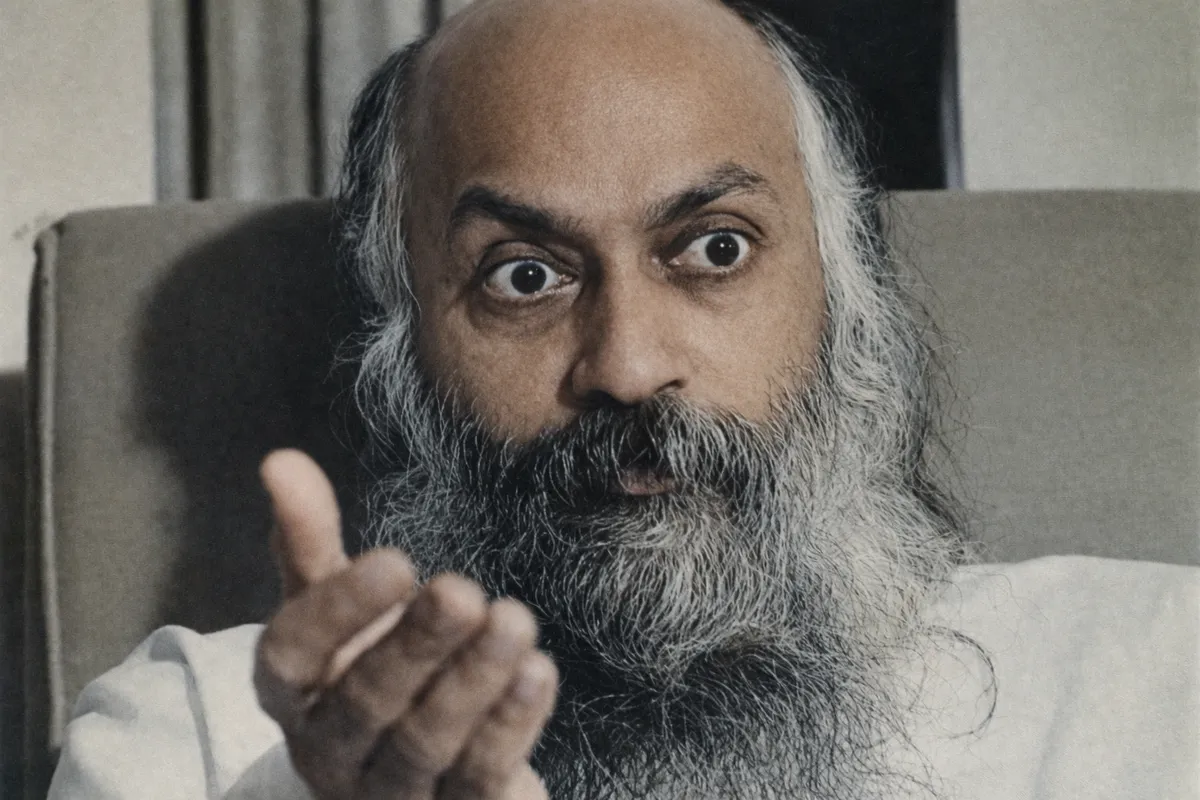
If your “me” feels big and heavy, be with a group to soften it; if it’s light and gentle, sit alone and go inward.
From the Discourses
Passages where Osho speaks to this question — each links to the complete discourse.
Beloved Osho, in the west, most of our growth methods tend to be group-oriented -- like encounter groups and psychodrama. In the east, although there are ashrams where seekers live together, the stress seems to be on the individual. Would you tell us about the two approaches?
In the East, people are in the community too much. So whenever they want to be religious, they want to go to the Himalayas. Society is too much around. They are not fed up with themselves, they are fed up with the society. This is the difference. In the West, you are fed up with yourself and you want some bridge, how to be communicative with the society, with others; how to create a bridge, how to move to the other, so you can forget yourself. In the East, people are fed up with the society. They have lived with it so long, and the society is all around so much that they don't feel any freedom. So whenever somebody wants to be free, to be silent, he runs to the Himalayas. In the West, you run to the society; in the East, people run from the society. That's why…
If groups are a safer and more stimulating place to begin to expand any conceivable, personal boundaries, why have you not encouraged the creation of indian groups with indian leaders?
In my childhood I used to go with my father. He is a great burper. Whenever he went to somebody else's house he would burp loudly. So I asked him, 'Why do you do it that much? You never do it that much at home?' He said, 'It has to be done otherwise the people will think that we are not satisfied.' The burp gives a satisfactory expression. It says the stomach is full and it is perfectly satisfied and it is happy. It is a physical expression. I was reading one of Janov's books in which he gives a few certificates from his patients who have been helped by primal therapy. In one certificate one patient says, 'I am very, very thankful to you because after primal therapy I began to burp for the first time in my life.' He said that it was amazing. I also say it…
In the West the mind is constantly trained to do something, to be active, because if you don't do anything you will not achieve anything. So a mind to achieve has been conditioned. In the East we have been thinking in totally different terms. We say not to be a doer; you already have everything... Mm, everything comes and goes. You are just a witness, and nothing really happens to you. You just remain untouched. It is just like a bird that comes into a room. He flies around in the room, afraid, then he goes out a window. A little fluttering, then he is gone. Your mind is just like that: a small window through which thoughts and emotions come and go. If you simply remain a witness, doing nothing, they go. Have you sometimes tried to help a bird to go out if he has entered your room?
Recently the west has devised many techniques to return to the source. These techniques all seem to have one thing in common: they admit that an individual cannot authentically return to these traumatic experiences by himself. The mind is too devious, the ego too complex, so analysis has been invented: primal therapy, fisher-hoffman, and the karma-cleaning tools of arica, to name a few. The basic premise seems to be that the individual will not pursue this journey alone; the other is needed -- the dynamics of a group, or an objective guide. Is it necessary to become so self conscious about the
Even Krishnamurti goes on saying that alone you can attain. But why does he insist on this, that alone you can attain? This is because his method is an indirect method. He will not allow you to know that he is helping, and he will not say to you, 'Surrender to me.' There is so much ego in the West, and he has been working the whole time in the West. The ego is so much that he cannot say, 'Surrender to me,' as Krishna said to Arjuna -- 'Leave everything and come and surrender to me.' Arjuna was of a different world, the East, which knew how to surrender, which knew the ugliness of the ego and the beauty of surrender. Krishna could say this without any ego on his part. The assertion seems to be very egoistic:'Come and surrender to me.' But Krishna could say it naturally, and…
So I would like you to do a few groups here, and in those groups become completely uncontrolled. Then you can have both the visions. Both have their benefits and both have their dangerous shadows. If a person becomes trained too much in eastern methods, he will be controlled, still, silent, but something will be untrue. You will never find fault with him. He will be able to manage himself in every situation, good or bad, but deep down he will become too much of a personality. He will become too much of a performer, so much so that he himself can forget that he had some original face of his own before this discipline started. It is good to remain controlled and disciplined. It gives you a certain grace, a certain charm, and you become more capable of being with people, moving in relationships, moving in the world.