
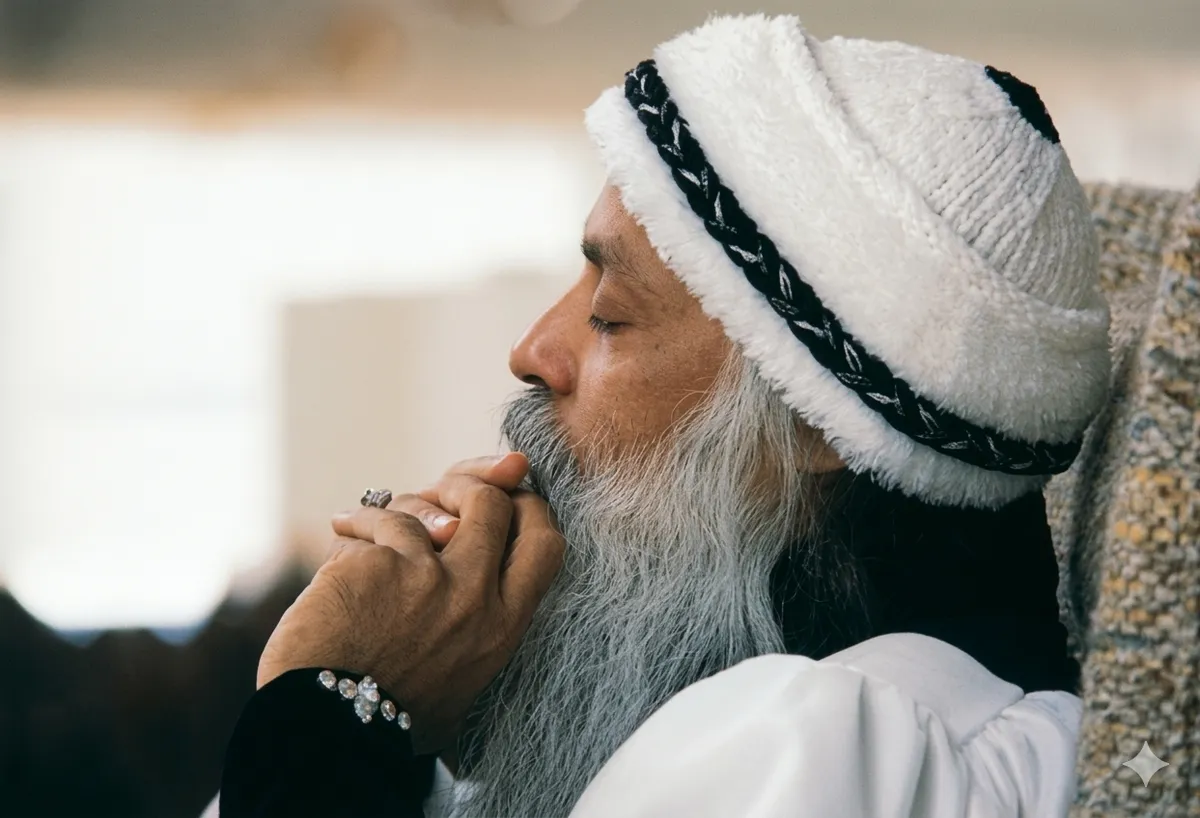
One is your mind worrying about who you are; the other looks so deeply that the ‘someone’ vanishes and only quiet awareness remains.
From the Discourses
Passages where Osho speaks to this question — each links to the complete discourse.
Beloved Osho, can you please say something about the difference between the spiritual question, "who am I?" and the psychological trauma of "who am I?"?
"Just fine," replied the second rat. "It took a while, but I have finally got him trained. Now, whenever I ring the bell, he brings me my dinner." It is such a strange world. The psychologist, Dr. Smith, must be thinking he is training rats, and the rats are thinking they are training Dr. Smith! The games of the ego... The wife thinks she is training the husband. All wives are training their husbands their whole lives; the husbands are training their wives. It seems life is just to train and to be trained -- for what? A woman reached Pablo Picasso. She wanted a portrait; the portrait was made. She was absolutely satisfied. She said, "Just one thing, you have forgotten to put great diamonds around my neck, a great diamond ring, diamond bracelets." Picasso said, "But you don't have them." She said, "It doesn't matter. I have cancer,…
Osho, you say that your main concern is our spiritual not our psychological growth. What is the difference between them?
"I think we should treat not the symptoms but the real problem." This was the approach of the Southern planter just after the Civil War. This gentleman of the old school found his wife in the arms of her lover and, mad with rage, killed her with his revolver. A jury of his Southern peers had brought in a verdict of justifiable homicide, and he was about to leave the courtroom a free man when the judge stopped him. "Just a point of personal curiosity, sir, if you are willing to clear it up." In reply, the gentleman bowed. "Why did you shoot your wife instead of her lover?" "Sir," he replied, "I decided it was better to shoot a woman once than a different man each week." If you try to change your mind, you will have to shoot a different man each week. It is better to shoot…
Osho, according to what you say and what all enlightened ones say, the ego has no existence—and yet you tell us to witness the ego! Please kindly help us understand this baffling riddle.
To live through that moment is tapascharya, spiritual austerity. It is a great austerity when you have absolutely no sense of who you are. When all the palaces built by your concepts have collapsed, when you stand in dense darkness, in emptiness, with not a single ray of light about who you are—the Christian mystics have aptly named this the Dark Night of the Soul. And only after this dark night does the dawn come. Whoever is afraid to pass through it never reaches the morning. So first the false notions have to be dropped, false identifications abandoned. A time will come when you will forget who you are; it will be a state like madness. If you are courageous and pass through this, then another time will come when the morning sun rises; for the first time you will know who you are. When it is revealed to you…
दूसरा प्रश्न: ओशो, आपके कहे अनुसार और समस्त बुद्ध-पुरुषों के कहे अनुसार अहंकार की सत्ता नहीं है--और फिर भी अहंकार के साक्षी होने को आप कहते हैं! कृपा करके इस अबूझ पहेली को हमें समझाएं।
उस घड़ी को जीने का नाम तपश्चर्या है। वह घड़ी बड़ी तप की है, जब तुम्हें बिलकुल पता नहीं रहता कि मैं कौन हूं। जब तुम्हारे सब धारणा के बनाए हुए महल भूमिसात हो जाते हैं, जब तुम निबिड़ अंधकार में, शून्य में खड़े हो जाते हो, प्रकाश की एक किरण नहीं मालूम होती कि मैं कौन हूं--ईसाई फकीरों ने इसके लिए ठीक नाम दिया है: डार्क नाइट आफ द सोल; आत्मा की अंधेरी रात। और इसी अंधेरी रात के बाद सुबह है। जो इससे गुजरने से डरा वह सुबह तक कभी नहीं पहुंच पाता। तो पहले तो झूठी धारणा छोड़नी होगी, झूठा तादात्म्य छोड़ना होगा। एक घड़ी आएगी कि तुम सब भूल जाओगे कि तुम कौन हो; बिलकुल पागल जैसी दशा होगी। अगर तुम हिम्मतवर रहे और इस घड़ी से गुजर गए तो एक घड़ी फिर से आएगी, जब सुबह का सूरज निकलेगा; पहली दफा तुम्हें पता चलेगा तुम कौन हो। जब तुम्हें पता चलता है कि वस्तुतः तुम कौन हो, यथार्थतः तुम कौन हो, परमार्थतः तुम कौन हो--तब तुम जानते हो कि अहंकार एक व्यावहारिक सत्य था।
Osho, please, in the question "who am I?" what does "I" mean? Does it mean the essence of life?
Or another famous koan is: "The sound of one hand clapping." The Master says to the disciple, "Go and listen to the sound of one hand clapping." Now this is patent absurdity: one hand cannot clap and without clapping there can be no sound. The Master knows it, the disciple knows it. But when the Master says, "Go and meditate on it," the disciple has to follow. He starts making efforts to listen to the sound of one hand clapping. Many sounds come to his mind: the birds singing, the sound of running water.... He rushes immediately to the Master; he says, "I have heard it! The sound of running water -- isn't that the sound of one hand clapping?" And the Master hits him hard on the head and he says, "You fool! Go back, meditate more!" And he goes on meditating, and the mind goes on providing new…
And whenever there is a man with a sincere enquiry the answer is not very far. In fact the answer is always hidden in the question itself; all that is needed is a sincere heart to enquire. When the question is authentic... Our questions also are not authentic, they come out of borrowed knowledge. For example if a Christian comes he will ask a question that no Hindu is ever going to ask. If a Hindu comes he will ask a question that no Mohammedan is ever going to ask. A Mohammedan asks a question which no Buddhist would ever ask. I have known all these people -- they come with different questions. I was puzzled, puzzled because if the question is real then it can't be that a Christian will not ask something and only a Hindu will ask it. If the question is real it is everybody's question.