
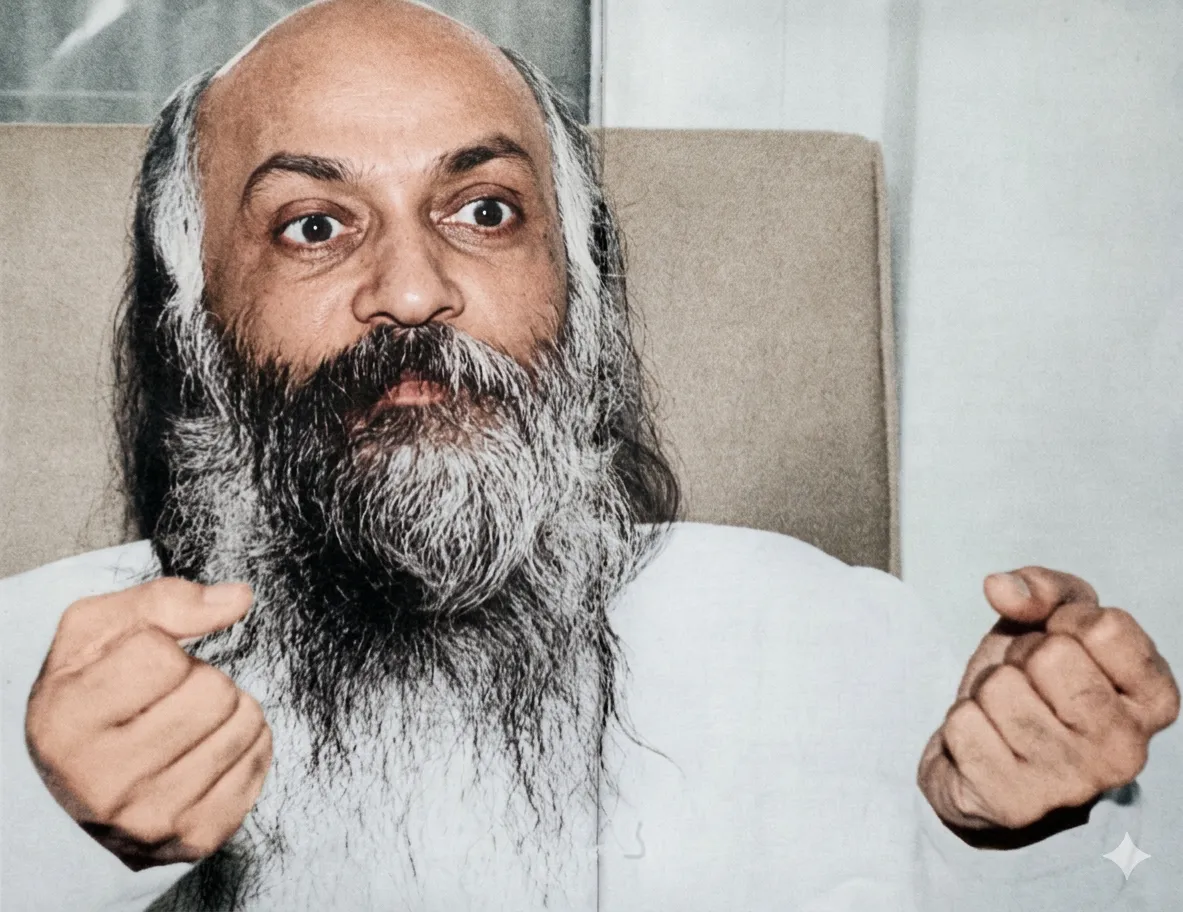
They’re the same thing: when all the fake, heavy stuff drops away it seems empty, but what’s left is a quiet, shining fullness.
From the Discourses
Passages where Osho speaks to this question — each links to the complete discourse.
Beloved Osho, when I close my eyes, I feel such an enormous presence, such a vast isness, such a beatitude. But it is a fullness, not an emptiness. Could you please say something about the difference between this fullness, and the emptiness or nothingness which you are speaking of?
These ideas appeal to the ego. The ego would like to have all the stars, if not inside the chest then at least hanging on the coat outside the chest. "Enormous light"... the ego is very willing. To cut the very roots, Buddha says the experience is as if you were to blow out a candle. There was a small flame on the candle giving a small light -- even that is gone, and you are surrounded with absolute darkness, abysmal darkness. People used to come to ask him, "If you go on teaching such things, nobody is going to follow you. Who wants darkness, enormous darkness? You are crazy. You say that the ultimate experience is ultimate death. People want eternal life, and you are talking about ultimate death." But he was a very consistent man, and you can see that for forty-two years he hammered on the genius…
Question: Second question: Osho, becoming empty—that is, attaining supreme bliss—is no goal for me. Who am I? My previous births? Where do I go after death? From where do people come, where do they go? What is all this? I have been wandering for fourteen years. When I was fifteen, a monk told a story in his talk. Its impact carried me away. Then from one monk to another—whomever I heard of, I went to. I kept vows, I kept meditating. I tried to know myself. Then another question began to arise: Who is going to know whom? Who wants to see whom? Who will search for whom? Nothing makes sense. The breath goes on. The heart beats. And nothing else! Then a notion formed that no one knows the mystery of this life! All useless. All lies. All talk; nothing.
और तुम कहते हो: ‘परमसुख पाना भी मेरे लिए कोई लक्ष्य नहीं।’ तुम तो बड़ी गजब की बातें कर रहे हो बालकृष्ण! तुम्हें होश है तुम क्या कह रहे हो? कोई प्राणी है इस अस्तित्व में, सुख पाना जिसके लिए लक्ष्य न हो? तुम सोचते हो तुम अपवाद हो? आदमियों की तो छोड़ दो, पशु-पक्षी भी सुख पाने के लिए ही खोजबीन में लगे हैं। कितनी ही अंधी खोज हो, मगर खोज तो सुख की ही है। पौधे भी सुख की तलाश कर रहे हैं--अपने-अपने ढंग से।
A Jain has asked: “You say that the ultimate state is emptiness. Then what will we do after attaining such emptiness? Better to keep this life—at least we experience pleasure and pain!”
What Mahavira said, you have not heard as he said it; otherwise these bad days, this misery, this poverty would not have befallen. Those who throw this blame and raise such disputes—the fact they point to is there; but it points toward you, not toward Mahavira. If only you had understood Mahavira, such blessedness would have flowered in this land, such a constellation of glorious blossoms gathered here as nowhere else could be. Had you understood Mahavira, the boundless within you would have manifested; a halo of light would surround you. Even if nothing were in your hands outwardly, you would be rich. And now the situation is such that even if you have everything, your poverty does not leave you. If you have not seen the poverty of the rich, you have seen nothing. If you have not seen the powerlessness of the powerful, you have seen nothing. If…
एक जैन ने प्रश्न पूछा है कि ‘आप कहते हैं कि वह परम अवस्था तो शून्य की है, तो ऐसे शून्य को पाकर क्या करेंगे? इससे तो यही जीवन ठीक है। कम से कम सुख-दुख का अनुभव तो होता है!’
महावीर ने जो कहा, उसको तुमने वैसा ही नहीं सुना है जैसा उन्होंने कहा था। अन्यथा ये दुर्दिन, यह दुर्दशा, यह दारिद्य्र, यह दीनता न घटती। इसलिए जो लोग ऐसा लांछन लगाते हैं, ऐसा विवाद खड़ा करते हैं, उनके विवाद में तथ्य तो है; लेकिन तथ्य का इशारा तुम्हारी तरफ है, उन्हीं की तरफ है। तथ्य का इशारा महावीर की तरफ नहीं है। काश! तुम महावीर को समझते तो इस देश में जैसा धन्यभाग फलता, इस देश में जैसे महिमावान फूलों का जमघट जुड़ जाता, वैसा कहीं भी नहीं हो पाता। अगर महावीर को समझे होते तो तुम्हारे भीतर जो अपरिसीम है, वह प्रकट होता। तुम्हारे चारों तरफ प्रकाश-मंडल निर्मित होता। न भी कुछ तुम्हारे पास होता तो भी तुम समृद्ध होते। …
Osho, Buddha insists on emptiness and Shankara on fullness. They each marshal weighty arguments and debates for their respective positions. They know the Truth, the Divine. Even so, why do they refute the other and extol their own? And you support both at once—why is that?
Death is just as divine. Night is as much God as day is. One aspect had been missed; there had been too much talk—only talk remained; the air was smoky with words; a web of words had been woven. A fresh expression was needed; the Divine was in search of a new word with which to knock again on the hearts still untouched by the stupidity of scholarship; to call again to those who are innocent, guileless, simple. Buddha caught hold of “emptiness.” It was a significant word. Consider: Buddha and Mahavira were born in the same era. Yet Buddha’s impact was unprecedented; Mahavira’s was not. Buddha’s thought spread across the world; its waves went to far horizons. Mahavira’s remained limited, reaching only a few. Both are equally wise. Both have the same experience. Both are mighty. One is not superior to the other, neither is behind. Then why did…
पहला प्रश्न: ओशो, बुद्ध शून्यता का आग्रह करते हैं और शंकर पूर्णता का। वे अपने-अपने आग्रह के लिए भारी तर्क और वाद-विवाद भी खड़ा करते हैं। इन्हें सत्य का, परमात्मा का पता है। फिर भी ये दूसरे का खंडन एवं स्वयं का मंडन क्यों करते हैं? और एक आप हैं जो दोनों का एक साथ समर्थन करते हैं, ऐसा क्यों?
एक पहलू चूक गया था, चर्चा बहुत हो चुकी थी, चर्चा ही चर्चा रह गई थी; हवा में धुआं ही धुआं था बातचीत का, शब्दों का जाल गुथ गया था। एक नई अभिव्यंजना चाहिए थी, परमात्मा नये शब्द की तलाश में था, जिससे फिर उन हृदयों पर दस्तक दे सके जो अभी पांडित्य की मूढ़ता से अछूते हैं। फिर उन्हें पुकार सके जो निर्दोष हैं, निष्कलुष हैं, जो सहज हैं। बुद्ध ने शून्य पकड़ा। महत्वपूर्ण शब्द था। तुम सोचो, बुद्ध और महावीर एक साथ ही पैदा हुए। लेकिन बुद्ध का प्रभाव अप्रतिम हुआ, महावीर का नहीं हुआ। बुद्ध का विचार सारे जगत पर फैलता चला गया, उसकी लहरें दूर-दिगंत तक गईं। महावीर का विचार बड़ी सीमित दुनिया में रहा, थोड़े से लोगों तक गया। दोनों एक से प्रज्ञावान हैं। दोनों का एक अनुभव है। दोनों बड़े समर्थ हैं। एक-दूसरे से श्रेष्ठ हैं, कहीं कोई किसी से पीछे नहीं है। फिर महावीर का विचार दूर-दिगंत तक गया क्यों नहीं? कारण था। महावीर पिटे-पिटाए शब्दों का उपयोग कर रहे थे। उन्होंने परमात्मा को पुराने और बासे शब्दों से ही पुकारा--आत्मा। …
Sitting near you I increasingly feel deep silence and what seems to be emptiness, but there is no bliss in it. I tend to regard this as an indication that something is wrong, especially at darshan where so many people are so blissful. I don't seem to have any idea whether I am on the right track or not. Sometimes I think I am becoming more meditative and other times I think I am totally off beam and lost. Please comment.
Remember the Eastern meaning. When Buddha says "God is not" he is not an atheist. He is simply saying that the nature of God is nothingness. He is not denying God at an; he is not agreeing with Epicurus or with the Charvakas. When he says "God is not" you have to remember, you have to be constantly aware that his "not" is not your "not"; his "not" does not say that God does not exist. His "not" simply says that God exists as nothingness. Hence we cannot say God is, because that will make your gestalt change to the positive. Either you can say God is nothingness or you can say God is not. And of course saying God is nothingness will not come closer to the truth. "God is not" comes very close, so close that one step more and you will disappear into nothingness. But that nothingness…