
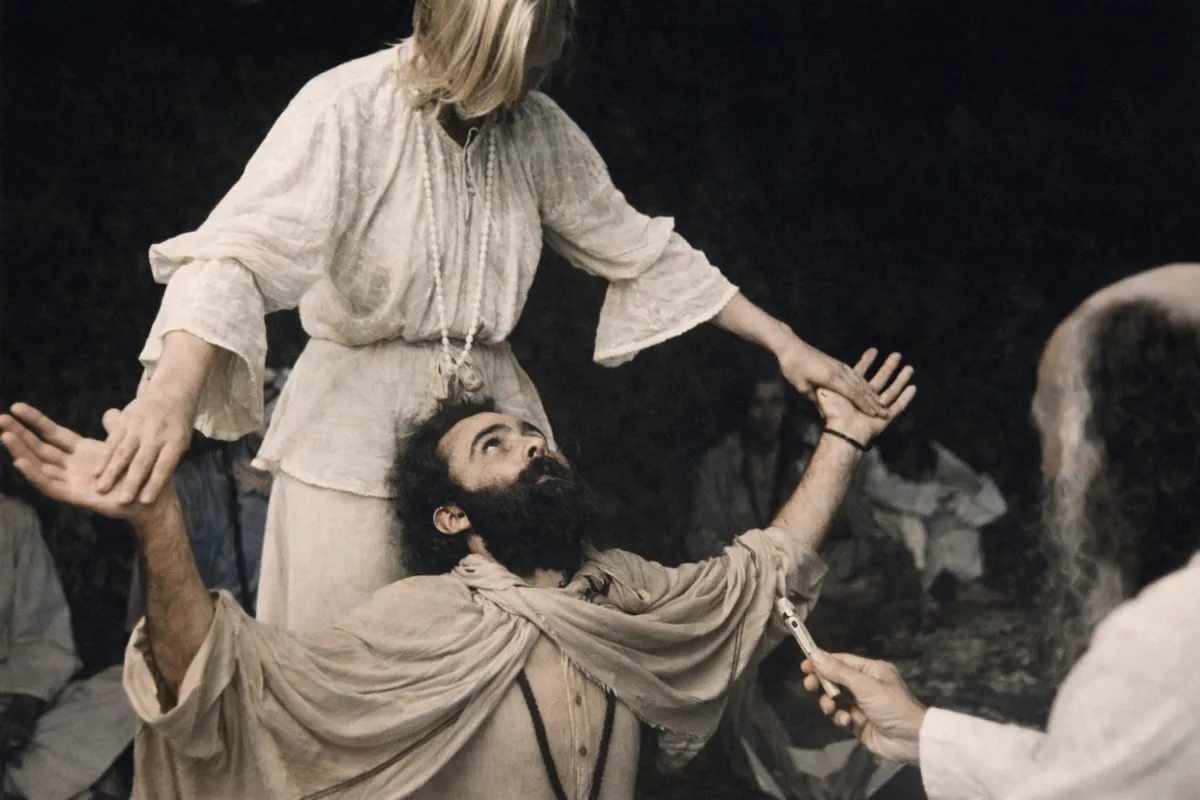
Being a fatalist is giving up in frustration; floating is trusting life like a leaf on a river because you’re part of the river.
From the Discourses
Passages where Osho speaks to this question — each links to the complete discourse.
What is the difference between waiting for godot and waiting for god?
It is as if the sun has risen in the morning and you are sitting in your room with closed doors and windows, in darkness. Open the doors, you become available to the sun. The sun was already available -- just the meeting happens. You cannot wait for God. All waiting is for Godot. Godot means the one who never comes, who CANNOT come, whose arrival is impossible. And the only impossible thing is that which has already happened -- how can it happen again? You are alive, and you are waiting for life, Now, this is ridiculous. The real man of religion does not think in terms of God. He thinks in terms of life or, even better, of living -- because life can again become an abstract idea. Living, moment-to-moment living. In that very living, one knows what God is, because one knows who one is. Your idea…
Beloved Osho, could you please explain the difference between trusting existence and fatalism?
The difference between trust and fate is very subtle. On the surface it seems they mean exactly the same thing, but in reality they are diametrically opposite experiences. Fate is a consolation. You are poor, and you see others getting richer and richer -- some consolation is needed. You do everything and you do it honestly, truthfully, morally. You never use wrong means; still you are a failure. And you see others being dishonest, cunning, insincere, immoral, criminal, using all kinds of wrong means and succeeding, becoming richer, attaining power, prestige. How to explain it? It is not new. Since the very beginning man has been puzzled by it. And he had to create some idea as a consolation. Fate, kismet, destiny, God -- everything is written in the lines of your hand, in the lines of your forehead; everything is predetermined in your birthchart, you cannot do anything against…
Beloved Osho, what is the difference between the emptiness of the child before the formation of the ego and the awakened childlikeness of a buddha?
Whether you are for it or against it doesn't matter -- your concern shows where your ego is hanging. And I will include the capitalist in it also: his whole concern is how to gather money, hoard money -- because money has power over matter. You can purchase any material thing through money. You cannot purchase anything spiritual, you cannot purchase anything that has any intrinsic value; you can purchase only things. If you want to purchase love, you cannot purchase; but you can purchase sex. Sex is the material part of love. Through money, matter can be purchased, possessed. Now you will be surprised: I include the communist and the capitalist both in the same category, and they are enemies, just as I include Charvaka and Mahatma Gandhi in the same category, and they are enemies. They are enemies, but their concern is the same. The capitalist is trying…
Osho, is it a factual truth that nothing happens through our doing? Should we really just let things be as they are happening?
Whether it is factual or not—do you understand?—it is supportive for your descent into samadhi. So the question of whether it is factual is not very important. This is not a big question. My own view is that many times very wondrous things have been discovered, but we have grabbed them and trapped them in the wrong place—things, ideas—like fate. Fate is not factual, but for samadhi it is very meaningful. If a person is a complete fatalist, then as far as samadhi is concerned, there is no obstacle for him. The matter is finished. The point is not the factuality of whether fate exists or not. To reduce it to “Does fate exist or not?” is to throw the whole thing into foolishness. For those who discovered it, it was a device for meditation. These are all devices within which meditation will happen. The meaning of fate is: now…
प्रश्न: यह, ओशो, फैक्चुअल बात है कि हमारे करने से कुछ होने वाला नहीं है? सचमुच जैसा हो रहा है वैसा ही होने दें?
मेरी तो जो अपनी दृष्टि है वह यह है कि कई दफा बहुत अदभुत चीजें खोजी गई हैं, लेकिन हमने उनको ऐसी जगह पकड़ कर फंसा दिया चीजों को, विचारों को--जैसे भाग्य है। भाग्य फैक्चुअल नहीं है, लेकिन समाधि के लिए बड़ा अर्थपूर्ण है। अगर एक आदमी पूर्ण भाग्यवादी है तो समाधि के लिए उसको बाधा ही नहीं है। बात खतम हो गई। फैक्चुअल का सवाल नहीं है यह कि भाग्य होता है कि नहीं होता है। वह एक बेवकूफी में डाल दिया सवाल को कि भाग्य होता है कि नहीं होता है। जिन्होंने खोजा था उन्होंने तो डिवाइसेस फॉर मेडिटेशन है। ये सब उपाय हैं जिनके बीच में ध्यान घटित हो जाएगा। भाग्य का मतलब यह है कि अब कोई सवाल ही नहीं है।
Osho, if life is a storyline in which each person’s role is fixed and one only has to enact it as ordained, isn’t that fatalism?
The word has been spoiled; with too much use it’s become debased. Otherwise “destiny” is a very lovely word. Destiny means things happen; they are not “done.” Destiny means the plot is decided—don’t worry needlessly. Destiny means what has to happen will happen; what had to happen has happened; what has to be will go on happening. Don’t carry the burden on your head. You are not responsible. Think of it like this: a Ramleela is being performed; the leela, the play, is on. Rama knows perfectly well that Sita will be abducted. There’s no need to stay awake nights, worrying. It’s all fixed. It’s a script. Sita will be abducted, Rama will wander from forest to forest, asking every tree, “Where is my Sita?” And he will ask with great feeling. Then the curtain will fall, and backstage they’ll laugh and chat. Ravana will be sitting there too. They’ll…
दूसरा प्रश्न: ओशो, जीवन एक कथानक है, जिसमें प्रत्येक व्यक्ति का अभिनय नियत है और जिसे नियत ढंग से उसे अभिनीत भर करना है, क्या यही भाग्यवाद नहीं है?
… अन्यथा बड़ा प्यारा शब्द है भाग्य। भाग्य का अर्थ है, चीजें होती हैं, की नहीं जातीं। भाग्य का अर्थ है, कथानक तय है, तुम नाहक चिंता मत लो। भाग्य का अर्थ है, जो होना है, होगा; जो होना था, हुआ है; जो होना है, होता रहेगा; तुम सिर पर बोझ मत लो। तुम उत्तरदायी नहीं हो। जैसे समझो, रामलीला का खेल हो रहा है; लीला हो रही है। राम भली-भांति जानते हैं कि सीता चोरी जाएगी। अब इसमें कोई रात-रातभर जागकर परेशान होने की जरूरत नहीं है। यह सब तय है। यह कथानक है। सीता चोरी जाएगी, राम भटकेंगे जंगल-जंगल, वृक्ष-वृक्ष से पूछेंगे, कहां मेरी सीता है! और बड़े भाव से पूछेंगे। और फिर परदा गिरेगा और पीछे बैठकर वे हंसेंगे और गपशप करेंगे। रावण भी वहीं बैठे होंगे। चाय पीएंगे; घर चले जाएंगे।