
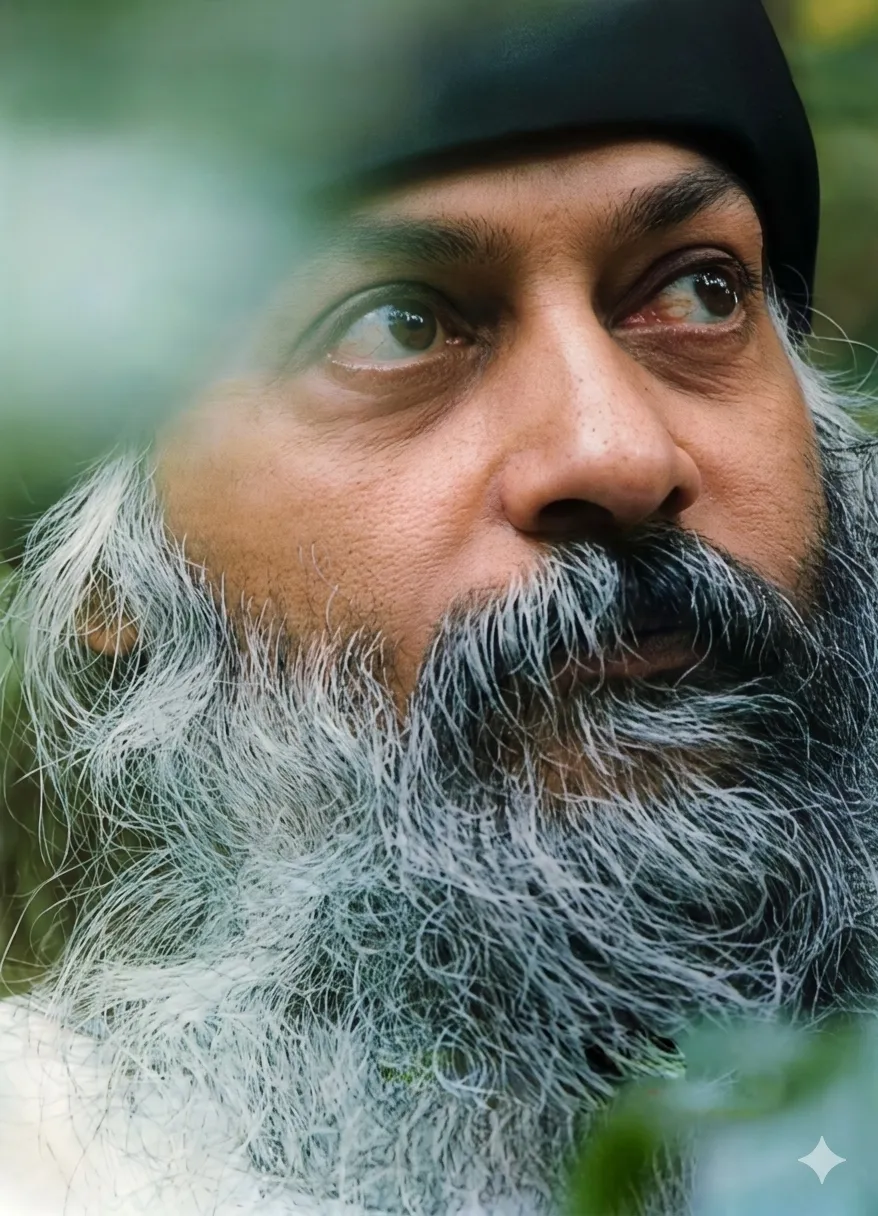
A disciple depends on the master to carry them; a friend walks beside the master as an equal, free and responsible for their own steps.
From the Discourses
Passages where Osho speaks to this question — each links to the complete discourse.
Beloved Osho, what is the difference between the emptiness of the child before the formation of the ego and the awakened childlikeness of a buddha?
Whether you are for it or against it doesn't matter -- your concern shows where your ego is hanging. And I will include the capitalist in it also: his whole concern is how to gather money, hoard money -- because money has power over matter. You can purchase any material thing through money. You cannot purchase anything spiritual, you cannot purchase anything that has any intrinsic value; you can purchase only things. If you want to purchase love, you cannot purchase; but you can purchase sex. Sex is the material part of love. Through money, matter can be purchased, possessed. Now you will be surprised: I include the communist and the capitalist both in the same category, and they are enemies, just as I include Charvaka and Mahatma Gandhi in the same category, and they are enemies. They are enemies, but their concern is the same. The capitalist is trying…
Beloved Osho, many of your sannyasins were happy to hear from you that you are our friend, but it was a great shock for me. My beloved master, will you say something about the master-disciple relationship?
He went, because Buddha promised him; but it was a trouble. Every day he had to be informed of what direction Buddha was in. And morning and evening he would bow down on the earth, tears of joy in his eyes -- just dust in his hands, but he would touch it as if he were touching the feet of Buddha. And people would say to him, "Mahakashyap, you yourself are now a master. It doesn't seem right for you to behave like a disciple." Mahakashyap's answer was, "As long as Gautam Buddha is alive I cannot be the master, I can only be the disciple. Because to be disciple is so beautiful; under the shade of the master it is so cool, it is so protected. When Buddha dies, of course I will be a master -- under the hot sun, there will no longer be any shade over…
Osho, what is the first experience of samadhi like?
You will know only when it happens. It cannot be said; at most a few hints can be given. It is as if, in the dark, a lamp is suddenly lit. Or as if a dying patient, right at the edge of death, suddenly finds a medicine that works; life’s wave, life’s thrill spreads again—so it is. As if a corpse becomes alive—such is the first experience of samadhi. It is the taste of nectar. The experience of the ultimate music. But it will be only when it happens; and only then will you understand. You will not understand by my saying it. It is as with love. How can anyone explain it? To someone who has never loved, never known love, no matter how many explanations you offer—he will hear it all and still ask, “I haven’t understood; please explain a little more.” It is like explaining light to…
तीसरा प्रश्न: ओशो, समाधि का पहला अनुभव कैसा होता है?
होगा तो ही जानोगे। कहा जा सके, ऐसा नहीं है। कुछ-कुछ इशारे किये जा सकते हैं। जैसे अंधेरे में अचानक दीया जल जाये, ऐसा होता है। या जैसे बीमार मरता हो और अचानक कोई दवा लग जाये...मरते-मरते कोई दवा लग जाये; और जीवन की लहर, जीवन की पुलक फिर फैल जाये--ऐसा होता है। जैसे कोई मुर्दा जिंदा हो जाये--ऐसा होता है समाधि का पहला अनुभव। अमृत का अनुभव है। परम संगीत का अनुभव है। पर होगा तो ही होगा। और होगा तो ही तुम समझ पाओगे; मेरे कहने से समझ में न आ सकेगा। प्रेम में जैसा होता है। अब कोई किसी को कैसे समझाये? …
Beloved Osho, what is a disciple?
A disciple comes to a state where he feels that either he has to commit suicide or he has to change his whole life so that there is some significance, some fragrance, some beauty, some individuality, some decisiveness, something that you have done. Your birth you are not responsible for, your death you will not be responsible for -- two of the most important things in life are not in your hands -- but you can commit suicide; that is a decisive point. To commit suicide is to accept failure, is to accept that you are defeated. But it is only in such a situation of the mind that a man starts looking -- perhaps there are ways of living other than how he has lived up to now, perhaps there are alternative styles of life. This search for an alternative style of life.... Because he can see all around…
Beloved Osho, I love to hear you call us your friends. Why is it both exciting and challenging?
One thing is to be remembered: Gautam Buddha cannot come back. He has said, "I will be coming back." That's purely symbolic -- he cannot come back. A man of that stature, a being who has reached to the ultimate experience of existence cannot come back; it is just not possible in the very nature of things. He cannot take another form, another body. He cannot be born again in the womb of a mother; he cannot become again flesh and bones. Once you have reached the state of being where you realize yourself as pure consciousness, it is no longer possible for you to be born again. So when Buddha says, "Next time when I come back..." it has to be understood only symbolically. All the Buddhists of the world have been waiting -- they are waiting unnecessarily. They will never find Gautam Buddha back in the body again.…