
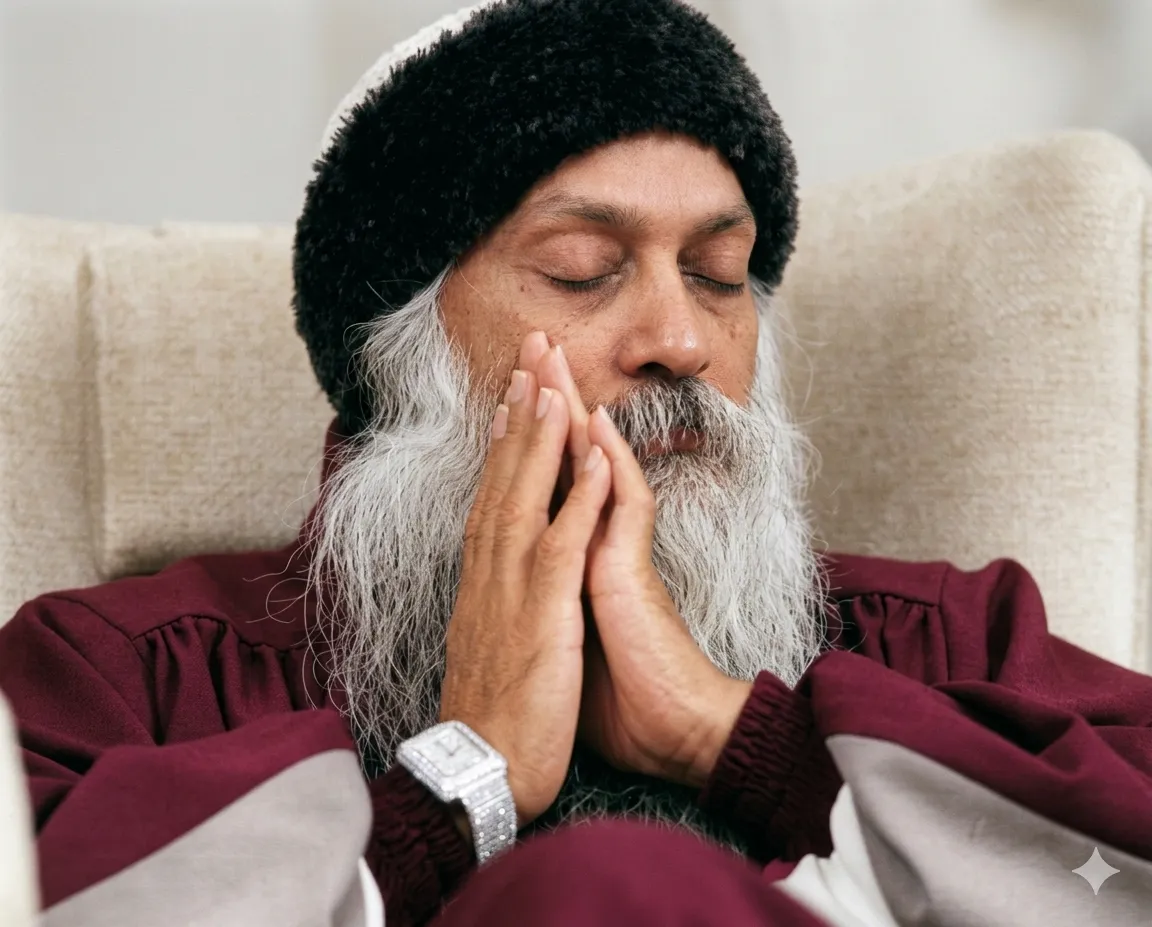
No one else can decide for you; only your own honest experience shows what’s true.
From the Discourses
Passages where Osho speaks to this question — each links to the complete discourse.
Question: BELOVED OSHO, WHAT IS THE CRITERION OF THE TRUTH? Sahabsadev Hasan, truth is not an experience of the mind; hence no logic can prove it or disprove it. No argument can convince you about it or unconvince you about it. Truth is an experience beyond mind, so there is no objective criterion possible. That's why science never talks about it, because science can only talk about things which can be objectively proved. Truth is a subjective experience, just like love. What is the criterion of love? Can you prove when you fall in love? Can you prove that really you have fallen in love? Is there a way to prove it? Is there any argument, any logic that will support you -- any eyewitnesses? All that you can say is, "I know for certain that my heart is beating differently" -- but that is something inner to you.
Question: BELOVED MASTER, HOW CAN WE KNOW THAT A PERSON HAS REALIZED THE TRUTH? ... But he was a very cultured man; he behaved as if he had not noticed anything, the shoe on the head. But howsoever he tried, the shoe was there. He wouldn't look at the shoe, but the question was continuously there, "What kind of man are you receiving? -- a great emperor. And this man seems to be mad. Finally he could not contain himself and he said, "What kind of madness is this? Why are you carrying that shoe on your head, and one shoe on one of your feet? Bodhidharma said, "For you. He said, "For me? Bodhidharma said, "Yes, for you, just to see whether you are really interested in truth or in stupid things. You are interested in the shoe, you are not interested in me.
No, no. Many times one has to go too; look, from where have you come—into our Punjab, into Amritsar...
I understand, I understand your point. If you feel I am going wrong, then make me understand. Try to unsettle me—what harm is there in that? (The audio recording of the question is not clear.) There is no touchstone, no touchstone. The person who is on the right path has an inner sense that he is right. And the one who is wrong has the sense that he is wrong. Just as when a thorn gets embedded in your foot you say, “I am in pain.” But what is the criterion that you are in pain? How are we to accept that you are in pain? Then the thorn is removed. You say: “Now there is no pain.” What is the criterion that now you have no pain? Your experience is your criterion. Your experience is your criterion.
Truth is experienced at the innermost core, but bliss starts overflowing you. That's the only proof that truth has been experienced. If the saint is sad he is not a saint. There must be rejoicing, there must be laughter, there must be singing and dancing and celebration. His whole life is a celebration; moment to moment it is a continuum of celebration. These so-called saints with long faces are just stupid people deceiving others, and not only others -- they are so stupid that they manage to deceive themselves too. They start believing that they have arrived, but nothing has happened to them. Their desert is so clear, there seems to be no oasis in their being. My whole effort here is to make you a garden, to make you cheerful in every possible way. But that can happen only when you have experienced something of truth on your own.
Osho, what is the definition of God?
Words are very small. If you say God is light, then what of darkness? The scriptures have said that God is light. Suppose we accept this as a definition—then what about darkness? Where will darkness go? Darkness is too; in fact it is far more than light. Light sometimes is and sometimes is not; darkness is always, eternal. Where will you place darkness? If you say God is light, darkness is left out. If you say God is darkness, then light is left out. If you say God is both darkness and light, a contradiction arises: they cannot be together. Try to have both darkness and light in the same room. If you bring in light, darkness disappears; if you preserve darkness, you cannot have light. Then how can both be together? That becomes an impossibility. So you cannot say “both” either. Then the fourth device is to say: it…
पहला प्रश्न: ओशो, परमात्मा की परिभाषा क्या है?
शब्द तो बड़े छोटे-छोटे हैं। अगर कहो परमात्मा प्रकाश है, तो फिर अंधेरे का क्या होगा? ऐसा कहा है शास्त्रों में कि परमात्मा प्रकाश है। चलो मान लें इसे परिभाषा, फिर अंधेरे का क्या होगा? फिर अंधेरा कहां जायेगा? अंधेरा भी है, प्रकाश से कहीं ज्यादा है। प्रकाश तो कभी होता है कभी नहीं भी होता; अंधेरा सदा है, शाश्वत है। अंधेरे को कहां रखोगे? अगर कहा परमात्मा प्रकाश है, तो अंधेरा बाहर पड़ गया। अगर कहा परमात्मा अंधेरा है, तो प्रकाश बाहर पड़ गया। अगर कहो परमात्मा अंधेरा प्रकाश दोनों है, तो विरोधाभास होता है। दोनों एक साथ हो नहीं सकता। एक ही कमरे में अंधेरा और प्रकाश करके दिखाओ। प्रकाश करोगे, अंधेरा खो जायेगा; अंधेरा बचाओगे, प्रकाश न कर सकोगे। तो दोनों साथ कैसे होंगे? तब एक असंभव बात हो गई। तो यह भी नहीं कह सकते कि दोनों है।