
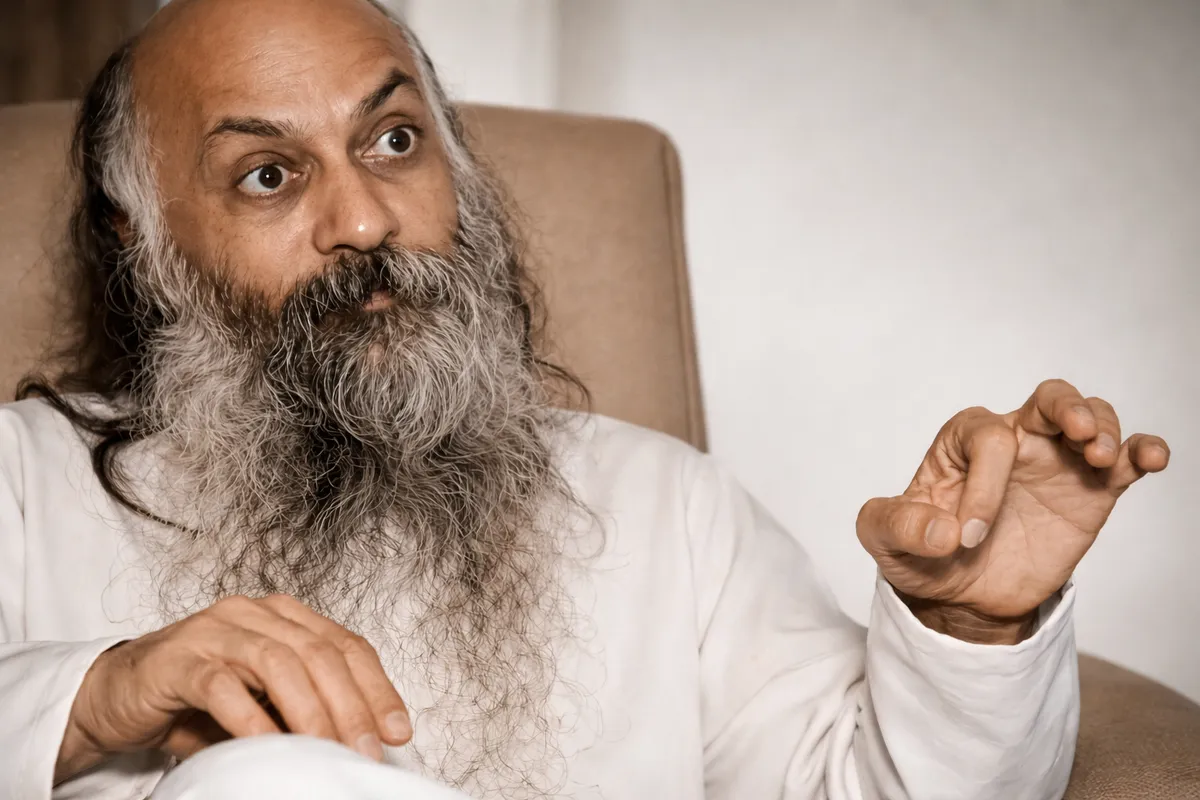
They were deeply connected without meeting, like two wise friends who don’t need to talk to know they understand each other.
From the Discourses
Passages where Osho speaks to this question — each links to the complete discourse.
Can you tell us about your connection with j. Krishnamurti?
It is a real mystery. I have loved him since I have known him, and he has been very loving towards me. But we have never met; hence the relationship, the connection is something beyond words. We have not seen each other ever, but yet... perhaps we have been the two persons closest to each other in the whole world. We had a tremendous communion that needs no language, that need not be of physical presence. Once it happened -- just a coincidence -- he was in Bombay. He used to come to Bombay every year to remain there for a few weeks. He had perhaps more followers in Bombay than anywhere else in the world. I came to Bombay. I was just going to New Delhi and I had to wait a few hours. Some friends who had been deeply connected with J. Krishnamurti and who were also connected…
Osho, sensitive people from the far corners of the world are being drawn to you. Yet it is surprising that your voice does not seem to reach saintly men like Krishnamurti, Vinoba, Jayaprakash, and Kripalani. Why can they not perceive that here in Poona there is a person who holds the medicine for humanity’s fundamental malady?
With Krishnamurti the ease, the benefit, is that your intellect will always remain satisfied. One who once begins to walk with him keeps on walking. No occasion will arise to leave, because the very reason for joining will never be contradicted—Krishnamurti will go on confirming it again and again, a thousand times. His intellectual conviction will become stronger and stronger. But the danger is that he will remain stuck in the intellect and never reach the heart. And you ask about Kripalani? Krishnamurti cannot come to me; there is no need. Krishnamurti is religion embodied. Kripalani also cannot come to me; there is no need—because Kripalani is pure politics; he has nothing to do with religion. Krishnamurti cannot come because he is established in religion; Kripalani cannot come because he has nothing to do with religion. His whole life has gone into politics—setting up moves and counter-moves, arranging pawns! A…
Question: OSHO, IS J. KRISHNAMURTI ENLIGHTENED? Somebody knocked on the door. It never used to happen, because I had told all my professors that even if the university was burning down I was not concerned; they were not to bother me. I had told the librarian, "If you want to close the library you can -- I will remain here the whole night -- but don't ever knock on my door. I don't like that kind of familiarity, not at all." Somebody knocked; it was the first time. I thought, "Who can it be?" I opened the door. The celibate, red with anger, closed the door behind him and asked me, "Do you love this girl?" I said, "I don't even hate her." He said, "What do you mean?" I said, "Exactly what I say to you: I don't even hate her; the question of love does not arise.
Osho, the way you speak of Shri J. Krishnamurti with love and praise, he does not speak of you in the same way. Sometimes it feels as if he is about to say something different, but then he avoids it. As a result, your disciples go with great love to listen to Krishnamurti, but his followers do not come to you with an open heart. Please explain.
What Krishnamurti says is entirely right—one hundred percent right. But Krishnamurti’s way is very narrow. It is completely right, yet it is like a footpath. My way is a great royal road. On my path, Buddha, Krishna, Christ, Moses, Zarathustra, Bodhidharma, Lao Tzu—all are included. So I include Krishnamurti as well; no difficulty arises for me—my house is spacious. Krishnamurti lives in a small room. The room is perfectly fine; nothing is wrong with it. In my large house Krishnamurti’s room fits easily, but my large house cannot be contained in Krishnamurti’s room. Krishnamurti is Hinayanist; I am Mahayanist. Krishnamurti’s boat is a small dinghy—you know, in small villages at most one person sits and rows out to catch a fish. My vessel is big, a great ship—Mahayana. Come aboard from every direction, all kinds of people: those who follow every scripture, every doctrine—there is room for all. That’s why.…
Osho, you have spoken many times about zen masters, and today you said that j. Krishnamurti is zen and zen means no teaching. Can you explain this point?
The disciple accepts the Master so that he can come closer to him. In saying yes to the Master he becomes attuned to the Master. The word "attunement" is beautiful; it means "at-onement". He becomes one with the Master. In that oneness something that cannot be given through words is transpired through the being -- something like bringing an unlit candle close to a lit candle. There is a certain point when the unlit candle comes within that limit -- suddenly the flame from the lit candle jumps into the unlit candle. The lit candle loses nothing at all, but the unlit candle gains infinitely. Now the reverse process is happening: when the disciple comes to the Master he gives his ego and thinks he is losing much -- and the Master gets nothing. When the Master gives something he gives infinitely, he gives his light. but he loses nothing;…