
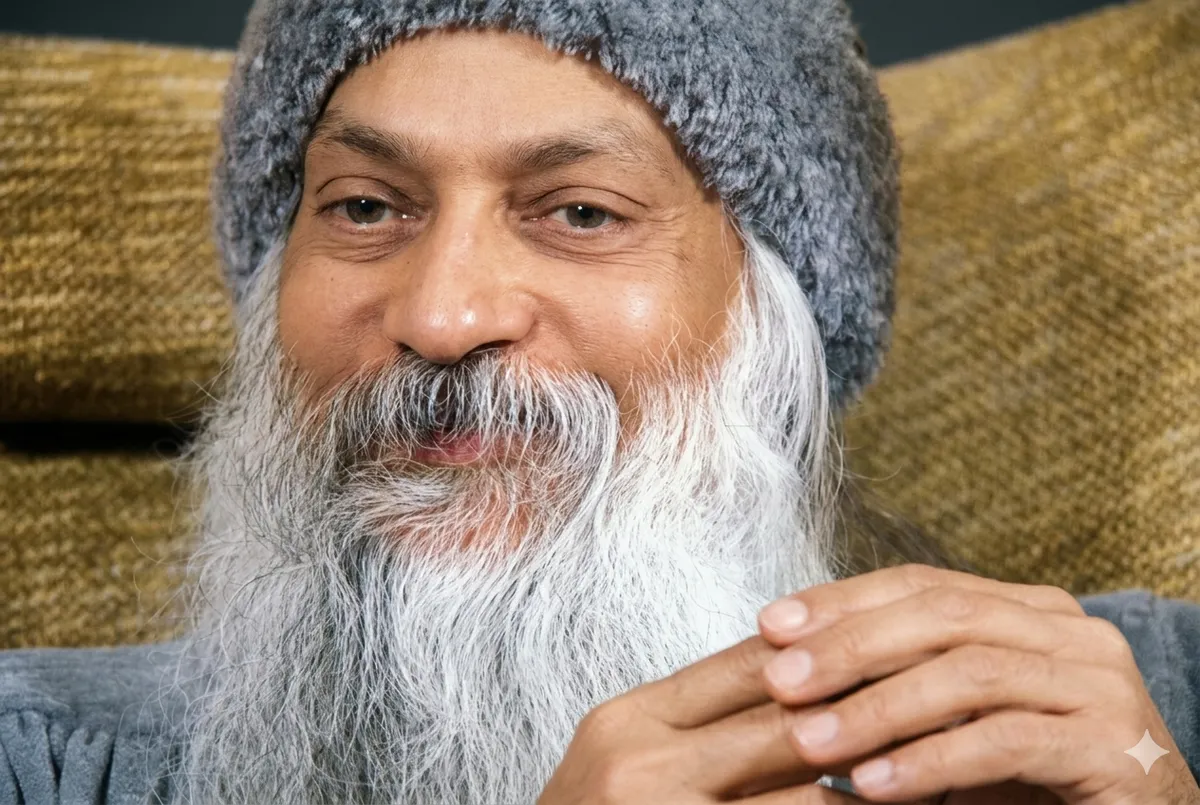
According to Osho, conviction in one's path arises from inner seeing—an unborrowed, autonomous authority that feels as self-evident as being alive or sensing a headache. When eyes are open and vision clear, no doubt appears; certainty itself is the proof. External agreement is irrelevant; uncertainty signals deviation, while inner authenticity affirms the rightness of the way.
You know you’re on the right path when it feels obviously true inside—clear, doubt-free, and not needing anyone else to agree.
From the Discourses
Passages where Osho speaks to this question — each links to the complete discourse.
Buddha answered, "You were certainly wrong, but your eyes got cured because you refused to believe what others told you unless you experienced it for yourself. If you had accepted what your friends had told you then the matter would have ended there and no question of treatment for your eyes would have arisen." People who believe are unable to reach any understanding. People who accept silently are unable have any experience of their own. The journey of those who are blind and hold on to the fact that if the others say that there is light then certainly there must be light, ends right there. The journey only continues when the restlessness stays and stays and stays and never disappears. Restlessness comes only when you feel there is something which people say is there, but you don't see it so you cannot accept it.
You—if someone makes you a little doubtful, you wobble. People fear talking to atheists—lest they arouse their doubt and shake their faith. Such faith is worth two pennies, if anyone can shake it. It is borrowed; being from outside, a doubt from outside can break it. In the Hindu scriptures it is written: do not enter a Jain temple—even if a mad elephant is about to trample you to death. Better to die than to take refuge in a Jain temple. And in the Jain scriptures it is written: do not take refuge in a Hindu temple. Hindu or Jain, Muslim or Christian—the panic is the same. Why such fear? Lest Jain doctrines enter your ears, lest Hindu scriptures be heard—lest your doubts arise, your faith shake. These frightened people have not awakened anyone—they have put them to sleep. They gave no courage—only weakness; no strength—only impotence. No.
Osho, why is it that the moment we cling to some belief—whether theism or atheism—the mind feels so reassured? Why does it seem almost impossible for it to stand in the middle, dropping both?
There is no greater courage than to stand in existence without conclusions. By “without conclusions” I mean: no belief, no superstition. It means: we will see existence as it is, without bringing our notions in between. We will neither say “God is” nor “God is not.” We will neither say “the soul is” nor “the soul is not.” We will inquire. But inquiry is hard. Inquiry means you must pay a price. Who wants that bother? So we borrow beliefs on credit. We say, Mahavira knew, Buddha knew, Krishna knew—why should we get into the mess? We’ll cling to them, hold their feet, and pass through. That is not faith; it is only weakness. And the weak do not move. It is not trust to think we can walk to freedom by holding Buddha’s feet. If you have no trust in yourself, how will you trust Buddha? No real trust…
It is like lightning flashing. Night was dark. In that instant everything is revealed—the path, trees, mountains. Darkness returns even thicker. But now you know there is a path. You will have to grope, search; there is fear of falling—but at least the path exists. From seeing with the Master’s eye, a trust arises that the path is. In the Master’s presence, gradually, his fragrance fills your nostrils and the feeling arises: what has happened to him can happen to me. What is possible for one is possible for all. In the presence of Buddha or Mahavira or Krishna or Sahajo, the joy of their life becomes contagious. Sometimes, despite yourself, your eye will open. Unbeknownst to you, they will shake you awake; you will open your lids a little and glimpse; confidence will come. A small child walks—his mother gives him her hand. The child must do the walking.
Beloved Osho, although nothing is really clear to me, how can it be so clear to me that the truth is in you? I don't know it, but I see it in your eyes. I feel it in your being.
It is one of the most fundamental questions. One does not know what truth is. But when one comes across it, a few things become clear: that whatever he has believed up to now was not truth, because it has not given him this depth in the eyes, this silence in his presence, this authority in his words, this poetry to his life. The false is barren. So although you do not know what is true, when you come across truth, you immediately know what is false. And if you understand what is false, a vague insight into truth starts arising in you. Because the truth that you see in my eyes is also in your eyes, just asleep. You have never awakened it. Let the false go, and your eyes will have the same truth. Your words will have the same music, your presence will have the same charisma.…