
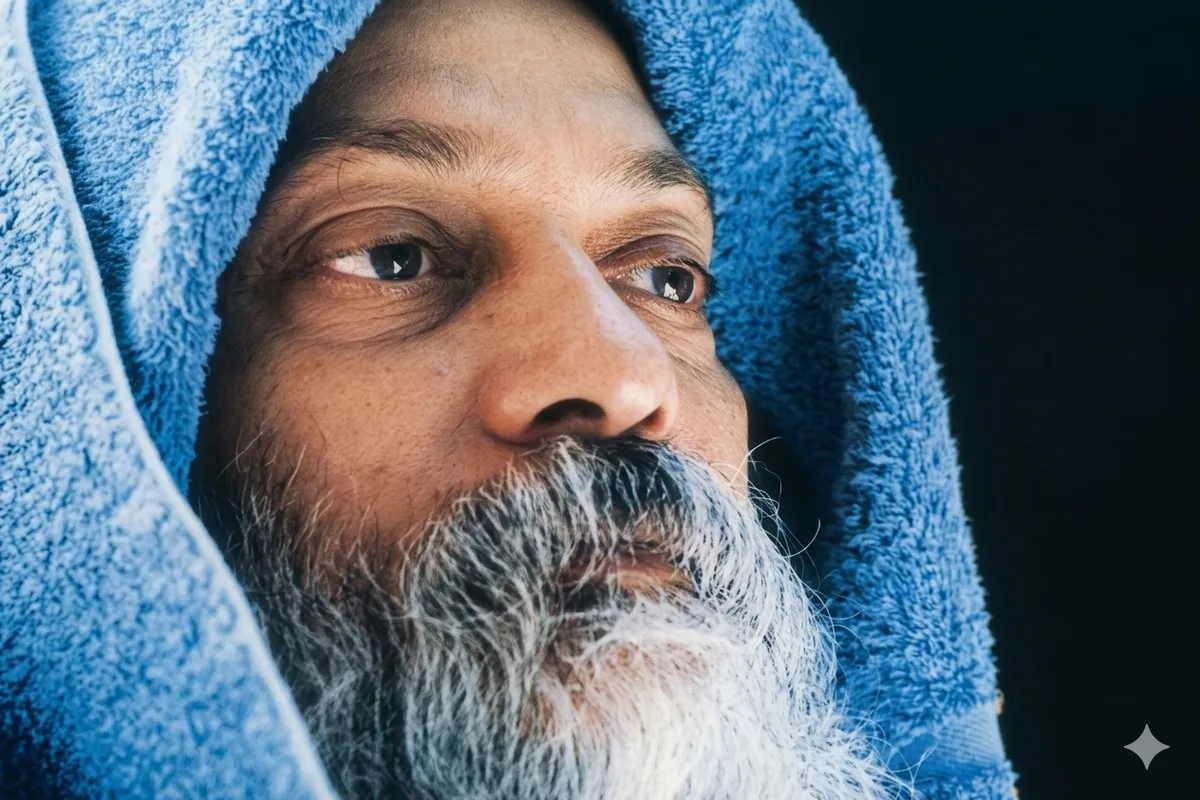
Sannyas isn’t a dress; it’s gently letting your ‘me’ melt and giving yourself to love, step by step.
From the Discourses
Passages where Osho speaks to this question — each links to the complete discourse.
According to me Sannyas is a direct relationship between an individual and God. There cannot be any intermediary. Sannyas is a direct surrender by an individual. When God is present on all sides, there is no need for anyone to be an intermediary between them. If a person wants to surrender to God he can do so. An unfit person begins to be fit by surrendering himself to God. Moreover, the beginning of fitness qualifications takes place by the determination, surrender, and prayers of the unfit. A Sannyasi is not a realized person, to be a sannyasi is simply to make a firm determination to start on a journey to become a realized person. A Sannyasi is simply the first point of that holy journey, it is not the end. It is only the blessed beginning, it is the milestone on that road, it is not the destination.
Osho, you have said that sannyas is the realization of truth. Then are ochre robes and the mala also essential for sannyas? And can a person not walk on your path without initiation? Kindly guide.
The day before yesterday a friend asked—he has taken sannyas, a simple-hearted man—he asked, “What is the scientific reason for this mala?” How can a mala possibly have a scientific reason? Its reason is religious, inward—not scientific. I told him, “If you want something ‘scientific,’ ask Laxmi.” A scientific reason? Does love ever have a scientific reason? A young man fell in love with Mulla Nasruddin’s daughter. He came and said, “I am in love with your daughter; please permit me to marry her.” Mulla said, “First prove it—what is the cause of your love?” The young man replied, “There is no cause, sir! Love has happened. Where there is a cause, can there be love? Where there is a cause, there is business, a bargain. Love is causeless.” Your love has happened with me; mine with you. Now some symbol becomes necessary. Think of this mala as the seven…
Osho, what is the definition of God?
Words are very small. If you say God is light, then what of darkness? The scriptures have said that God is light. Suppose we accept this as a definition—then what about darkness? Where will darkness go? Darkness is too; in fact it is far more than light. Light sometimes is and sometimes is not; darkness is always, eternal. Where will you place darkness? If you say God is light, darkness is left out. If you say God is darkness, then light is left out. If you say God is both darkness and light, a contradiction arises: they cannot be together. Try to have both darkness and light in the same room. If you bring in light, darkness disappears; if you preserve darkness, you cannot have light. Then how can both be together? That becomes an impossibility. So you cannot say “both” either. Then the fourth device is to say: it…
Osho, what does it mean to wear saffron clothes?
Clothes do not make one a sannyasin—but a sannyasin too has his own kind of clothes. Clothes do not make one a sannyasin, yet a sannyasin may have his own robes. Clothes are a very ordinary thing, but not utterly meaningless. What you wear has many meanings. Why you wear it also has many meanings. One man wears loose clothes. Wearing loose clothes in itself makes no difference, but why does a person choose loose clothes? And why does another choose tight clothes? These are indicators of the person. If a man is very calm, he will not like tight clothes. A taste for tight clothes hints that the person may be quarrelsome, restless, aggressive, sensual. Loose clothes are not suitable for fighting. That is why you cannot dress a soldier in loose clothes; you can dress only a monk in them. A soldier should wear tight clothes—the work is…
Osho, you have said that adopting personalities and faces from the outside is a subtle theft and gives birth to hypocrisy and irreligion. But it is being seen that these days many new sannyasins are gathering around you, and without any special preparation or maturity you are recognizing their sannyas. Are you not thereby causing great harm to religion? Please explain.
First thing: if someone tries to become like me, I will stop him; I will tell him that trying to be like me is self-destruction. But if someone sets out on the journey of trying to become himself, I have no hesitation in giving him my blessings. Those sannyasins who want me to be a witness to their journey toward God—to be a witness on their path—I have no objection to becoming their witness. But I am no one’s guru. I have no disciples. I am only a witness. If someone wants to take a resolve in my presence that he is setting out on the journey of sannyas, I have no objection to becoming a witness. But if someone comes to become my disciple, I have a grave objection. I cannot make anyone a disciple, because I am not a guru. If someone comes to walk behind me, I…