
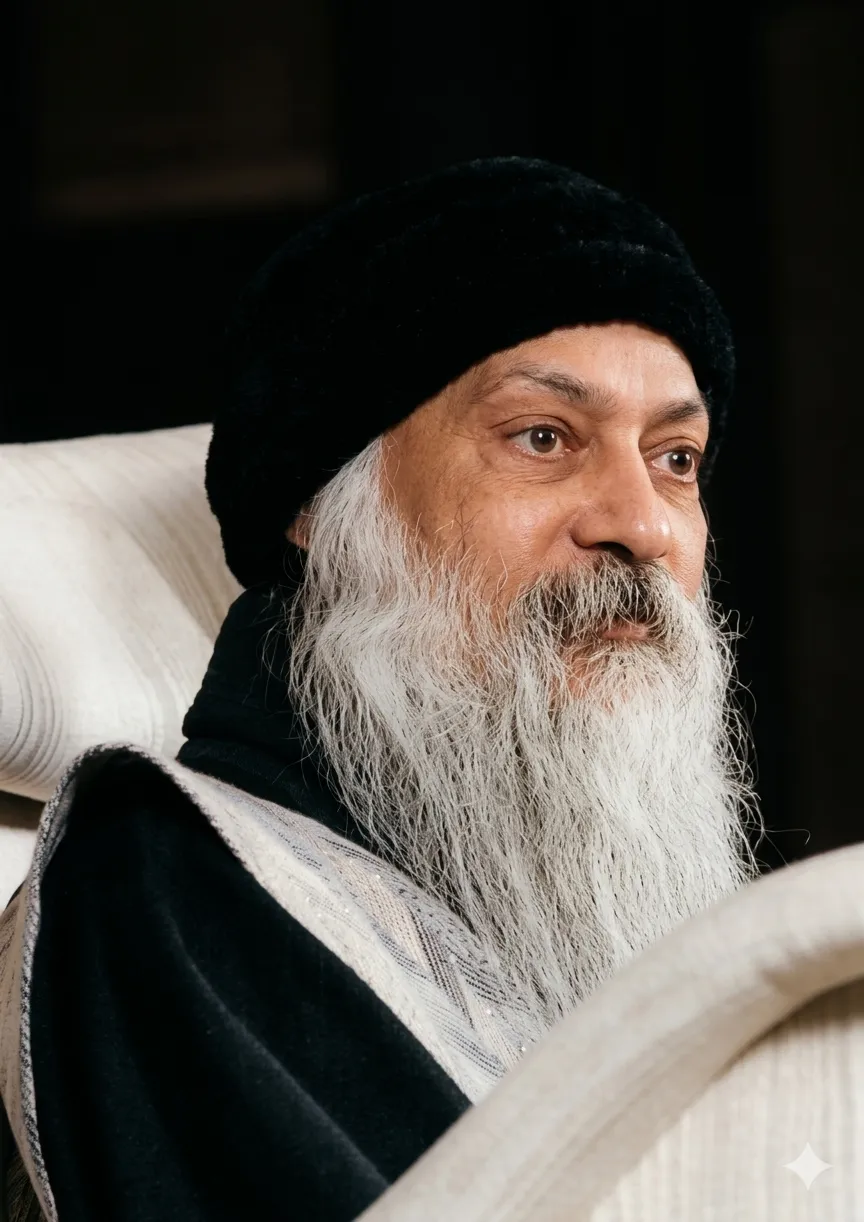
History is a time-book of repeatable events and mistakes, while the deepest truths happen inside you, beyond clocks and proof.
From the Discourses
Passages where Osho speaks to this question — each links to the complete discourse.
Osho, what is history?
Before long, those who went to live in the valleys wished they had gone to live in the hills and those who had gone to live in the hills wished they had gone to live in the valleys. The liberators, under the guidance of God, set fire to the discontent, so presently the world was at war again. This time the destruction was so complete... that nothing at all was left in the world except one man and one woman and one flower. But that's enough, that will do; that one flower will do. Again everything will come back. History is a wheel. It is a vicious circle, it goes on moving in the same rut. Many, many times man has become very civilized, and many, many times all civilization has disappeared from the earth. This is not for the first time that we have discovered science. Ancient records tell…
Many western historians feel that humanity is constantly making progress. If this is the case, then how is it that human consciousness is so unevolved?
Mark and Luke are contradictory because they are writing history. But Tulsidas and Valmiki are not contradictory. They are not writing history, they are not concerned with history at all. They are reliving, in their imaginations. They say, "We cannot say much. We cannot say enough because we are not capable. All that is said is only a fragment. It is not the whole story." If you yourself see Krishna, you will see something else altogether. But you are at liberty to see it because the event is not historical. So the life of Krishna or of Ram, becomes very rich. Jesus' recorded life was very poor because his followers were obsessed with history. They could not write anything that was beyond history. The eastern mind could see that we cannot do justice to Krishna or Buddha if we limit ourselves to bare events. This will be an injustice because…
Beloved Osho, suddenly, sitting with you again, I tingle inside. Your beat inside the tablas -- a magic moment. Is that the quality of non-doing?
Then the work is no longer work. Doing is no longer doing; it becomes your creativity. Whatever you do now, you do with your totality. And the whole existence supports you, goes on filling you with more juice so you can pour that juice into your actions, into your doings. Suddenly you become a magician yourself. Whatever you touch becomes gold. Wherever you move, existence goes on welcoming you, and whatever you do, howsoever small, becomes part of your meditation. I don't want you to follow the old pattern, which was basically faulty: meditate for one hour and then for twenty-three hours destroy whatever you have meditated. There are even Sunday religions like Christianity: just one day, for one hour, go to the church for a good morning's sleep, that's enough. Then for six days you can do everything that goes against all divine values -- but there is no…
Swami Anand Maitreya has asked: “Jagjivan was a shepherd, uneducated—then where did he find such lovely words? How could such precious expression happen?”
Your beauty fills my gaze as I rise— the whole atmosphere shines like your raiment. The dawn breeze has passed through your bedchamber— my morning is fragrant with your very body. Then everywhere is his feel. The breeze becomes his touch; the sun, his spread; the rainbow, his bow; the waves, his resonance; the mountains, his uplifted head. Recognize once—and the path to recognition is love, not knowledge. Those lost in knowledge remained ignorant. Those who acknowledged their ignorance bowed at his feet and said: “I will grasp his feet and cajole him. I tell you: whom else do I know? I have come to your refuge. The love I have joined I will never break; this image I will not forget. I will grasp his feet and cajole him.” One who can say this—not on the surface but from the whole being—does not take long. He leaps onto the…
स्वामी आनंद मैत्रेय ने एक प्रश्न पूछा है: ‘जगजीवन तो चरवाहे थे, अपढ़, फिर ऐसे प्यारे शब्द कहां से खोज पाए? फिर ऐसी बहुमूल्य अभिव्यक्ति कैसे हो सकी?’
सब-कुछ नहा गया है। तुझे नहाया हुआ देखता हूं चारों तरफ। क्योंकि सारे रंग तेरे, सारे रूप तेरे। नसीम तेरे शबिस्तां से होके आई है और मुझे अब पक्का भरोसा है कि यह हवा, जो सुवास लेकर आ रही है, यह तेरे निवास स्थान से आ रही है, यह तेरे मंदिर से आ रही है। नसीम तेरे शबिस्तां से होके आई है मेरे सहर में महक है तेरे बदन की-सी और मेरी सुबह में जो महक मुझे मिल रही है, वह तेरे देह की महक है; वह तेरी महक है। फिर तो वर्षा होती है और जमीन से सोंधी गंध उठती है, उसी की गंध है। फिर तो सब उसका है। एक बार पहचान। और पहचान की रीति--प्रीति, ज्ञान नहीं। जो ज्ञान में भटके, अज्ञानी रह गए। और जिन्होंने अपने अज्ञान को पहचाना, उसके चरणों में झुके और कहा: पैयां पकरि मैं लेहुं मनाय।। कहौं कि तुम्हहीं कहं मैं जानौं, अब हौं तुम्हरी सरनहिं आय। जोरी प्रीत न तोरी कबहूं, यह छबि सुरति बिसरि नहिं जाय।। पैयां पकरि मैं लेहुं मनाय।। जो ऐसा कह सकता है, ऊपर-ऊपर नहीं, प्राणों से; अपनी समग्रता से, उसे देर नहीं लगती। …
Question: OSHO, DO MIRACLES REALLY NOT EXIST? ... The span is thousands of years, and in those days particularly in India history was not written. History was not even counted as a subject. Writing history was introduced by the Mohammedans in India. In India the idea was that history consists of mundane, ordinary, day to day things, which go on being repeated. A king is born, a king dies; another king will be there, he will die. Empires are built and disappear. If you look at the millions of years in India it has been the custom to look at existence extending for millions and millions of years -- what does it matter that a man was a prime minister for three months in a country? Why bother?