
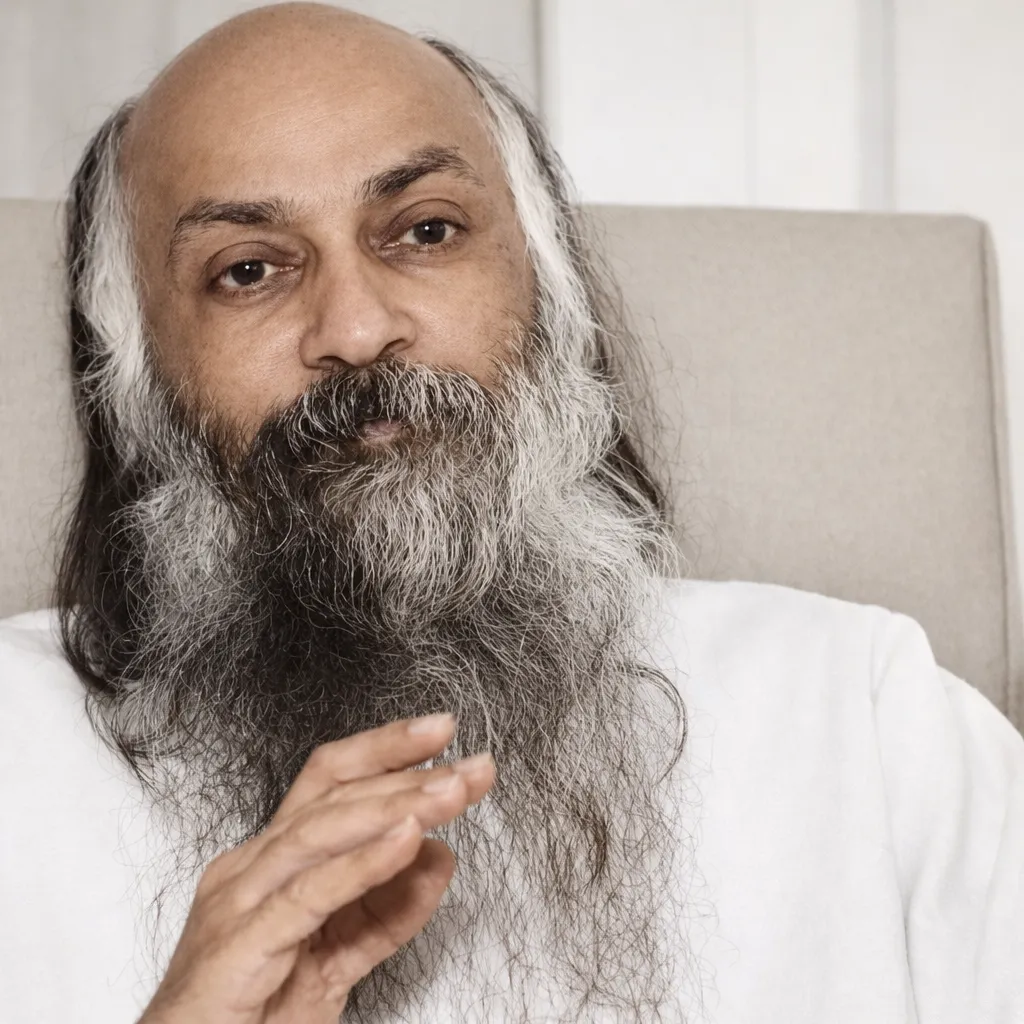
He isn’t trying to please logic; he’s honoring life’s opposites, so what looks mixed-up is just two sides that keep life alive.
From the Discourses
Passages where Osho speaks to this question — each links to the complete discourse.
Beloved Osho, by now, millions of people are confused by your contradictory actions and statements. But also we, your friends, tend to diminish or simplify your words. Osho, what is at the heart of your contradictions? How can we enter your wild dance of consciousness?
There are no contradictions -- only apparently so. Logically you can find hundreds of contradictions; but I am not speaking logically. Once that is understood you can see that all contradictions disappear. They are created by a certain system of logic, and if you have the glasses of that logic on your eyes, you will see contradictions. I am not speaking logically. I have no respect for logic. I have respect for life. And life is vast enough to have contradictions as complementaries. Life cannot exist without contradictions. Logic is dead. It can exist very clinically, without contradictions. But it is a dead system -- it is just a man-made system; it does not breathe. So there is a way to speak logically, which the philosophers have been doing down the ages. Their whole effort was not to get into any contradiction, into any inconsistency. Avoiding contradictions, avoiding inconsistencies, they…
Osho, with reference to the East—and especially India—a question has been pursuing me for a long time: those who once scaled the Gaurishankar of philosophy and reflection, of religion and meditation, how did they, in the course of time, become so broken, degenerate, and impoverished? Osho, please be gracious and shed some light on this question.
The question is meaningful. The East reached great heights—but crippled heights, like a bird that has flown very high with only one wing. How high can it truly go, and how far? Maybe it flutters a bit, rides the winds a little, drags itself some distance—but not for long. Seeing just one wing, you can already say: this bird will fall; its fall is inevitable. Flight happens with two wings. A lame man can walk, but how different that walk is from walking on two sound legs. The lame walk is painful, compelled. One with two healthy legs sometimes runs for no reason, even dances, strolls with nowhere to go. The joy in the meeting of those two legs is complete in itself. Therefore I do not tell my sannyasin to renounce the world. The world has been renounced and the result is clear—those who left it fell badly, flat…
पहला प्रश्न: ओशो, पूरब के और खासकर भारत के संदर्भ में एक प्रश्न बहुत समय से मेरा पीछा कर रहा है। वह यह कि जिन लोगों ने कभी दर्शन और चिंतन के, धर्म और ध्यान के गौरीशंकर को लांघा था, वे ही कालांतर में इतने ध्वस्त, और पतित, और विपन्न कैसे हो गए? ओशो, इस प्रश्न पर कुछ प्रकाश डालने की अनुकंपा करें।
प्रश्न सार्थक है। पूरब ने बड़ी ऊंचाइयां पायीं, लेकिन ऊंचाइयां अपंग थीं। जैसे कोई पक्षी एक ही पंख से आकाश में बहुत ऊपर उड़ गया। कितने ऊपर जा सकेगा? और कितनी दूर जा सकेगा एक ही पंख से? शायद थोड़ा तड़फ ले। थोड़ा हवाओं के रुख पर चढ़ जाए। शायद थोड़ी दूर तक अपने को खींच ले। लेकिन यह ज्यादा देर नहीं होने वाला है। तुम एक पंख देखकर ही कह सकते हो कि यह पक्षी गिरेगा। इसका गिरना अनिवार्य है। उड़ान होती है दो पंखों पर। …
And it has gone so beautiful, and it is going so beautifully. And I don't see that I can ever be disappointed, because in the first place I don't bother whether the river is going to the north or to the south. Wherever it goes, wherever it lands, that's my home. That's where I always wanted to go, but I was not aware. Q:* THE MODERN AGE, THE SO-CALLED AGE OF ENLIGHTENMENT, IS AN AGE OF LIBERALIZATION FROM OLD BELIEF SYSTEMS AND RELIGIONS. YOU CLAIM YOUR RELIGION A MODERN RELIGION. ISN'T THIS A CONTRADICTION IN ITSELF? A:* It is. It is a contradiction to call it a modern religion, or better, a religionless religion, which will make the contradiction more clear. But to me, existence allows contradictions. it is not logical; it is very illogical. In fact, existence depends on contradictions. What is life and death? Are not they contradictory?
Osho, today I shall ask about contradiction. To me, sir, this issue has been very confusing. Socrates cleansed the system by advocating democracy; over time Aristotle’s attitude shifted toward changing the system. I agree with your view that our future organizations will be organizations of love, not of domination. But I must admit, sir, that to run a government—whether of small units or of work organizations—we will have to frame a code of conduct which checks the malpractices of bad elements and keeps the system sound. May I have, sir, the details?
Large nations are antagonistic to this; they obstruct. They too call for international government, but what they mean is to dominate—to become the international government themselves. The call for internationalism is very old, and it has come in two kinds: Alexander and Genghis Khan too wanted an international government—one world under their rule. But that could not be; the very feeling was wrong. In that way, an international government can never be formed. It will arise on the basis that the units are small—so small as to be negligible in terms of power—and thus able to unite and come together. Therefore the nation must go. In the future, there can be no place for nation-states. There will be small towns, small districts, small clusters that wish to associate. Those small clusters will organize themselves; they can manage within their small bounds. They will have no great power. Their administrative thread…
ओशो, टुडे आई शैल आस्क अबाउट कंट्राडिक्शन। टु मी सर दिस इस्यू हैज बीन वेरी मच कनफ्यूजिंग। साक्रेटीज क्लीन्स दि सिस्टम बाई प्रोनाउंसिंग दि डेमोक्रेसी, व्हेयर इन ड्यूरेशन ऑफ टाइम चेंज्ड द एटिट्यूड ऑफ अरिस्टोटल टु चेंज दि सिस्टम। आई एग्री विद योर व्यूज़ दैट अवर फ्यूचर आर्गनाइजेशंस विल बी दि आर्गनाइजेशंस ऑफ ओवर लव नॉट ऑफ डॉमिनेशंस। बट आई हैव टु एडमिट सर दैट टु रन ए गवर्नमेंट व्हेदर ऑफ स्माल यूनिट आर ऑफ वर्क आर्गनाइजेशंस, वी शैल हैव टु फ्रेम ए कोड ऑफ कंडक्ट व्हिच शैल चेक दि माल-प्रेक्टिसस ऑफ दि बैड एलिमेंट्स एण्ड कीप दि साउंड सिस्टम। शुड आई हैव फ्रॉम यू सर दि डिटेल्स ऑफ अकाउंट?
बड़े राष्ट्र उसमें विरोधी हैं, बाधा डालते हैं। बड़े राष्ट्र भी अंतर्राष्ट्रीय सरकार चाहते हैं लेकिन उसका मतलब यह होता है कि वे हावी हो जाएं और वे अंतर्राष्ट्रीय सरकार बन जाएं। अंतर्राष्ट्रीयता की पुकार बहुत पुरानी है, वह दो तरह की है। दुनिया में सिकंदर ने और चंगीज ने भी अंतर्राष्ट्रीय सरकार चाही है। पर वह सरकार उनकी हो। वे छा जाएं, एक राष्ट्र हो जाए सारी दुनिया। लेकिन वह नहीं हो सका। वह भावना ही गलत थी। उस भांति कभी कोई अंतर्राष्ट्रीय सरकार नहीं बन सकती। अंतर्राष्ट्रीय सरकार बनेगी इस आधार पर कि छोटे यूनिट, इतने छोटे यूनिट कि उनका कोई अर्थ नहीं है शक्ति के मूल्यों में, वे ही संयुक्त हो सकते हैं और इकट्ठे हो सकते हैं। इसलिए राष्ट्र जाना चाहिए। राष्ट्रों की कोई जगह नहीं हो सकती है भविष्य में। होंगे छोटे-छोटे नगर, होंगे छोटे-छोटे जिले, होंगे छोटे-छोटे टुकड़े, जो आपस में इकट्ठे होना चाहते हैं। वे छोटे टुकड़े इकट्ठे होंगे और जो अपने को छोटी सीमा में मैनेज और व्यवस्थित कर सकते हैं, ये इकट्ठे होंगे। …
Osho, you often advise us to follow two courses of action that seem to be incompatible with each other. First you tell us to be completely in the moment, without mind, to be our fear, our joy, or rage. Then you tell us to become detached from our egos, to watch what comes up within ourselves. How can we do both? Please explain.
And what I am doing here is not helping you to become great philosophers. My whole approach is anti-philosophical, anti-logical. My approach is existential. You have to experience; except experience there is no proof of what I am saying. Don't listen to my words, listen to the intervals. Don't be too much obsessed with what I say, become more and more attuned with my silence. The moments when nothing is said are far more pregnant. My message is not in the words but beyond the words. But I can understand, Lisa, your difficulty. That is the difficulty of all logical people -- and the whole world is trained for logic. Here we are doing just a totally different thing. We are trying to undo what the society, the college, the university has done to you. They have made you obsessed with language and logic. Language certainly divides things; that's why…