
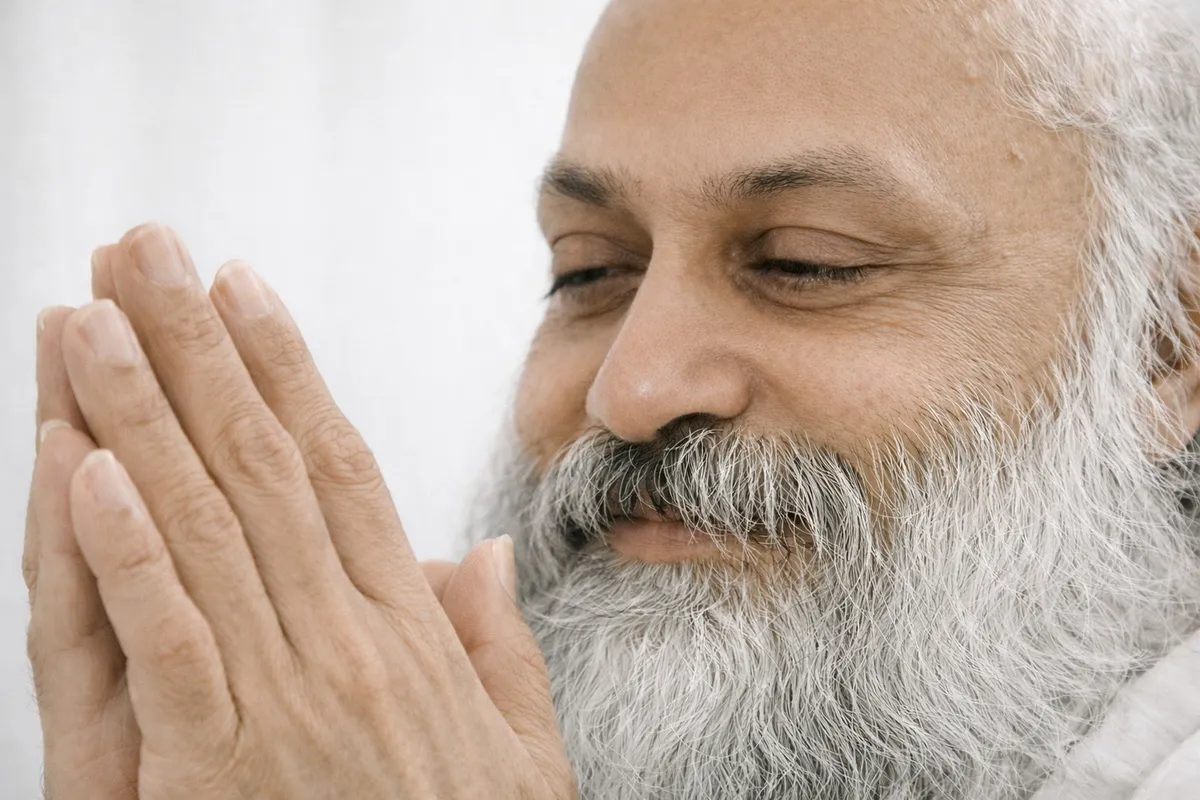
When you feel a big inner emptiness, your old ego is falling away—keep calmly watching and it turns into deep, fearless wholeness.
From the Discourses
Passages where Osho speaks to this question — each links to the complete discourse.
Beloved Osho, the other night, following the energy between my eyes, I went into myself, looking for "who am I?" at a certain point I found myself immersed in great nothingness. The sensation was very strong. I couldn't go on; I felt so afraid of this emptiness that I stopped. Osho, what is this energy that is felt between the eyes? Is it the so-called "third eye"? If this was the right way, why was I so afraid and trembling?
Ramaprem, this is the right way. That's why you became so afraid, because the right way means a certain death, the death of your ego, the death of your personality as you have known it, and the beginning and the birth of your essential self. But the death comes first, hence the fear and trembling. The resurrection comes later. You have been in a very beautiful space. This is the third eye that in the East has been talked about for at least ten thousand years. It is only symbolic. You have two eyes to see the world of duality -- the day and night, the beautiful and the ugly, the true and the false. The whole world consists of dualities. The third eye is a poetic and symbolic expression that your two eyes have become one, that all duality has disappeared. For the outside world two eyes are needed,…
Just go on seeing what is happening -- what the body is doing, what the mind is doing. Not that you have to verbalise it. You are not to evaluate it, you are not to judge it. You are not even to label what it is. Simply go on seeing whatsoever is. You remain with it and yet you remain far away. This experience can grow slowly, slowly. Just think -- one day you were a child, then the body changed; you became a young man. But have you changed? Has that awareness inside you changed? It is the same. You may be young, you may be old. You may be ill, you may be healthy, sometimes poor, sometimes rich, sometimes famous, well-known, sometimes thrown into oblivion -- nobody bothers about you, sometimes a somebody and sometimes a nobody.
Osho, you said that awareness created centering and crystallization, but I personally feel that awareness brings a feeling of deep void within me. Please explain the relationship between centering and inner void.
As man is, he is without a center -- without a real, authentic center. He has a center, so to speak, but the center is false. He only thinks he has a center. The ego is a false center. You feel that it is there, but it is not. If you go to find it, you will not find it at all. Bodhidharma reached China 1100 years after Buddha. He was a Buddha himself. The Emperor Wu came to receive Bodhidharma. When no one was there, he asked Bodhidharma, "I am very, very disturbed. My mind is never at ease. What can I do? Tell me. Make my mind at peace, at ease. I am in deep conflict; an inner struggle continues -- so do something." Bodhidharma said, "I can do something. Come early in the morning at four o'clock, but remember to bring your self." The Emperor felt: "Either…
Do you know who I am?
Emptiness has the nature of bliss, has the nature of existence, has the nature of consciousness. Not that consciousness fills it: it is not like a lamp burning in a room so the light is filling the room. You can put the lamp off and the light goes; you cannot put off consciousness. It is the very nature of that inner emptiness -- it is not that it is filling it. You cannot destroy it. How can you destroy emptiness? You can destroy everything in the world; you cannot destroy emptiness. That's why you cannot be murdered, you cannot be killed. There is no possibility, because you are not. The sword can kill the wheel, but the hub? -- the hub will remain intact. It cannot be destroyed; it was not there in the first place. Is-ness is the nature of the inner emptiness; consciousness is the nature of the…
Beloved Osho, being near you, looking into your eyes, feeling you, I am losing my ground. And I feel what I am, what I am not. Osho, how can I find myself? There seems to be nothing to find.
You have found it! Yes, nothing is there to be found. But to say it from the very beginning is to destroy the whole business. So religions go on saying to you, "You will find God, and you will find the soul, and you will find this and that." The truth is: you will not find anything. And it is better that you don't find anything, otherwise there is going to be trouble. Just think: if you find God sitting inside you, what are you going to do stuck with the fellow for eternity? Nothingness is beautiful. It implies freedom, infinity. The whole sky is yours. And you don't find anyone, so there is no question of quarrel, no question of who is higher and who is lower; no question of how to coexist because to anybody who is there you will be a stranger -- red people in Oregon!…