
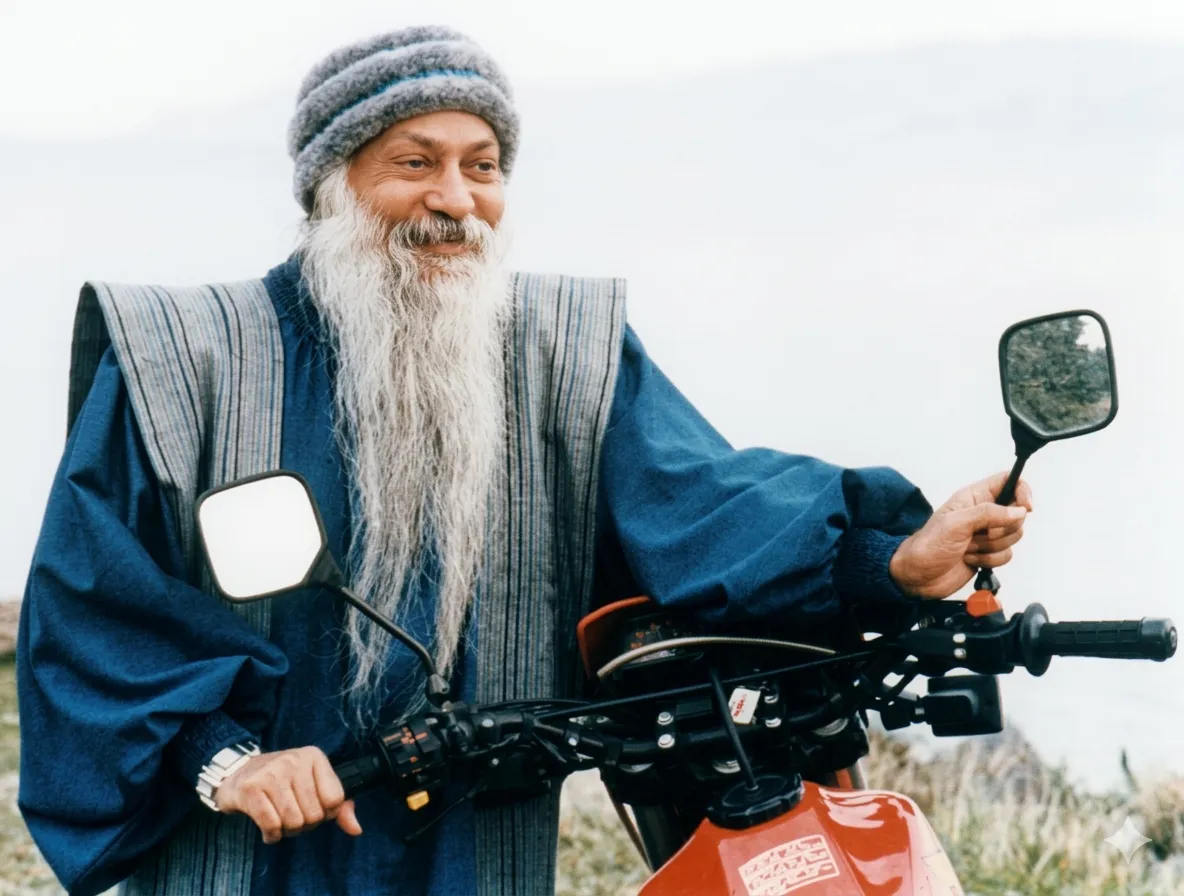
When someone’s separate self is gone, their wisdom spreads everywhere and can be called back with the right ‘passwords.’
From the Discourses
Passages where Osho speaks to this question — each links to the complete discourse.
Osho, do they have any separate entity now, in the liberated state?
They have no separate entity left. The moment moksha happens, no personality remains for a person. But we still have a personality, because we are not liberated; therefore, through certain methods—if we make use of them—answers can become available to us almost as though from a person. They have no personality left.
प्रश्न: ओशो, उनकी कोई सेप्रेट एंटाइटी इस समय है मुक्त अवस्था में?
उनकी कोई सेप्रेट एंटाइटी नहीं रह जाती। मोक्ष होते ही किसी व्यक्ति का कोई व्यक्तित्व नहीं रह जाता। लेकिन हमारा व्यक्तित्व है, जो हम अमुक्त हैं, इसलिए अगर इस तरह के उपाय हैं, जिनके हम उपाय करें, तो हमारे लिए करीब-करीब वे व्यक्ति की तरह उत्तर उपलब्ध हो सकते हैं। उनका कोई व्यक्तित्व नहीं रह गया है।
Osho, questions arise—and for many of them the answers also come. What is all this?
Girls want people to tell them they are beautiful. A handful of fools to say it—that’s all it takes—and you’ll always find such fools loitering on the seafront; no matter what she looks like—even if she resembles Kali of Calcutta, motherly and forbidding—some fool will still exclaim, “Ah, what beauty!” It feels good when someone says, “You are intelligent!” You gather your self-image from others’ borrowed opinions. You ask their questions and paste on their answers. You call this your knowledge. All of it stale and borrowed... No—no one else can give you knowledge. No one else can answer your questions. The one who truly wishes you well, who truly wants you to become a flame of life, will tell you: the answer to every one of your questions is within you. Therefore the way is to sit silently and go inward. And a moment comes, as you keep finding…
प्रश्न: ओशो, प्रश्न उठते हैं और उनमें से बहुत से प्रश्नों के उत्तर भी आ जाते हैं। यह सब क्या है?
लड़कियां चाहती हैं कि लोग उनसे कहें कि तुम बड़ी सुंदर हो। ऐसे दस-पांच नालायक मिल जाएं और कह दें--मिल ही जाते हैं चौपाटी पर घूमते-घामते, कि भला वह कलकत्ते की काली-वाली हों, माई भला हों, मगर कोई न कोई नालायक मिल ही जाएगा कि अहा, कैसा सौंदर्य है! इससे अच्छा लगता है। कोई तुमसे कह दे कि तुम बुद्धिमान हो! इससे अच्छा लगता है। तुम्हारे अपने संबंध में धारणाएं तुम दूसरों के उधार विचारों से इकट्ठी करते हो। तुम उनसे प्रश्न पूछते हो, उनके उत्तरों को चिपका लेते हो। इसे तुम अपना ज्ञान समझते हो। इस सब बासे और उधार...।
Maneesha has asked a question: BELOVED OSHO, HAS ONE ONLY RECEIVED A HIT IF IT HURTS?
Maneesha, a master hits not to hurt but to heal. And a disciple receives the hit with tremendous gratitude, not with anger. Unless a hit is received with gratitude it cannot do its work of healing. You are all full of wounds, and they all need to be exposed to the sun, to the open sky. Unless you allow yourself to be exposed completely, you cannot get rid of those wounds. The normal way in the world is to hide the wounds so nobody knows about them -- go on hiding them deeper and deeper in the unconscious, so even you forget them. But to work on the consciousness, cleaning it from all the wounds is absolutely necessary. Those wounds have to be brought into the open. You are asking, "Has one only received a hit if it hurts?" No, Maneesha. If it hurts you have missed. If it does…
Osho, aspiration dissolves and becomes abhipsa. When abhipsa ends, what remains? Please clarify.
Akanksha means the world’s desires. Akanksha means desires—plural. Not one, many. The world means many. When akanksha dissolves and becomes abhipsa—abhipsa means desire, not desires. The single desire is called abhipsa; the many desires are called akanksha. When all the rays of desire gather together and are focused on one truth—on the Divine, or liberation, or on the Self, on nirvana, on kevalya—that is abhipsa. When the net of desires collects into one, abhipsa is born. When rays gather, fire is born. Rays are many; fire is one. Up to here, it is understandable: a man wants wealth, position, wife, son, brother; he wants life, a long life. All these wants—these many wants—gather together, and the man wants only the Divine—this much we can still understand. One who has had many desires can at least imagine that all desires have merged, all small streams and rivulets have fallen into a…
तीसरा प्रश्न: ओशो, आकांक्षा मिटकर अभीप्सा बन जाती है। अभीप्सा की समाप्ति पर क्या कुछ बचता है? स्पष्ट करें।
आकांक्षा यानी संसार की आकांक्षाएं। आकांक्षा यानी आकांक्षाएं। एक नहीं, अनेक। संसार अर्थात अनेक। जब आकांक्षा मिटकर अभीप्सा बनती है--अभीप्सा यानी आकांक्षा, आकांक्षाएं नहीं। एक की आकांक्षा का नाम अभीप्सा, अनेक की अभीप्सा का नाम आकांक्षा। जब सारी आकांक्षाओं की किरणें इकट्ठी हो जाती हैं और एक सत्य पर, परमात्मा पर, या मोक्ष पर, या स्वयं पर, निर्वाण पर, कैवल्य पर केंद्रित हो जाती हैं, तो अभीप्सा। आकांक्षा और आकांक्षाओं का जाल जब संग्रहीभूत हो जाता है, तो अभीप्सा पैदा होती है। किरणें जब इकट्ठी हो जाती हैं, तो आग पैदा होती है। किरणें अनेक, आग एक। यहां तक तो समझ में बात आ जाती है कि आदमी धन को चाहता है, पद को चाहता है, पत्नी को चाहता है, बेटे को चाहता है, भाई को चाहता है, जीवन चाहता है, लंबी उम्र चाहता है। यह सब चाहत, ये सब चाहतें इकट्ठी हो जाती हैं और आदमी सिर्फ परमात्मा को चाहता है--यहां तक भी समझ में आ जाता है। …
Jesus and buddha were certainly individuals. Cannot their individuality and its expression be called personality? You too, it could be said, have a personality, yet not an ego. Please clarify the concepts of personality, ego, individuality, and self.
So somebody becomes an individual only when he has become infinite. It will look paradoxical, but let me say it: somebody becomes individual only when he has become universal, when he is one with the whole. Then somebody is an individual. But then to call him an individual will be stretching the meaning of the word too far. It will be a little too outlandish. It is better to call Buddha a nobody -- neither a person nor an individual. All those things have been left far behind. He has transcended all limitations. The question is from Prem Divya. She asks, PLEASE CLARIFY THE CONCEPTS OF PERSONALITY, EGO, INDIVIDUALITY AND SELF. Personality and ego are two aspects of the same coin, just as individuality and self are two aspects of the same coin. The personality has a center -- that center is called the ego. Because personality itself is false,…