
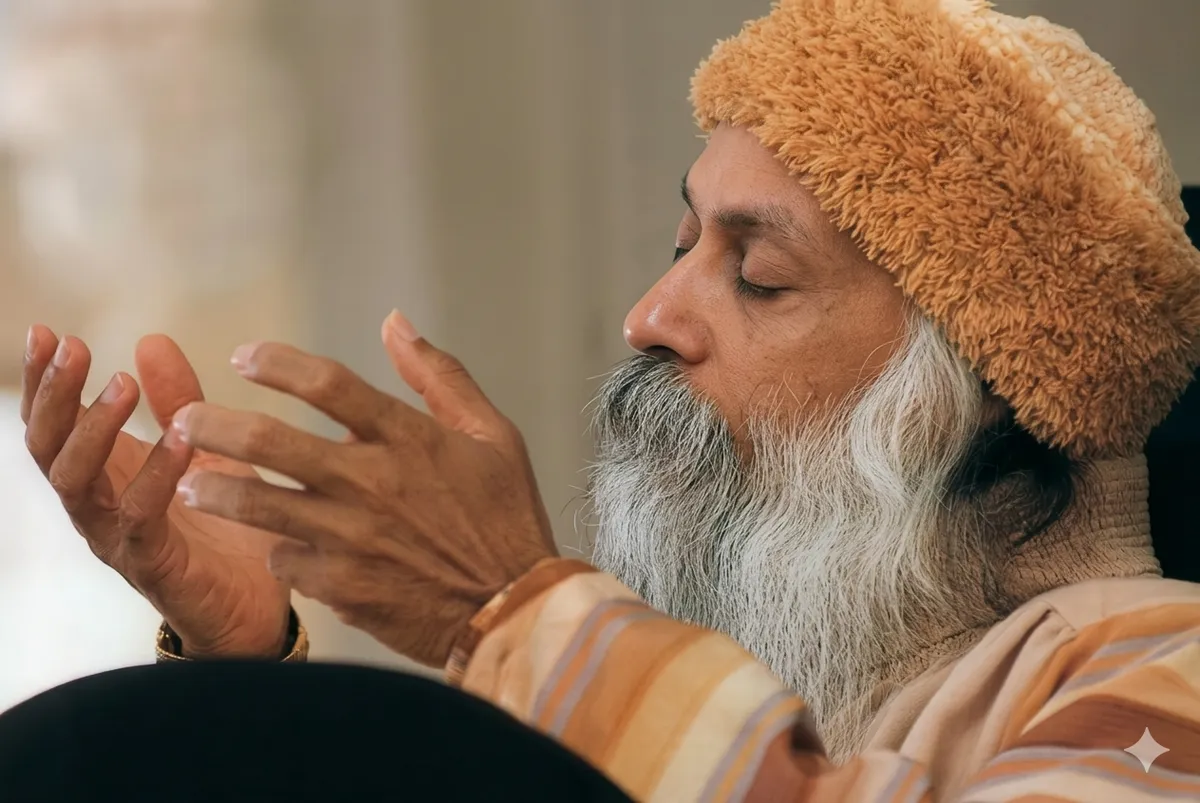
We act like robots, repeating old habits instead of noticing and choosing in the present—until something wakes us up to be aware.
From the Discourses
Passages where Osho speaks to this question — each links to the complete discourse.
What do you mean when you say that man is a machine?
Do you live in the present moment? Do you recognise things as they are right now? Or do you just go on seeing them through old eyes, old mind... memory? Don't you have cliches? You immediately put things into certain boxes, ready-made boxes. For example, if you are a Hindu and you meet a man and you were very interested in the man... the man looks beautiful and is very nice, and you like his vibe. Then you ask things about him and he says 'I am a Mohammedan.' Finished. All that nice vibe is no longer there; you have shrunken back. You have a box, a fixed box that Mohammedans are not good. You are a Hindu, Mohammedans are bad. You immediately categorise him, you pigeon-hole him. Now you are no longer interested in the reality of the man. The reality was saying something else, but it was going…
Why do the sufis say that man is a machine?
You are a machine. It is just a built-in program in you now: you feel nervous, your hand goes into the pocket, the packet comes out. It is almost like a machine doing things. You take the cigarette out, you put the cigarette in your mouth, you light the cigarette, and this is all going on mechanically. This has been done millions of times, and you are doing it again. And each time you do this it is strengthened; the machine becomes more mechanical, the machine becomes more skillful. The more you do it, the less awareness is needed to do it. This is why the Sufis say man functions as a machine. Unless you start destroying these mechanical habits... Sufis have many methods to destroy them. For example, they teach many devices. They say: Do something just contrary to what you have always done. Try it. You come home,…
That is the definition of consciousness: beyond mechanicalness. And that has to be your work: don't behave mechanically. Bring more and more consciousness into your acts -- even small acts: walking, eating, talking, listening taking a shower. Make them more and more conscious. Do each thing deliberately with a self-remembering that you are doing it. That self-remembering is not needed ordinarily, because once you have learned to do a certain thing then there is no need to remember. Then the body has learned the way and it does it mechanically. For example, if you are learning driving; first you have to be very attentive, very alert. As you start getting the feel of it, the knack of it, you become less and less attentive. After a month, when you have got the licence, you can forget about being attentive. Now the mechanical part in the body takes over.
Osho, what is the definition of God?
Words are very small. If you say God is light, then what of darkness? The scriptures have said that God is light. Suppose we accept this as a definition—then what about darkness? Where will darkness go? Darkness is too; in fact it is far more than light. Light sometimes is and sometimes is not; darkness is always, eternal. Where will you place darkness? If you say God is light, darkness is left out. If you say God is darkness, then light is left out. If you say God is both darkness and light, a contradiction arises: they cannot be together. Try to have both darkness and light in the same room. If you bring in light, darkness disappears; if you preserve darkness, you cannot have light. Then how can both be together? That becomes an impossibility. So you cannot say “both” either. Then the fourth device is to say: it…
पहला प्रश्न: ओशो, परमात्मा की परिभाषा क्या है?
शब्द तो बड़े छोटे-छोटे हैं। अगर कहो परमात्मा प्रकाश है, तो फिर अंधेरे का क्या होगा? ऐसा कहा है शास्त्रों में कि परमात्मा प्रकाश है। चलो मान लें इसे परिभाषा, फिर अंधेरे का क्या होगा? फिर अंधेरा कहां जायेगा? अंधेरा भी है, प्रकाश से कहीं ज्यादा है। प्रकाश तो कभी होता है कभी नहीं भी होता; अंधेरा सदा है, शाश्वत है। अंधेरे को कहां रखोगे? अगर कहा परमात्मा प्रकाश है, तो अंधेरा बाहर पड़ गया। अगर कहा परमात्मा अंधेरा है, तो प्रकाश बाहर पड़ गया। अगर कहो परमात्मा अंधेरा प्रकाश दोनों है, तो विरोधाभास होता है। दोनों एक साथ हो नहीं सकता। एक ही कमरे में अंधेरा और प्रकाश करके दिखाओ। प्रकाश करोगे, अंधेरा खो जायेगा; अंधेरा बचाओगे, प्रकाश न कर सकोगे। तो दोनों साथ कैसे होंगे? तब एक असंभव बात हो गई। तो यह भी नहीं कह सकते कि दोनों है।
To a fly that likes the smell of putrid meat, the fragrance of sandalwood is foul.
BEINGS WHO DISCARD NIRVANA COVET COARSE SAMSARA'S REALM. AN OX'S FOOTPRINTS FILLED WITH WATER WILL SOON DRY UP; SO WITH A MIND THAT'S FIRM BUT FULL OF QUALITIES THAT ARE NOT PERFECT, THESE IMPERFECTIONS WILL IN TIME DRY UP. LIKE SALT SEA WATER THAT TURNS SWEET WHEN DRUNK UP BY THE CLOUDS, SO A FIRM MIND THAT WORKS FOR OTHERS TURNS THE POISON OF SENSE-OBJECTS INTO NECTAR. IF INEFFABLE, NEVER IS ONE UNSATISFIED, IF UNIMAGINABLE, IT MUST BE BLISS ITSELF. THOUGH FROM A CLOUD ONE FEARS THE THUNDERCLAP, THE CROPS RIPEN WHEN FROM IT POURS THE RAIN. ... <q>SO A FIRM MIND THAT WORKS FOR OTHERS TURNS THE POISON OF SENSE-OBJECTS INTO NECTAR.</q> Two things: first, one has to create a cloud of meditation in one's being; and the second thing is compassion -- one who works for others. Buddha insists on two things: meditation and compassion -- PRAGYAN and KARUNA.