
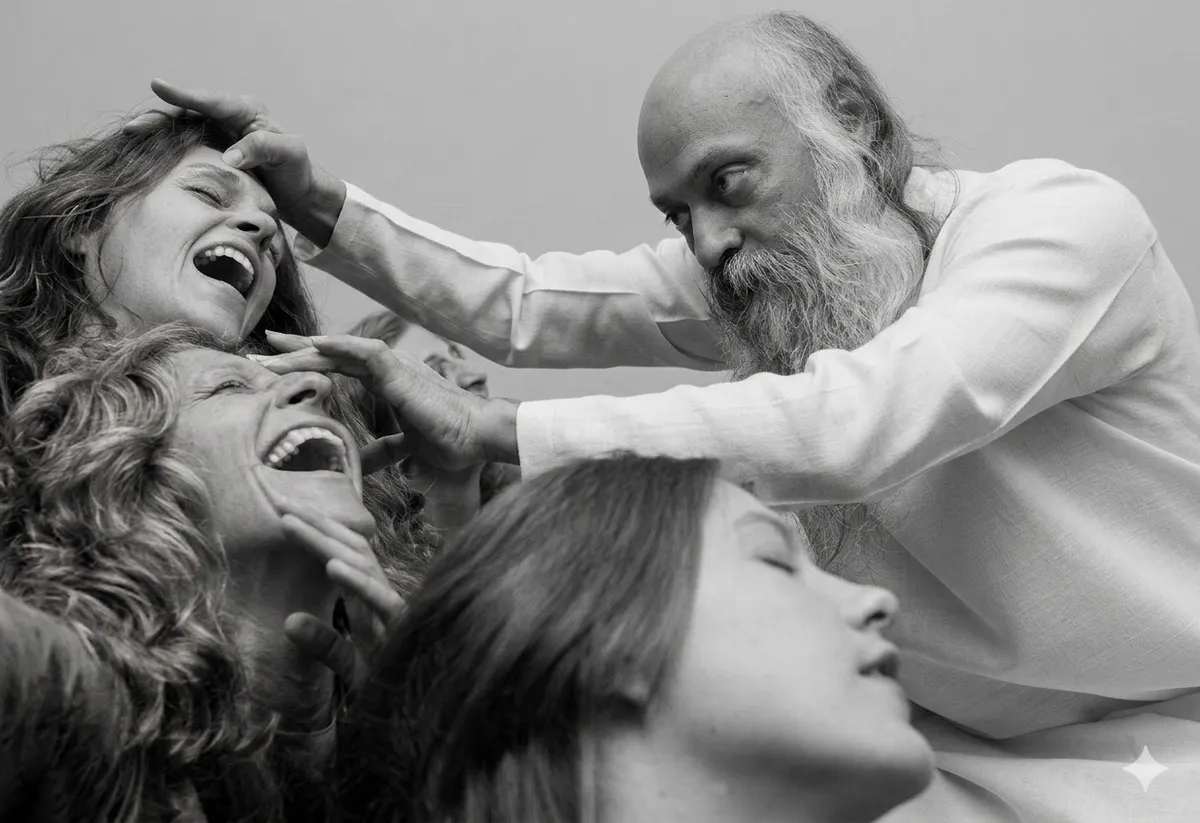
It’s like seeing open sky in the mirror—no labels—so you can start fresh today.
From the Discourses
Passages where Osho speaks to this question — each links to the complete discourse.
Who are you?
Whomsoever you think, because it depends on you. If you look at me with total emptiness, I will be different. If you look at me with ideas, those ideas will color me; if you come to me with a prejudice, then I will be different. I am just a mirror. Your own face will be reflected. There is a saying that if a monkey looks into the mirror he will not find an apostle looking at him through the mirror. Only a monkey will be looking through the mirror. So it depends on the way you look at me. I have disappeared completely so I cannot impose on you who I am. I have nothing to impose. There is just a nothingness, a mirror. Now you have complete freedom. If you really want to know who I am, you have to be as absolutely empty as I am. Then two…
Osho, who are you?
I AM JUST A MIRROR -- nothing more, nothing less. If you come close to me you can see your face as it is. Many people will see ugly faces and they will become angry at me. They will think that this ugliness is part of me. Many people will see beautiful faces; they will become infatuated with me. They will think that this beauty is part of me. Both are wrong. Just a few days ago THE SUNDAY STATESMAN published an article about me. The title of the article is "Rajneesh -- Sage or Satyr?" The writer is a famous Bengali scholar, a follower of Sri Aurobindo. He has written many books, particularly on Aurobindo's philosophy. He cannot come to a conclusion; he wavers. I enjoyed his article. One moment he thinks I am a saint, another moment he thinks I am a sinner. One moment he feels I…
I do not feel I am a man yet I see a man's face in the mirror.
A great insight has happened to you, a great realisation. Let it sink deep, let it become a constant awareness. No face is yours. All faces are false. Once you had the face of a lion, once you had the face of a donkey, once you had the face of a tree and once the face of a rock. Now you have the face of a man -- or a woman, ugly, beautiful, white, black. But you don't have any face. Your reality is faceless. And that facelessness is what Zen people call the original face. It is not a face at all. When you were not born, what face had you then? When you die, what face will you carry with yourself? This face that you see in the mirror will be dropped here; it will disappear into the earth -- dust unto dust. You will go faceless just…
Beloved Osho, I am deeply grateful to existence that I can be here beside you and that you are available for me. I believe you are my only authentic mirror. All the other mirrors around me seem to reflect my masks and the roles I'm playing. How can I become more sensitive towards myself? How can I say "yes" to what I am, and "no" to what I am not?
How do you know which is the mask and which is the original face? Are you certain? How can you be certain -- because a belief can never be certain -- that what you feel near me is your original face? Perhaps my presence and my people's presence and the silence that surrounds this strange temple -- godless, but so full of godliness; prayerless, but so full of prayerfulness ... You start feeling these things, they infiltrate into your being and you feel happy, thinking, "Perhaps this is my reality, this is my original face. Everybody else reflects only my mask." But if you are really experiencing it, why do you go on keeping your masks? Throw them away! Then no mirror will be able to reflect that which is not! If you see that this is a mask, immediately destroy it! Not the mirror, mind you! Destroy the mask!…
Beloved Osho, each time I see you, I am shocked by your beauty. You've got to be the most gorgeous being that has ever happened! Osho, in what way do you experience your own beauty?
So he made the portrait. It took many sittings and the woman became more and more puzzled as she saw the portrait coming up. When the portrait was complete she said, "Only one question, I want to know where my nose is. Everything is okay, but at least I should know where my nose is. From there I can figure out the eyes, the mouth, my ears -- that can be the center for finding myself." Picasso said, "I told you in the very beginning...! Now it is a trouble to find the nose -- who knows where your nose is! I have painted it, that is true, but in so many sittings I can't remember exactly where I have put it. You take it home and contemplate; perhaps you may find it. It is there, that much is certain. It is there, this much I can guarantee because I…