
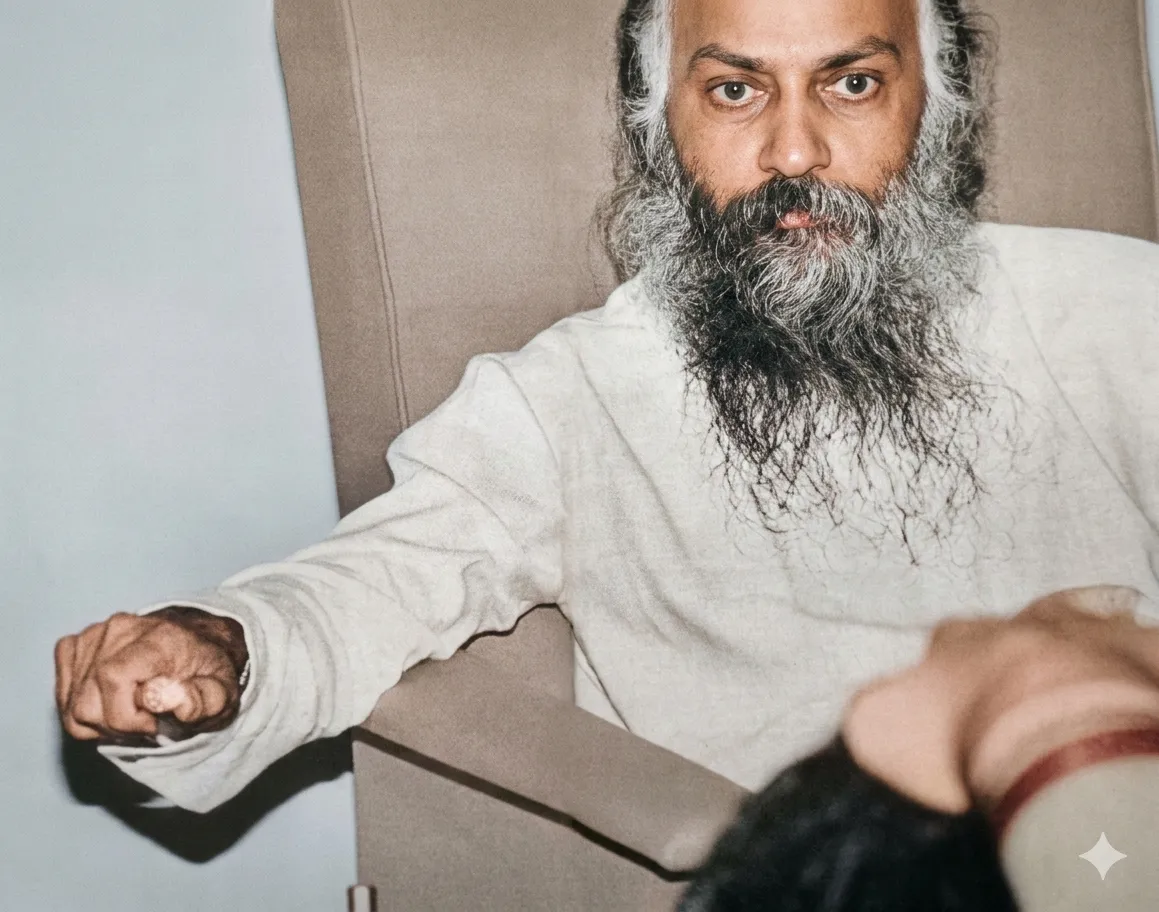
We try to own things and people because we feel empty inside; when we feel whole through awareness, we stop gripping so hard.
From the Discourses
Passages where Osho speaks to this question — each links to the complete discourse.
There is a basic cause to it: each child learns in his childhood that he has just to demand and all his demands have to be fulfilled. And they are fulfilled, otherwise he would not survive. He has no responsibility to give anything -- he simply gets; and because of this a very wrong pattern sets in. The child simply gets and there is no question of giving. He becomes very manipulative, he becomes very political: he knows how to manipulate the mother and the father and the whole family. If it is needed he cries, creates a tantrum, creates such hell that they have to yield, or, if sometimes it helps, he smiles; but these are all strategic, political gimmicks. The whole effort is of dominating, of possessing. And the child wants to be dictatorial -- each child is dictatorial.
Why am I so possessive about things?
The question is from Anam. Ordinarily everybody is possessive of things, because nobody possesses themselves; it is a substitute. When you don't possess yourself, you start possessing things. It gives a sort of security -- at least you possess something: a big house, a big balance in the bank, a beautiful woman, a wife, a husband. children, security, respectability. You possess something, you don't possess yourself. To take your eyes away from that inner zeroness, nothingness, that emptiness, you go on filling things all around you. But it is not going to satisfy, because whatsoever you possess will never make you full inside; you will remain empty. The idea to possess things arises because we don't possess our being. Because the being is missing, we start moving into the world of having -- 'Have this, have that' but you will remain frustrated. Deep down the emptiness will be felt again…
Osho, in one discourse you said that for men the “I-sense” and for women the “mine-sense,” that is, possessiveness, are obstacles. Isn’t possessiveness just another form of love? Must I really drop such a loving quality, which has overtaken my life? And then will I have to live dry and arid? Please guide me.
Kashmeera, you are right. If I were producing monks of the old style, your statement would be absolutely right—that then life would become dry and arid. But I am talking of a very different sannyas: a renunciation that does not run away from love, rather awakens to the truth of love; a renunciation that does not accept love as merely momentary, but embraces it as its eternal truth; that does not flee the world or flee love, but drops the ego. For sorrow does not come from love; from love comes joy, even if momentary. Yes, when love goes and the ego becomes strong, then sorrow comes. This is a subtle process; you will understand only if you look carefully. Sorrow never comes from love. Sorrow comes from ego, from attachment, from possessiveness, from the sense of I. Therefore in the beginning, love relations are very pleasant and delightful. The…
दूसरा प्रश्न: ओशो, आपने एक प्रवचन में कहा था कि पुरुष के लिए ‘मैं-भाव’ और स्त्री के लिए ‘मेरा-भाव’ अर्थात ममता बाधा है। क्या ममता प्रेम का ही दूसरा रूप नहीं है? क्या इतने प्रेमपूर्ण गुण को, जो कि मेरे जीवन पर छा गया है, उसे छोड़ना ही पड़ेगा? और रूखा-सूखा होकर रहना पड़ेगा? कृपया मार्गदर्शन दें।
कश्मीरा, तू ठीक कहती है। अगर मैं पुराने ढंग के साधु-संन्यासी पैदा कर रहा होता तो तेरा वक्तव्य बिलकुल ठीक था--कि फिर तो जीवन रूखा-सूखा हो जाएगा। लेकिन मैं तो किसी और ही संन्यास की बात कर रहा हूं। ऐसे संन्यास की जो प्रेम से भागता नहीं, वरन प्रेम के सत्य में जागता है। ऐसे संन्यास की जो प्रेम को क्षणभंगुर ही नहीं स्वीकार करता, बल्कि अपनी शाश्वत सचाई की तरह अंगीकार करता है। जो संसार से नहीं भागता और प्रेम से नहीं भागता, बल्कि अहंकार को त्यागता है। क्योंकि दुख प्रेम से नहीं आता, प्रेम से तो सुख ही आता है, क्षणभंगुर ही सही। हां, जब प्रेम चला जाता है और अहंकार मजबूत हो जाता है, तब दुख आता है।
A nun who was searching for enlightenment made a wooden statue of buddha and covered it with gold leaf. It was very pretty and she carried it with her wherever she went. Years passed, and still carrying her buddha, the nun settled down in a small country temple where there were many statues of buddha each having its own shrine. The nun burned incense before her golden buddha each day, but not liking the idea of her perfume straying to the other statues, she devised a funnel through which the smoke would ascend to her statue only. This blackened the nose of the golden statue and made it especia
Somewhere, something seems to have gone deeply wrong -- in the very roots. This is not love; otherwise, fear disappears -- the more you love, the less you fear. When love really comes to its totality there is no fear. But in possessiveness, fear goes on growing more and more, because when you possess a person you are always afraid he may leave you, he may go away -- and the doubt is always there. The husband is always doubting that the wife may love somebody else. They become spies on each other, and they cut each other's freedom so there is no possibility. But when you cut freedom, when you cut the possibility of the unknown, life becomes dead, stale. Everything becomes flat, meaningless, a boredom, a monotone. And the more it happens, the more you become possessive. When life is ebbing, when the love is going, when something…
Question: BELOVED OSHO, WHY DO I CLING TO MY MISERY? WHY CAN I NOT DROP IT? ... Let me repeat, there is nothing worse than this that you can do, that you are capable of: reducing a being to a thing. And that's what possession is. Only things can be possessed; beings cannot be possessed. You can have a communion with a being. You can share your love, your poetry, your beauty, your body, your mind. You can share but you cannot do business. You cannot bargain. You cannot possess a man or a woman. But everybody is trying to do that all over the earth. The result is this madhouse we call the planet earth. You try to possess -- it is naturally impossible, it cannot happen in the very nature of things. Then there is misery.