
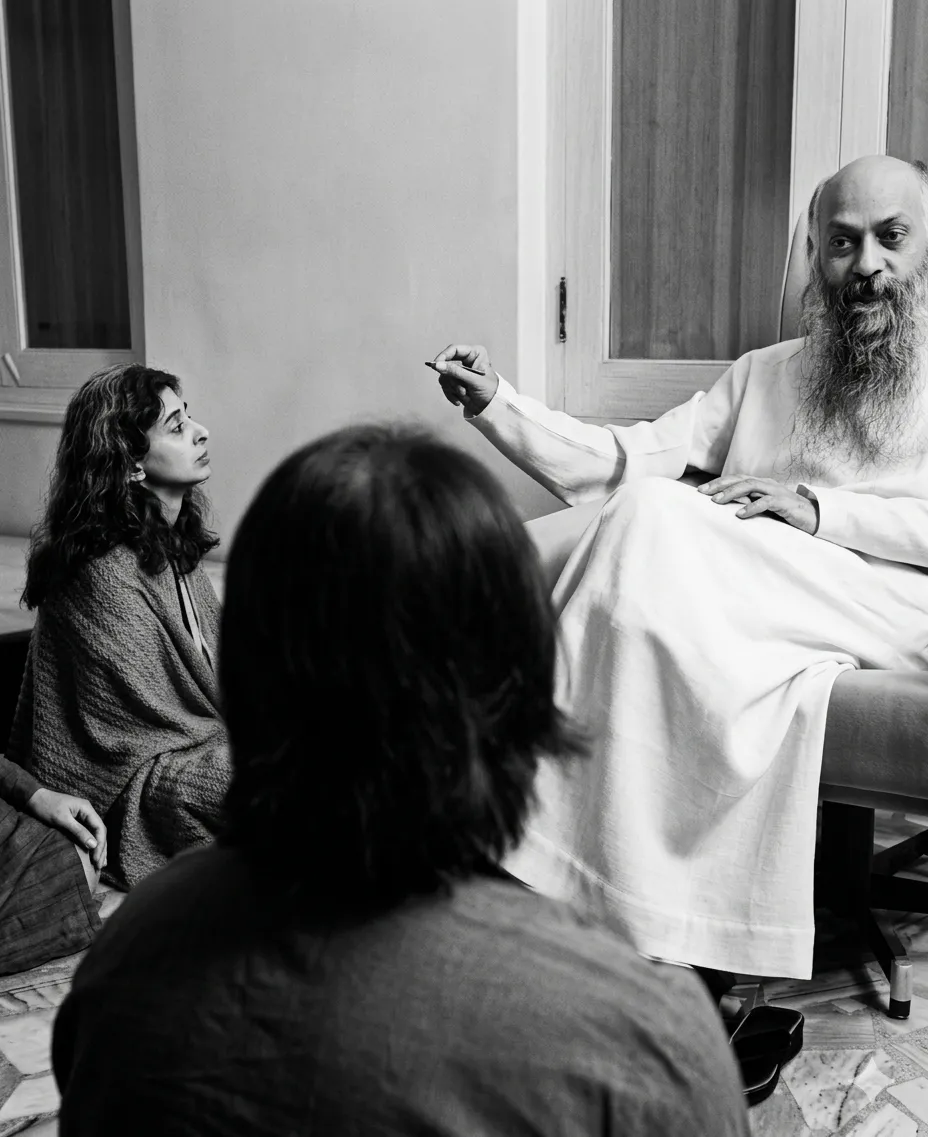
Your past habits push you to act blindly or chase goals, but with calm awareness a natural, effortless will appears.
From the Discourses
Passages where Osho speaks to this question — each links to the complete discourse.
Can this happen through will power?
Will is power; energy. There is no such thing as 'will power'. Will is power, will is energy. But by 'will' I mean the whole: Those who use the term 'will power' use it in a psychic sense. They use it to mean the power of concentration. I am not using the term in that sense. To me, 'will' means the whole. So only God is will. We are never will; we are just desires. Will is power, without desire. It is power with no movement or, with an inner movement. It is power without direction: directionless, dimensionless. When we say, "God is power," it does not mean that God is powerful. It means: God-power. God is the energY of the whole, the power of the whole. So when I say 'will power', it does not mean that will has power. Will is power -- it is energy. You can…
Osho, is there any method to increase willpower?
So do not take a very big resolve all at once, one that you already know is beyond you—and this is what often happens: those who set out on the journey of resolve take resolves beyond their limits. Your own mind counsels you, “Yes, take it.” And then you get stuck, and you fall. Then the same mind says, “Now drop it. You’re not anyone’s slave; you took it yourself, now leave it.” Why does the mind do this? Because the greater your resolve becomes, the smaller your mind becomes. The day a resolve is fulfilled, the mind dies; it cannot survive. Mind and resolve are opposing forces. Mind is the name of your weakness; resolve is the name of your soul. Mind is your disease; resolve is your health. Therefore the mind will keep putting you in difficulties. It will say, “Take a big one.” When you take it,…
प्रश्न: ओशो, संकल्प शक्ति को बढ़ाने के लिए कोई...
तो बहुत बड़ा संकल्प मत ले लेना एकदम से, जिसको तुम पहले से ही जानते हो...और अक्सर यह होता है, जो लोग भी संकल्प की यात्रा पर निकलते हैं, अपनी सीमा के बाहर संकल्प ले लेते हैं। तुम्हारा मन ही तुम्हें समझाता है कि हां, ले लो। और लेकर फिर तुम फंसते हो, फिर गिरता है। फिर तुम्हारा मन ही कहता है कि अब छोड़ो, कोई किसी की गुलामी थोड़े ही है, अपना ही लिए हुआ है, अब छोड़ो। और मन ऐसा क्यों करता है? मन ऐसा इसलिए करता है कि जितना तुम्हारा संकल्प बड़ा होगा, मन तुम्हारा उतना ही छोटा हो जाएगा। जिस दिन संकल्प पूर्ण होगा, मन मर जाएगा, मन बच नहीं सकता। मन और संकल्प विरोधी चीजें हैं। मन तुम्हारी कमजोरी का नाम है और संकल्प तुम्हारी आत्मा का नाम है। मन तुम्हारी बीमारी है, संकल्प तुम्हारा स्वास्थ्य है।
You have talked about how the subtle body can be separated from the physical body using one's willpower. Can the subtle body of a seeker who follows the discipline of witnessing, or that of a seeker who follows the discipline of tathata, suchness, be separated without exercising the will?
After having chained him firmly, they said, "What sort of a man are you? We are putting you in chains and you are helping us! We were afraid this might lead to some fighting and trouble." Diogenes said, "You are having fun chaining me, I am having fun in being chained. Where is the need for any trouble? It's great! Now tell me, where do we go from here?" The men said, "We feel very embarrassed in telling you that we are in the business of slavery. We'll now take you to the marketplace and put you up for sale." Diogenes said, "Good, let's go." He took off with great excitement and began walking even faster than the captors. They said, "Please slow down a little. What's the hurry?" Diogenes said, "Now that we are going to the marketplace, why not reach in time?" So finally they reached the marketplace.…
Osho, just as you distinguish between thought and the power of thought, isn’t there the same distinction between desire and willpower?
Certainly. As long as there are thoughts, you do not have the power of thought. There is a crowd of thoughts, not the power of thought. The power of thought arises only when the crowd of thoughts has departed. Then within you there is the pure energy of thought—uncovered by thoughts, laid bare; a burning fire of thought-power, with no ashes of thoughts upon it, only the glowing ember. Exactly the same holds for desires and willpower. The more the desires, the less the willpower. The fewer the desires, the greater the willpower. If you drop all desires, then whatever you will, the very moment you will it, it will be fulfilled. Your willpower will become that immense. When you do not desire, you have such vast energy that the very act of willing brings fulfillment. This is the secret of life: those who are eager to have their desires…
आखिरी प्रश्न: ओशो, आप विचार और विचारशक्ति में जैसा भेद करते हैं, क्या वैसा ही भेद इच्छा और इच्छाशक्ति में भी तो नहीं है?
निश्चित है। जब तक विचार हैं, तब तक तुम्हारे पास विचार की शक्ति नहीं। विचारों की भीड़ है, विचार की शक्ति नहीं। क्योंकि विचार की शक्ति तो तभी पैदा होती है, जब विचारों की भीड़ विदा हो जाती है। तब तुम्हारे भीतर शुद्ध ऊर्जा होती है विचार की। विचारों से ढंकी नहीं होती, उघड़ी होती है; जलती हुई आग होती है विचारशक्ति की; राख विचारों की ऊपर नहीं होती, अंगारा दमकता है। ठीक वैसा ही इच्छाओं के और इच्छाशक्ति के संबंध में भी है। जितनी ज्यादा इच्छाएं, उतनी कम इच्छाशक्ति। जितनी कम इच्छाएं, उतनी ज्यादा इच्छाशक्ति। अगर तुमने सारी इच्छाएं छोड़ दीं तो तुम जो इच्छा करोगे, वह इच्छा करते ही पूरी हो जाएगी। इच्छाशक्ति इतनी बड़ी हो जाएगी। जब तुम इच्छा न करोगे, तब तुम्हारे पास इतनी विराट ऊर्जा होगी कि करते ही पूरी हो जाएगी।
Osho, when we are reborn, where is the accounting kept? What remains?
We are all bundles of habits. If you want to change these habits, resolve is needed. And the beginning of resolve is this: that it dawns on you that they can be changed. If you think they cannot be changed, your resolve will die completely. A German Jew, Frankl, during the last world war was imprisoned in a great camp. He has written—he has written very astonishing things—in his memoirs. Because he is a psychologist, he kept observing what was happening. December was approaching; the festival days were near. All the prisoners hoped that at least around Christmas there would be release; that around Christmas Hitler would show mercy and people would be freed. Frankl writes: until Christmas, however many tortures the prisoners were given, no one died. People remained ill, but there was a hope—Christmas is approaching. With that hope, there was strength in their life-breath. He writes: the…
पूछा है कि ओशो, जब हम पुनर्जन्म लेते हैं, तो हिसाब-किताब कहां रहता है? क्या रहता है?
… इन आदतों को बदलना हो तो संकल्प की जरूरत है। और संकल्प की शुरुआत इससे होती है कि आपको यह खयाल में आ जाए कि ये बदली जा सकती हैं। अगर आपको यह खयाल है कि ये बदली ही नहीं जा सकतीं तो आपका संकल्प बिलकुल मर जाएगा। एक जर्मन यहूदी फ्रैंकल पिछले महायुद्ध के वक्त जर्मनी के एक बड़े कारागृह में बंद था। उसने लिखा है--बड़ी हैरानी की बातें लिखी हैं--उसने अपने संस्मरणों में लिखा है। क्योंकि वह एक मनसविद है, वह निरीक्षण करता रहा, क्या हो रहा है। दिसंबर करीब आ रहा था। त्योहार के दिन करीब आ रहे थे। और सभी कैदियों को यह आशा थी कि कम से कम क्रिसमस के करीब छुटकारा हो जाएगा। क्रिसमस के करीब हिटलर दया करेगा और लोग छोड़ दिए जाएंगे। फ्रैंकल ने लिखा है कि क्रिसमस तक कितनी ही तकलीफें दी गईं कैदियों को, कोई नहीं मरा। लोग बीमार रहे, लेकिन एक आशा थी--क्रिसमस करीब आ रहा है। …