
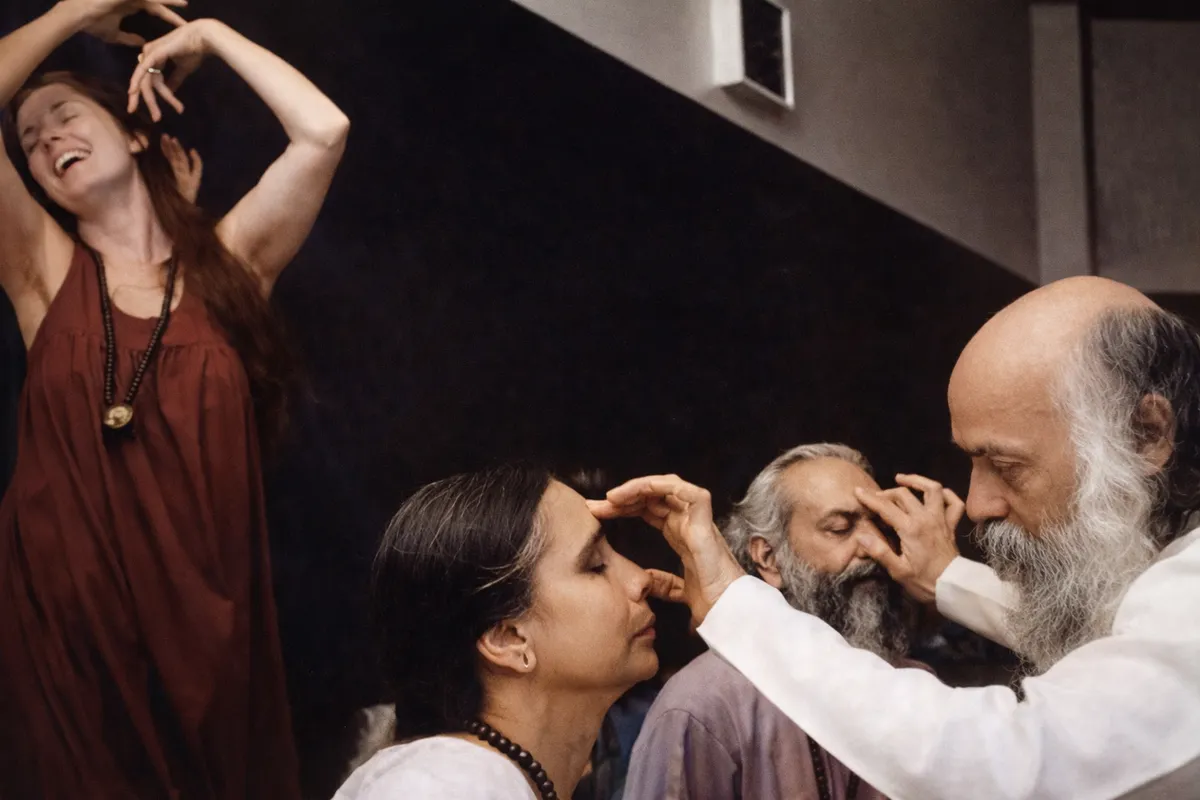
According to Osho, your seeking is the movement from blind enjoyment to its meaning: the higher, ultimate significance of life. Fully rejoice in life, but let that very fullness provoke the question, 'Is this all?' From that inquiry, guilt-free joy matures into awareness, discovering significance beyond pleasure and uniting celebration with understanding, not life-negation or mere hedonism.
You are looking for the deeper meaning behind having fun, so joy makes sense and is guided by awareness, not just more treats.
From the Discourses
Passages where Osho speaks to this question — each links to the complete discourse.
Beloved Osho, enjoying life seems to be the only thing I do, and I forget that I am a seeker. But when I think about it, a question arises: what am I seeking for?
Deva Charu, enjoying life is in itself a beautiful experience, but it is not enough. All the religions of the world have condemned it. Their condemnation has created a guilt feeling. So even though people are enjoying life, deep down they are feeling that they are doing something wrong, something they should not do. So their enjoyment remains halfhearted. They are in a deep split, a kind of schizophrenia. Part of them is pulling them away from the enjoyment and part of them is pulling them towards it. It becomes a very subtle tension. But according to me enjoying life in its totality and intensity is the very foundation of finding the higher and the ultimate significance of life. Enjoyment is blind, hence even if you are enjoying life, deep down a question remains: What is the significance of all this enjoyment? That's from where seeking arises: a desire to…
Osho, what, in truth, is the ultimate quest of a human being?
Or when you drink alcohol—what are you doing? You are saying, “This little awareness I have, O Lord, take it away from me. I cannot bear this awareness. Make me unconscious; take me back.” The old shore is pulling you. But whatever you do, you cannot become an animal again. There is no possibility of returning to the past. Travel backward does not happen. No matter how much the young man wishes to be a child again—he cannot. No matter how much the old man wishes to be young again—he cannot. No matter how much the dead wish to live again—now it cannot be. Where we have passed, we have passed. We will never go there again. Yet the longing persists. That is why people, though they become young and then old, still sing songs of childhood: “Ah, how lovely were those days!” This is foolishness. If childhood was beautiful,…
Question: BELOVED OSHO, WHAT DOES IT MEAN TO BE A SPIRITUAL SEEKER? Once this sleep has been broken, the dream has been broken and you become awakened to the reality that is here and now, just in the present. You are reborn. You come to ecstasy, to fulfillment, to all that has always been desired but never achieved. Spiritual seeking is to be here and now, and you can only be here and now when there is no desiring mind; otherwise the desiring mind will create wavering. Just like a pendulum, the mind goes either to the past, in the memory, or to the future, in desires, in dreams. But it is never here and now, it always misses the point of here and now. It just goes to the one extreme, the past, or to the other, the future.
It is not a difficult process because the process of looking is the same, just the object changes: you start turning your consciousness upon yourself. You may have seen many pictures of snakes swallowing their own tails. Those pictures are very ancient symbols of mystery schools; they represent this inner transformation. When your consciousness starts turning upon itself you become a circle, and the moment you are a circle you are no more the same old person. Your life starts having a new grace, a new beauty, a new beatitude. You become golden, you become precious. For the first time you have a contact with god, and that contact is a magical transformation. It is sheer magic and a miracle. Enjoy the trip, don't be too fixated on the target, Osho said in conclusion. Bliss is not a pond, it is a river. It is not static.
Osho, you say that getting lost in bhajan is an intoxication. You also say that if we seek joy in swimming, in play, in meditation, joy is lost—and that when we dissolve in them, joy itself finds us. Please clarify immersion, and the boundary-lines between awareness and unawareness.
Doing bhajan in order to get lost is intoxication; getting lost while doing bhajan is not intoxication. Let me repeat. It is a little intricate, subtle—but you will understand. To do bhajan so that you can get lost—only to get lost—is intoxication. There is anxiety in life, sorrow, pain, tension, restlessness, anguish. One wants to escape it, to forget it, to keep oneself busy anywhere so it is forgotten. Someone goes to the cinema and forgets for two hours; someone sits in a bar and forgets for two hours; someone goes to the temple and begins kirtan and forgets there. These are different methods of forgetting, but all three have the same aim—to forget anxiety. But when you return home, anxiety is waiting. You are the same as before; those two hours have gone to waste; nothing of substance has happened. Those two hours will not dissolve anxiety. Seeking to…