
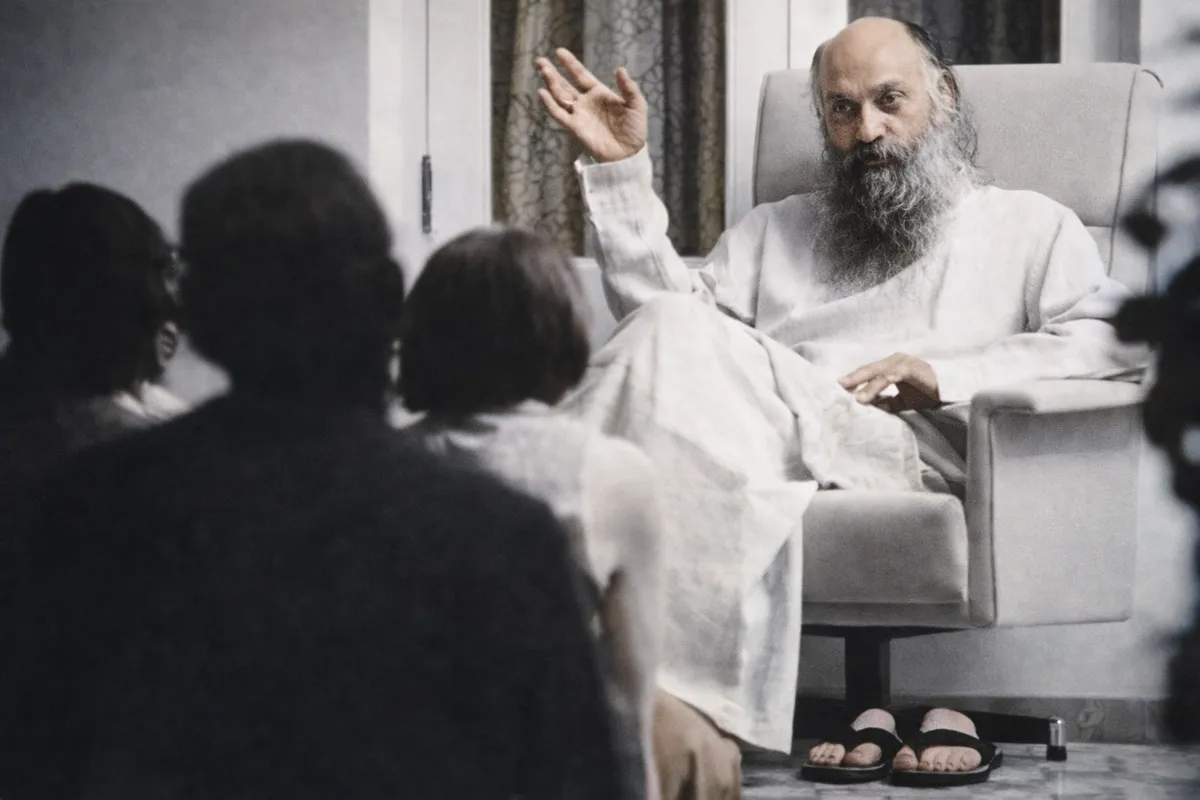
Helping because you “should” makes people feel bad and you expect payback; helping because you love feels good and asks for nothing.
From the Discourses
Passages where Osho speaks to this question — each links to the complete discourse.
It is not good to serve people out of a sense of duty?
It is related. No, not at all, it is ugly. When you do something only out of duty, without love, you are harming yourself and you are harming the other too. Because if you are not doing it out of love, you will feel that the other has to be grateful: you will feel that you have obliged the other. You will wait for a return; in fact, you will make a demand, gross or subtle, 'Now, you do something for me, I have done so much for you.' When you do something out of love, you do it without any idea of any return. It is not a bargain-you do it because you are happy doing it; the other is not obliged. Not that love is not returned -- love is returned a thousand-fold but only love is returned, never duty. In fact, if you are doing a duty…
Another friend has asked: Osho, what is the relationship between the method of meditation and jati-smaran (recollection of past lives)?
But the one who becomes skilled in this—who can fully awaken any day’s memory up to the age of five—will find that the memories begin to awaken completely. And you should test it. As today passes, note down some events and lock them up. After two years, try to recall today. Most of it will have been forgotten. Then remember—and after remembering, break the lock and compare whether what you recalled matches what you had written. You will be amazed—astonished—that besides what you wrote, many more details have come back which you did not even note at the time. They will all be there in memory. Buddha called this alaya-vijnana. There is a corner of the human mind he called the storehouse of consciousness. Like a junk room in the house where we keep all the odds and ends, there is a storehouse that collects memories—where everything from birth after…
The first youth who served the father was dutiful. A moral mind was working within. The beloved has died; one duty remains, which must be fulfilled. Duty and love are stark opposites. If you serve your mother because it is your duty—because she is your mother—your mother will never be satisfied. Because the meaning is clear: it is a burden. Duty is always a burden; it is not love. A mother wants love. If you served because you felt joy in serving, that would be different. Service would be your delight. But you serve because the other is in pain, because it is necessary. A duty to be done. A moral mind is at work; the feeling of the heart is gone. Pity and love are not synonyms. Love is a rare phenomenon. Pity is an ordinary thing. Any decent man can pity—and should. But pity is lifeless.
Osho, it has been said that the english made the best servants in the world. When you gave me my name you translated it as 'in service of love'. I know now that it can also be translated as 'the servant of love'. I have wondered about this. Sometimes it seems that I am most in service of love when I am most myself and not intending to serve. Otherwise it seems more like subservience and that I am suffering from the english cultural disease of politeness, servility and helpfulness. Will you please comment?
The question is from Ma Prem Dasi. PREM DASI actually means 'the servant of love'. But, while giving sannyas to her, I had knowingly translated it as 'in service of love'. The exact translation is 'the servant of love'. I translated it as 'in service of love' for a certain reason. I would like you to become more and more serving, but I should not like you to become servants. Servants don't serve, only masters serve; servants do their duty. Duty is a four-letter, ugly word. They have to do it; there is no beauty in it, there is no joy in it. So be in service, but never be a servant -- that is one thing. The second thing: when you become a servant, you learn habits. Service is an on-going process. To become a servant is to attain to a character, a dead character. People know you are…
Osho, I am amazed to see your tireless effort for the good of mankind. But people are asleep, and far from living the truth, they are not even ready to listen to the truth!
The Christian fakir spoke aptly: “Brother, keep falling—and instruct your children as well, keep falling. Do not build parapets on wells; where they exist, remove them. Our children too must go to heaven, after all. If you keep falling, we will keep serving. You become lepers and we will massage your feet. You fall ill and we will open hospitals. Do not listen to those who teach birth control; you keep producing children so that we may open schools and educate them. Otherwise what will happen to our heaven?” I do not teach you service. I teach you to live from your joy. Yes, if in the flow of your joy something happens—if you come near a well and see someone fallen in, and your very feeling of joy tells you to pull him out, causelessly—with no desire to go to heaven, no desire to see your name in the…