
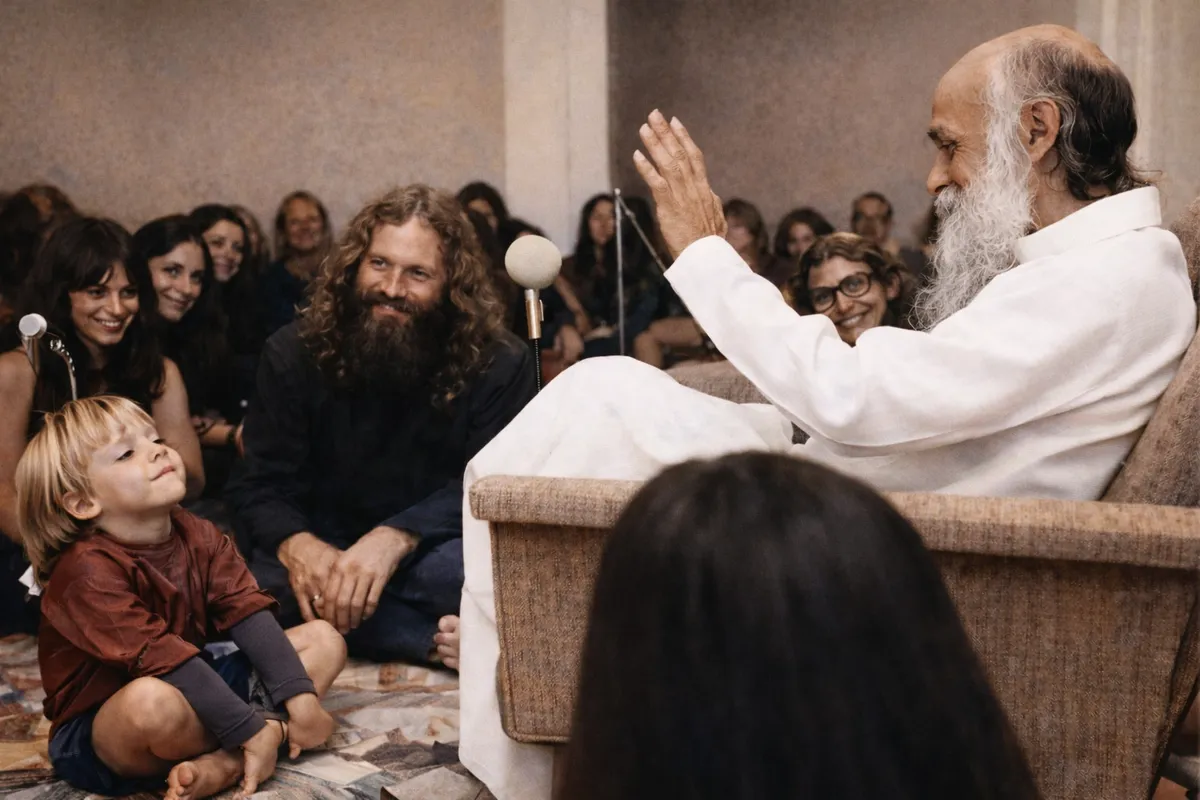
According to Osho, psychoanalysis isn’t entirely useless—it can relieve the guilt manufactured by religion—but it swings to the opposite extreme, making people proud of their neuroses and thus stagnant. Both condemnation (religion) and complacent acceptance (psychoanalysis) are wrong. The real way is guiltless awareness with a passionate urge to grow: accept your seed-nature yet evolve toward higher consciousness.
It can help by easing guilt, but if it makes you feel okay with not changing, you stop growing—drop guilt and keep evolving.
From the Discourses
Passages where Osho speaks to this question — each links to the complete discourse.
Is psychoanalysis really that useless?
No, not always. Sometimes it helps too. Meditate on this story. Felix Simons was a nice guy but a social flop. Although he was thirty-five, he had never conquered his childhood habit of bedwetting. Finally, one of his friends told him, 'Look, Felix, you might as well know the truth. We're all very fond of you, but nobody can stand to come into your house because it smells, and you're driving your wife up a wall. Why don't you see a psychiatrist about your problem? Enuresis is not too uncommon and it can be cured. Get it over with once and for all!' Felix was convinced. After six months of treatment he ran into the same friend. 'Well, Felix, did you take my advice?' 'Yes,' answered Felix, 'I've been seeing a psychiatrist three times a week for six months now.' 'Well, have you had any results?' 'Oh,' beamed Felix, 'great…
Beloved Osho, what does the revelation of the unconscious, as in psychoanalysis, bring to humanity -- according to you?
Jung had come to India in search of someone, to find out what the East has done to create so many people like Gautam Buddha -- not one but hundreds who have gone beyond mind and all its troubles and problems, worries, anxieties. What is the secret? He was going to universities, meeting psychoanalysts, and everywhere he was told, "You are wasting your time. These people are not the right people. These people have gone to the West to learn psychoanalysis and they are teaching psychoanalysis in the universities. You have come to search and seek somebody who is absolutely untouched by the West. And there is a man." And there was a man -- Shri Raman Maharshi. Wherever Jung went -- and he was there for three months -- everywhere the same name was given to him. "Go to Arunachal in South India and meet this man who is…
Beloved master, cannot psychoanalysis solve man's problems? Is religion really needed at all?
For example, in India, sex is taboo -- you should not talk about it -- but death is not taboo. You can talk about it; in fact, all the religious teachers talk about death. They make people so much afraid of death, talking again and again and again about it. They create so much fear in people that out of fear people start becoming religious. All Indian scriptures are full of the description of death. Death seems to be one of the most talked about subjects in India -- not sex. Sex is taboo. Sex is life, and if you choose death you cannot choose sex -- either/or. Freud did a great service to humanity; he brought sex from the dark corners of the soul into the open world. But immediately death became taboo; he himself became afraid of death. They are polar opposites, and the total man will be…
Can't psychoanalysis help people to know themselves? Is religion really necessary?
Sugeet, psychoanalysis can help a little bit, it can prepare the ground, but it cannot be a substitute for religion. In the West it is becoming a substitute for religion, and that is going to destroy something immensely beautiful. Religion is a totally different phenomenon from psychoanalysis. Religion is not analysis at all, religion is meditation. It is not thinking, it is not analysis. Psychoanalysis is concerned with the mind and helping the mind to become adjusted to society, to whatsoever is thought to be normal. It may be, it may not be. Usually the average is thought to be the normal, but the average is not necessarily the normal. The word normal comes from 'norm'; norm means the law. Normal is one who lives according to the law, the ultimate law, the ultimate norm. A Buddha is normal, a Jesus is normal, a Zarathustra is normal, a Bodhidharma is…
Question: BELOVED OSHO, LAST NIGHT I READ THIS QUOTE FROM KRISHNAMURTI: "ANALYSIS CANNOT LEAD TO UNDERSTANDING OR INSIGHT -- OBSERVATION AND NOT ANALYSIS!" THE FIRST YEARS RUNNING GROUPS HERE IN POONA, IT WAS MAINLY PROBLEM-ORIENTED. IT FELT LIKE A BIG CLEANUP. IN RANCHO RAJNEESH SOMEHOW I KNEW THERAPY WAS REALLY FINISHED, YET I DID NOT KNOW HOW TO BRING MEDITATION INTO THE GROUP ROOM. I WAS STILL FOCUSING ON THE DARK SIDE AND TOO SCARED TO REALLY MOVE INTO THE UNKNOWN. BEING HERE NOW, FOR THE FIRST TIME I GET A GLIMPSE THAT THROUGH MEDITATION, OBSERVING, AND SIMPLIFYING, EVERYTHING THAT IS IN THE WAY SLOWLY DISSOLVES BY ALLOWING THE LIGHTNESS TO SHINE WITHIN. AND WITHOUT DOING ANYTHING, SUDDENLY THE CLICK HAPPENS. EVERYTHING IS LIGHT AND PLAYFUL, AND WITH IT COMES AN INCREDIBLE FEELING OF PRECIOUSNESS AND GRATITUDE THAT WE CAN ALL BE HERE WITH YOU AT THIS TIME.