
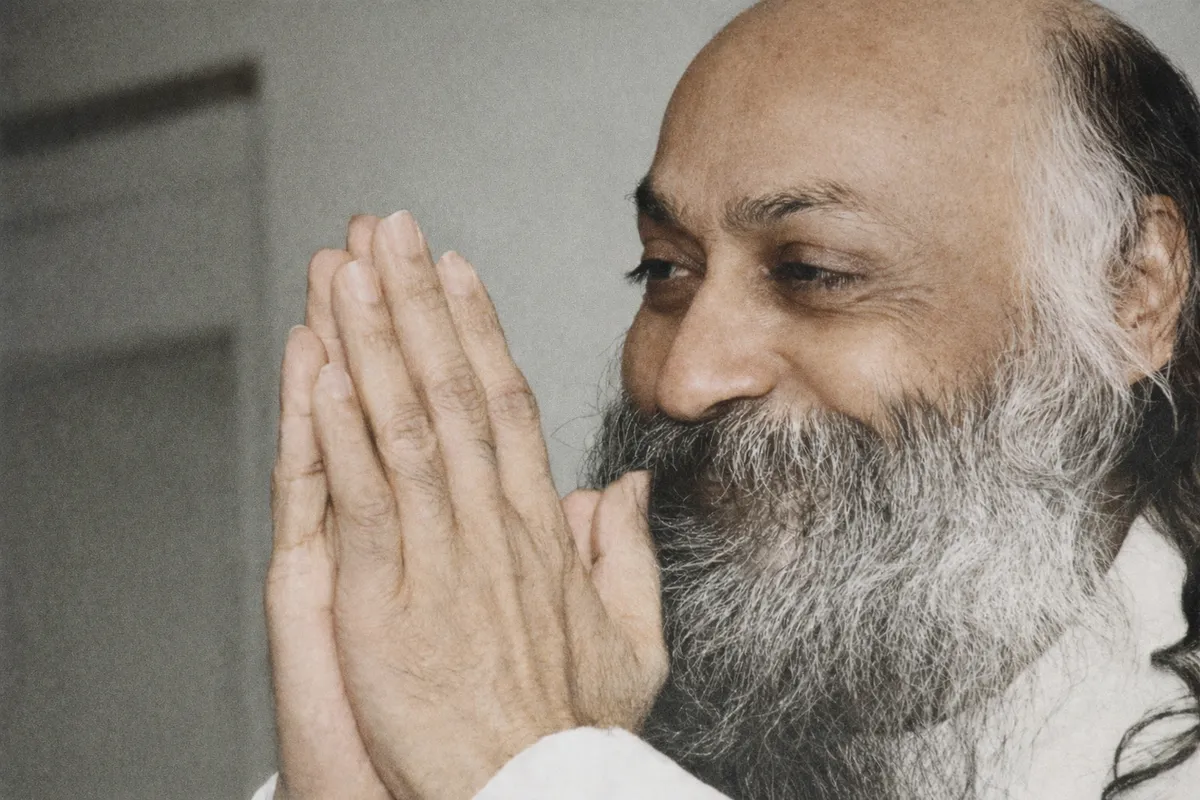
Yes—each disciple shares the master’s vision by becoming empty and quiet inside so his love and joy shine through you, not by joining groups or preaching rules.
From the Discourses
Passages where Osho speaks to this question — each links to the complete discourse.
You said that you don't "work" on people, so what is the meaning of having disciples?
A Master is just a presence, an encompassing present... Like a cloud he surrounds you. If you allow him, he enters to the deepest core of your being. Not that he enters! You simply allow... it happens. And in that moment when the disciple is allowing and the Master is present: a chemical change, better to call it alchemical, mutation -- the disciple also disappears, the same way as the Master has disappeared. The ego is no longer there. The disciple has also become a nondoer. Now he can function as a presence to others. He can be a Master. Sariputta, one of Buddha's disciples, one day entered into Buddha and allowed Buddha to enter in him. He became enlightened. Immediately, Buddha said, "Now, Sariputta, no need to hang around me. Now go. Go to the farthest corners of the country. Many people are thirsty. Now you have the water…
Beloved Osho, the master speaks, and the disciples listen. What is it that happens, and remains unsaid?
Yoga Chinmaya, the master speaks, the disciple listens -- yet there is much which the master does not speak, and the disciple listens. In fact, that is the whole secret of disciplehood. If you only listen to that which is said, you are a student. You listen to the words, you miss the wordless. The moment you start listening to the wordless, you are initiated into disciplehood. The master is speaking. Naturally he has to use words, but he is also leaving gaps in between. He is also using wordlessness. He is saying something, and he is also meaning something which cannot be said -- but it can be heard. If the disciple is silent, he will hear the words and he will also hear the wordlessness; he will hear what is being said, and he will hear also what is not being said and yet is transferred. You are…
A friend has asked: Osho, none among Buddha’s disciples rose to his stature. Among Christ’s disciples no second Christ was born. Mahavira’s disciples are just the opposite of him. In Krishna’s disciples too there is no Krishna. Do you still believe in the master–disciple tradition?
Yet Jesus was crucified—and that, paradoxically, became an advantage. Because of the crucifixion you remember him. Christianity was not born because of Jesus, but because of the cross. Had there been no crucifixion, Jesus would have been forgotten long ago. The cross became a mnemonic; his hanging on the cross became an event that overshadowed history. History has its own ways. But don’t imagine that among the disciples of Mahavira, Krishna, Christ, or Buddha none attained. Many did—each in his way. They reached exactly where the masters reached—but by their own routes. One reached dancing; another in silence; another by speaking. The ways differed. But whosoever can surrender near a buddha-like presence will certainly arrive. Surrender is the art of learning. Before a buddha-like presence you need the capacity to bow down completely. We have forgotten the art of bowing—that is why religion is fading from the world. A friend…
एक मित्र ने पूछा है कि ओशो, बुद्ध के शिष्यों में कोई भी उनकी श्रेणी का नहीं हुआ। क्राइस्ट के शिष्यों में भी कोई दूसरा क्राइस्ट नहीं बन सका। महावीर के शिष्य ठीक उनके विपरीत हैं। कृष्ण के शिष्यों में भी कोई कृष्ण नहीं है। क्या फिर भी आप गुरु-शिष्य प्रणाली पर विश्वास करते हैं?
लेकिन जीसस को सूली लग गई, यही एक फायदा रहा। सूली लगने की वजह से आपको याद रहे। जीसस की वजह से क्रिश्चियनिटी पैदा नहीं हुई, क्रास की वजह से पैदा हुई। अगर सूली न लगती, तो जीसस कभी के भूल गए होते। वह सूली याददाश्त बन गई। जीसस का सूली पर लटकना एक घटना हो गई; वह घटना इतिहास पर छा गई। इतिहास के अपने ढंग हैं। लेकिन इस खयाल में मत रहें कि महावीर, कृष्ण, क्राइस्ट, या बुद्ध के शिष्यों में कोई उनको उपलब्ध नहीं हुआ। हुआ; अपने ढंग से हुआ। ठीक उसी जगह पहुंच गया, जहां वे पहुंचे थे। लेकिन अपने ही ढंग से पहुंचा। कोई नाचता हुआ पहुंचा; कोई चुप होकर पहुंचा; कोई बोलकर पहुंचा। अपने-अपने ढंग थे। उन ढंगों में फर्क हैं। लेकिन बुद्ध जैसे व्यक्तित्व के पास जो भी समर्पित होने की सामर्थ्य रखता है, वह जरूर पहुंच जाएगा। समर्पण कला है, सीखने की। …
Beloved Osho, is it true that whatsoever the master says or does is simply a device to transform the disciple?
Gautam Buddha speaks; the same words have been repeated for twenty-five centuries by thousands of Buddhist monks, but those same words don't create the same impact. What is missing? If it was only the words, then whether Buddha speaks or Tom, Dick, Harry; whoever speaks, it makes no difference -- just a gramophone record, "His Master's Voice" -- the master is not there. But why don't those words create the same ringing of bells in your heart? When Jesus spoke, or Zarathustra spoke, the words were the same. Every day you use those words, but unless you have the experience your words are empty -- they may be scholarly, they may be that of a great pundit, they may be of a great rabbi. This word `rabbi' always reminds me of rubbish; I cannot get rid of that. They know the scriptures. Sometimes perhaps they are better orators than Krishna,…