
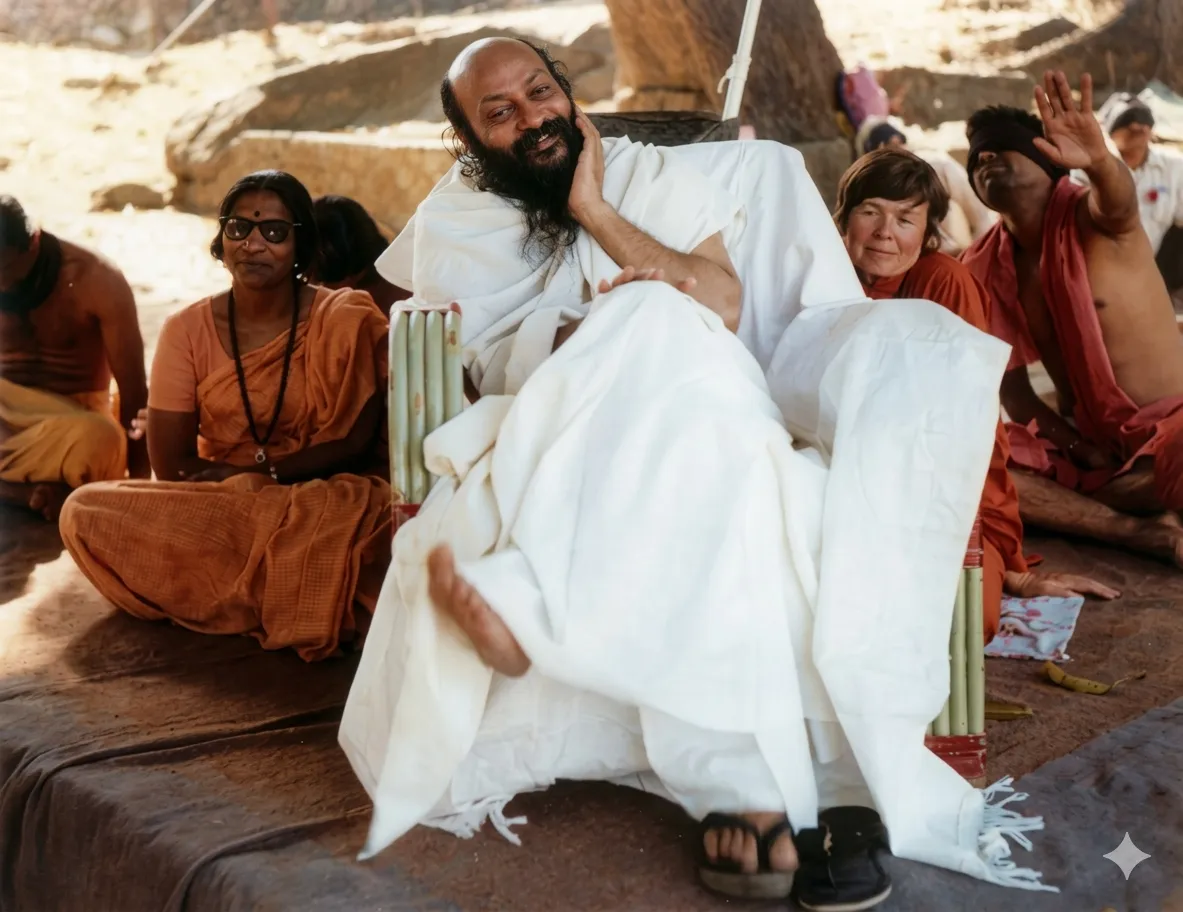
Real happiness has levels: hurting yourself is sick, enjoying a flower is healthy, and the highest joy is so full that old things drop away on their own.
From the Discourses
Passages where Osho speaks to this question — each links to the complete discourse.
Osho, just as you described gradations for renunciation—as more and more self-inflicted suffering—how would you describe gradations for enjoyment? Wouldn’t enjoyment be invisible?
Enjoyment is visible too. Enjoyment is visible too. Because we have reflected on renunciation, gradations appeared; if we reflect on enjoyment, gradations will appear as well. Enjoyment is visible too. It is visible who is how blissful, who is how serene, who draws how much delight from each thing. Understand it this way: a man is standing by a flower, by a rosebush. The man who is pricking his hand on the thorn is visible to us; then will the man who is breathing the fragrance of the flower not be visible? He will be visible too. But we have not looked! We have behaved as if a man becomes visible only when he pierces his hand on the thorn. Breathing the fragrance of the flower does not make him visible! Yet up to now we have honored the man who has pressed the rose’s thorn into his hand and…
Osho, you support the Upanishadic utterance “tena tyaktena bhunjīthāh”—first enjoyment, then renunciation. If one has to renounce anyway, why enjoy? Why bring in enjoyment at all?
But if you get hasty, half-baked, and say, “If one has to renounce, why enjoy?”—then how did it occur to you that you “have to” renounce? The thorn has not pricked you, so why think of removing it? You must have heard the words of one whose foot was pierced by a thorn—one who knew the pain, removed it, and knew the relief—some awakened one. You heard a Paltu, a Kabir, a Nanak, and borrowed their words. The thorn had pricked them, so there was pain; they removed it and found ease. You have not been pricked and you begin to remove a thorn that is not there—what will you remove? You will deceive yourself that there must be a thorn! A sick man takes medicine and becomes well; you, hearing of a sick man’s recovery, buy the medicine—being healthy, you will become ill. And this is what happened here.…
Osho, in the classical tradition the sannyasin turns away from māyā and sensual enjoyment and orients himself toward God-realization; yoga and bhoga are known to be mutually opposed. But in your sannyas there is no emphasis on dispassion from enjoyment. Therefore, kindly clarify your conception of sannyas!
So first thing: religion is not tradition. Religion is ever ancient and ever new. It is a paradox. It has always been—and yet each time it must be discovered anew. When the sun of religion rises, it is private, personal, not collective. It does not become society’s property or legacy. If you do not trust Buddha, Buddha has no way to make you trust. Have you thought about this? If you say, “We doubt you: you claim God-experience, but how are we to believe it?” Buddha will shrug his shoulders: “What can be done? What happened is private, personal. There is no way to spread it out on the table before you. It happened within; there is no device to bring it out. It happened so deep that it cannot be exhibited for all to see.” That is why there have been so many perfectly awakened ones, yet atheism has…
Thus every generation sows seeds of sadness in the next; with birth it leaves the seed of death; it poisons happiness and declares happiness a sin. The consequences are perilous. If I become incapable of savoring joy, only suffering remains; yet the mind does not consent to suffer—man is not made for suffering. Toward pain we have a deep resistance; toward pleasure, we are made to feel guilty. This inner tension becomes insoluble. And once a person begins to believe—even mistakenly—that joy is sin, he cannot tolerate others’ joy either. Hence, the saints and moralists have condemned anyone with a taste for happiness to hell. Those with even a small desire for joy are branded sinners. Religions made a strange proclamation: the man willing to endure suffering is religious; the one eager to inflict suffering on himself is great.
Osho, what is the definition of God?
Words are very small. If you say God is light, then what of darkness? The scriptures have said that God is light. Suppose we accept this as a definition—then what about darkness? Where will darkness go? Darkness is too; in fact it is far more than light. Light sometimes is and sometimes is not; darkness is always, eternal. Where will you place darkness? If you say God is light, darkness is left out. If you say God is darkness, then light is left out. If you say God is both darkness and light, a contradiction arises: they cannot be together. Try to have both darkness and light in the same room. If you bring in light, darkness disappears; if you preserve darkness, you cannot have light. Then how can both be together? That becomes an impossibility. So you cannot say “both” either. Then the fourth device is to say: it…