
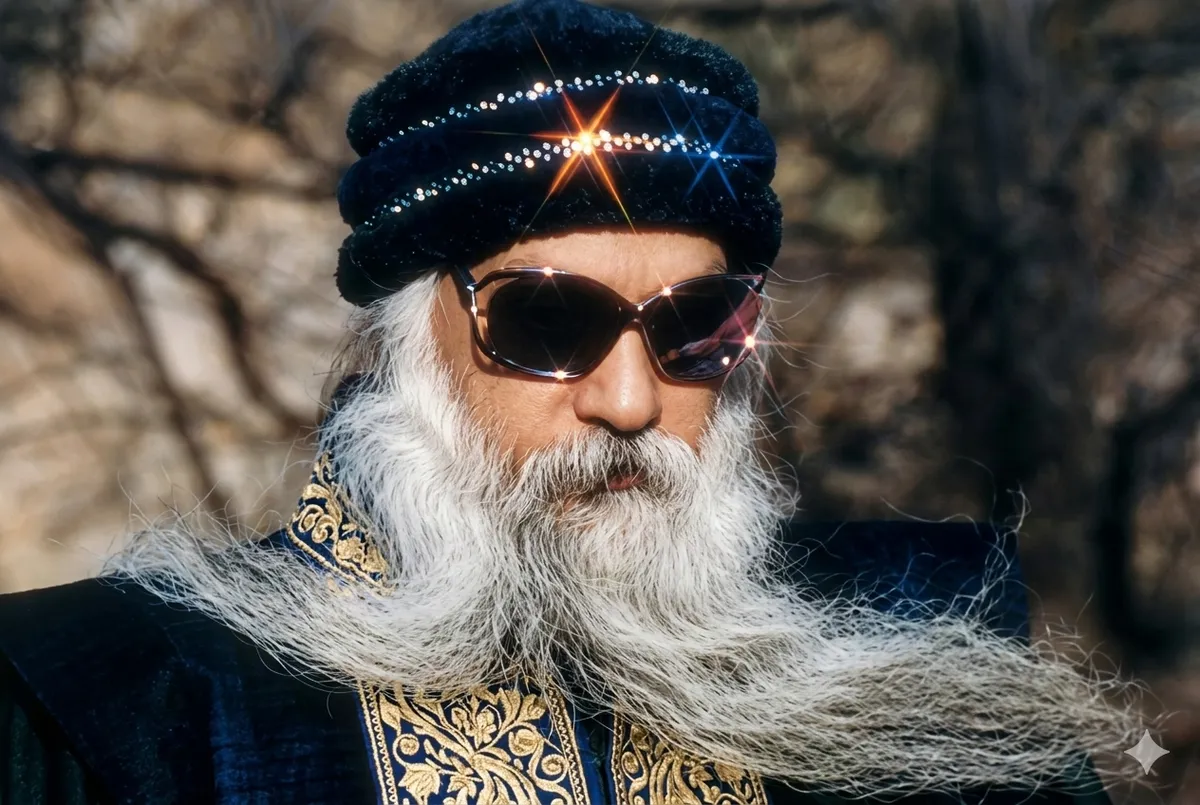
You can love many teachers; a real one won’t mind—only a possessive teacher makes it a problem.
From the Discourses
Passages where Osho speaks to this question — each links to the complete discourse.
Becoming a sannyasin is attractive. But now I am deeply involved with arica. I love oscar very much. The contradiction would be loving and serving two masters. How to resolve it?
As far as I am concerned there is no problem -- you should ask Oscar. I am not jealous. You can love me, and you can love a thousand and one Masters -- there is no problem. In fact, my whole effort here is to make you fall in love with Lao Tzu, Chuang Tzu, Lieh Tzu, Buddha, Krishna, Christ, Gurdjieff, Krishnamurti, Ramana. Ramakrishna -- a thousand and one. I am not jealous. I am vast, I can contain all your loves; so as far as I am concerned, there is no need to be worried. But before deciding anything, you should ask Oscar, because I have the feeling that he is jealous.
Jesus, buddha and t.d. Suzuki have been my masters for five years now. Whenever I had a problem I would call on jesus' name for help. Now you are my master. What can I do with the rest of them? Jesus says a man can only serve one master. He will either love one and hate the other, or hate the one and love the other. Please comment.
So, being with me should make you feel grateful to whomsoever you have been with before. And I am not saying that only about Krishnamurti, Jesus, Suzuki and people like that, I am saying it about even the ordinary people you have lived with the parents you were born to and the friends and enemies that you had and the teachers under which you studied in the school, college, university. They were all part of your growth. If a single one had been missing you would not have been here. So feel grateful to your parents, to your friends, to your enemies, to your Masters, to your teachers; feel grateful to all your relationships that have existed in the past -- because this is the culmination of them all. And don't ask such a question: NOW YOU ARE MY MASTER WHAT DO I DO WITH THE REST OF THEM? No,…
Osho. Only one master at a time.
And the door that you have fallen in love with is the golden door for you. Now there is no other door if you have fallen in love with this door. And you will find others entering from other doors but when you reach to the very centre of existence, you will all be meeting there in tremendous love and brotherhood. Somebody will be a Hasid and somebody will be a Zen monk and somebody will be a Tibetan lama and somebody will be a Sufi and somebody has come through sitting silently and somebody has come dancing -- but in deep brotherhood at the centre all seekers meet. I know it is very difficult. If you start choosing two Masters you will be in conflict. Never choose two Masters -- one is enough, more than enough. When Mulla Nasrudin was dying he called his son, told him to come…
Osho, true masters are different, and a follower of one master cannot accept another. But we find ourselves bowing to Buddha, Mahavira, Lao Tzu, Jesus, Krishna—everyone. Perhaps it is because you yourself have oriented us toward them. Even on seeing the living master Krishnamurti, our hearts overflowed with joy, our feet began to dance. Why? And we cannot understand why Krishnamurti’s lovers cannot accept you?
True masters are certainly different. Broadly, three kinds can be seen. First is the kind of master like Krishnamurti; Mahavira and Buddha belong to the same line. Such a master has one central message: become utterly free, do not depend on anyone. Your liberation lies in your freedom. Liberation is not a final event waiting at the end; you must learn freedom from the very first step—only then will it flower at the last. Krishnamurti’s famous book is The First and the Last Freedom: the first freedom is the last freedom; the very first step of freedom is already the last step. So: do not go into anyone’s refuge, do not surrender anywhere, do not bind yourself to any ideology; avoid belief. Mahavira called this the state of ashraya-shunyata—no refuge. Take no shelter. Buddha’s last message at the time of his death—Ananda asked for a final word to treasure forever—was:…
Osho, in the classical tradition the sannyasin turns away from māyā and sensual enjoyment and orients himself toward God-realization; yoga and bhoga are known to be mutually opposed. But in your sannyas there is no emphasis on dispassion from enjoyment. Therefore, kindly clarify your conception of sannyas!
So first thing: religion is not tradition. Religion is ever ancient and ever new. It is a paradox. It has always been—and yet each time it must be discovered anew. When the sun of religion rises, it is private, personal, not collective. It does not become society’s property or legacy. If you do not trust Buddha, Buddha has no way to make you trust. Have you thought about this? If you say, “We doubt you: you claim God-experience, but how are we to believe it?” Buddha will shrug his shoulders: “What can be done? What happened is private, personal. There is no way to spread it out on the table before you. It happened within; there is no device to bring it out. It happened so deep that it cannot be exhibited for all to see.” That is why there have been so many perfectly awakened ones, yet atheism has…