
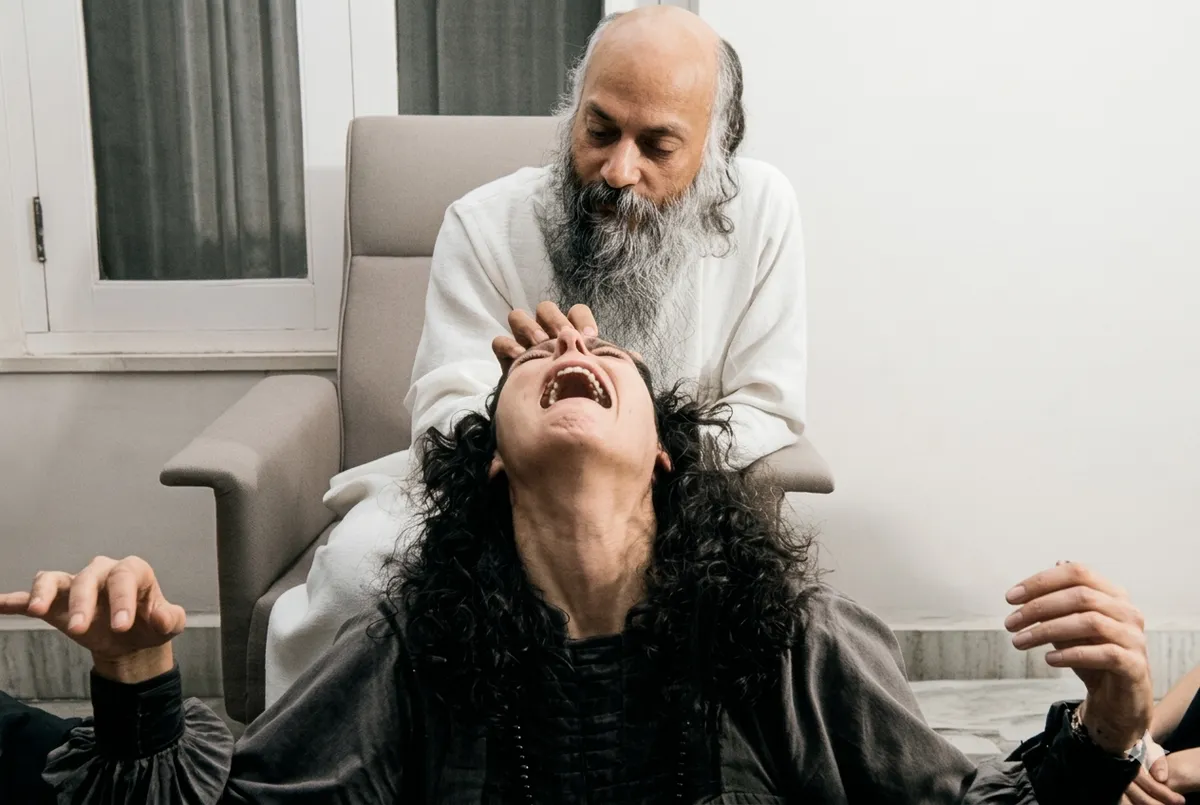
When you drop all thoughts and labels, what’s left can’t be called “me” or “the whole”—it’s just quiet, wordless being.
From the Discourses
Passages where Osho speaks to this question — each links to the complete discourse.
If the content is removed, does it become cosmic, or does it remain individual?
In truth, both these words of ours—“individual” and “cosmic”—belong to thought. What remains is neither individual nor cosmic; it is hard to say what it is. Because it is impossible to give it any concept; we have set aside all concepts. These two are merely ideas. On that level no thought has meaning. You cannot say it is personal, nor can you say it is impersonal. At that boundary, whatever is, cannot be named by any word. (The audio recording of the question is not clear.) This is inherent in all our thinking—if we try to think about it, this is bound to happen. Even calling it “cosmic” introduces a limitation.
हम इतने चिंतायुक्त हैं कि जो अंतर-धारा चिंता की चल रही है वह दिखाई नहीं पड़ रही है। और जब हम इस ऊपर की सतह पर शांत हो जाएंगे, तो अंतर-धारा बड़ी चिंता की चलती हुई मालूम होगी, जिससे घबड़ाहट होगी और लगेगा कि यह क्या हो रहा है। उस वक्त भी बिलकुल शिथिल होकर, उस वक्त भी चुपचाप साक्षीभाव रखना चाहिए। उस वक्त भी देखते रहना चाहिए, कुछ नहीं करना चाहिए। कुछ किया कि गड़बड़ शुरू हुई। (प्रश्न का ध्वनि-मुद्रण स्पष्ट नहीं है।) नहीं, कुछ भी मत करिए। नॉन-कोऑपरेशन करिए। किसी तरह का भी सहयोग मत दीजिए विचार को। चुपचाप बैठे देखिए और वे चले जाएंगे। विचार तो हैं, चल रहे हैं, लेकिन विचार अपने में शक्तिहीन हैं, जब तक कि मेरा उन्हें सहयोग न मिले, जब तक कि मैं उनको शक्ति न दूं। उनमें अपनी कोई शक्ति नहीं है। तो मुझे विचार से कुछ नहीं करना है, मैं जो शक्ति उसे देता हूं, वह भर नहीं देनी है। अभ्यास कुल इतना ही है कि मैं अपनी तरफ से शक्ति न दूं, वे आएं, आने दें; जाएं, जाने दें। …
Osho, is there any practical process for being in the realm of existence beyond thoughts, in the void?
The way to thin them out is non-cooperation. Right now we are their makers—that is, we are the ones maintaining them. When we sit idle, some thought or other is running, because without our cooperation they cannot run. Withdraw your cooperation from whatever thoughts are running, and do nothing else; regard just this as samayik, as meditation. If all thoughts dissolve, you will feel no ego and no person within. You will know only being—only being will be known, in which the distinction “I am an individual” or “I am the whole” will not be felt. Only pure being will remain—pure existence. In truth, because of the thoughts accumulated upon that pure existence, we appear to be a person. This sense that I am “A,” you are “B,” you are “C”—the A, B, C we have pasted on—is our thought-power. We commonly say, “I will become liberated”—this is not quite…
ओशो, क्या विचारों के पार अस्तित्व के जगत में, शून्य में होने की कोई व्यावहारिक प्रक्रिया है?
… जब खाली बैठते हैं तो कुछ न कुछ विचार चल रहे हैं। क्योंकि हमारे बिना सहयोग के वे चल नहीं सकते हैं। जो-जो विचार चल रहे हैं, उनसे सहयोग को खींच लें और कुछ न करें, बस इसी को सामायिक, इसी को ध्यान समझें। अगर सारे विचार विलीन हो जाएं तो आप में कोई ईगो, और कोई व्यक्ति नहीं मालूम होगा। आपको मालूम होगा केवल होना। केवल बीइंग मालूम होगा, जिसमें यह भेद मालूम नहीं होगा कि मैं व्यक्ति हूं या समष्टि हूं। केवल होना मात्र रह जाएगा। प्योर एक्झिस्टेंस मात्र होगा। वास्तव में उस प्योर एक्झिस्टेंस में जो विचार हमारे इकट्ठे हैं उन विचारों के कारण हम एक व्यक्ति मालूम होते हैं।
Is there still an individual body?
No. It only seems so to others. If I try to talk about it, to verbalize it, then the whole thing becomes a problem. Whenever we talk about what happens when one goes beyond meditation, it becomes a paradox. It can never be explained because any type of explanation will create new paradoxes, new contradictions. This fifth stage is an explosion of everything that has been. Now nothing remains. It is an explosion of the totality that you were: your memory, your intellect, your ego, your personality, your being, your soul. Everything that you were is now not; you just go beyond. There is no you; you become everything. That is the point of Brahman, cosmic consciousness. Dynamic Meditation can lead you only up to the fourth stage, satori. The fifth is beyond method. Guidance is possible only up to the fourth stage. That is why Krishnamurti talks of no-guidance.…
Osho, but in that knowing, Maharaj-ji, can there not be sameness—that as another has known, I may know the same? And may that sameness become available to me.
If you look very closely, such sameness is possible only if I am exactly as the other was. Otherwise it can never be. See the full implications: when I am knowing, my whole personality, my total being, is knowing. Only if your whole personality is exactly as mine, could the event of our knowing be one and the same. And no two persons are ever the same. In fact, forget persons—that is a far-off matter. Pick up a stone from a Delhi street; search the whole earth and you will not find another exactly like it. Pluck a flower from a garden; comb all the forests and you will not find another just like it. Here, each and every thing has its own uniqueness. And that very uniqueness is its soul. In my view, this uniqueness is its soul. A machine has no soul, because a machine is not unique.…
प्रश्न: ओशो, लेकिन उस जानने में महाराज जी, समानता तो हो सकती है, जैसा दूसरे ने जाना, वैसा ही मैं जानूं। और समानता मुझे उपलब्ध हो जाए।
यह जो, अगर बहुत गौर से देखेंगे: यह समानता तभी हो सकती है जब कि जैसा दूसरा था, वैसा ही मैं हूं। अन्यथा यह कभी नहीं हो सकती। अगर इसके पूरे इंप्लीकेशंस को समझेंगे, तो जब मैं जान रहा हूं तो मेरा पूरा व्यक्तित्व, मेरा टोटल बीइंग जान रहा है। और मेरा पूरा व्यक्तित्व, और अगर ठीक आपका पूरा व्यक्तित्व बिलकुल वैसा हो, जैसा मेरा है; तो हम दोनों के जानने की घटना एक ही हो सकती है। और व्यक्ति कभी दो एक जैसे नहीं हैं। व्यक्ति तो बहुत दूर की बात है, एक पत्थर उठा लें दिल्ली की सड़क का, तो सारी जमीन पर खोजने से ठीक वैसा दूसरा पत्थर हम नहीं खोज सकते। एक फूल एक बगिया में से चुन लें, और सारे जंगल छान डालें तो दूसरा फूल वैसा हम नहीं चुन सकते। यहां एक-एक चीज का अपना अनूठा होना है। और यह अनूठा होना ही उसकी आत्मा है। मेरे हिसाब में यह जो अनूठापन है, यह उसकी आत्मा है।
Therefore Buddha has been very difficult to understand. Because he says there is no Atman; he says there is no God; he says there is no Brahman. Then what remains is that which remains—that which remains. And what remains? Emptiness remains—shunya—without any boundary. Emptiness remains in which there is no wave of thought. Emptiness remains in which there is no center, no ego. Emptiness remains... one should say: nothing remains. This very losing of everything is the finding of everything. This is the ultimate, the last. Beyond this? There is no way beyond—for now there is no one left who could go beyond. From the cosmic unconscious, from the Brahman-unconscious, the leap that happens is into the void, into the Supreme, into Truth, into Mahanirvana, into Moksha—whatever name we may give. In truth, all names are futile. All language is futile.
इसलिए बुद्ध को समझना बहुत मुश्किल पड़ा है। क्योंकि वे कहते हैं, आत्मा भी नहीं है; वे कहते हैं, ईश्वर भी नहीं है; वे कहते हैं, ब्रह्म भी नहीं है। फिर जो बच जाता है वही है, दैट व्हिच रिमेंस। अब वह क्या बच जाता है? शून्य बच जाता है, जिसकी कोई सीमा नहीं है। शून्य बच जाता है, जिसमें कोई विचार की तरंग नहीं है। शून्य बच जाता है, जिसमें कोई सेंटर नहीं है, कोई ईगो नहीं है। शून्य बच जाता है... कहना चाहिए कुछ भी नहीं बच जाता है। यह जो सब-कुछ का खो जाना है, यही सब-कुछ का पाना भी है। यह परम है, यह आखिरी है। इसके पार? इसके पार का उपाय नहीं है। क्योंकि अब कुछ पार भी किसी के जा सको, वह भी नहीं बच जाता है। कॉस्मिक अनकांशस से, ब्रह्म-अचेतन से जो छलांग लगती है, वह शून्य में, परम में, सत्य में, महानिर्वाण में, मोक्ष में, जो भी हम नाम देना चाहें, दे सकते हैं। असल में, सब नाम व्यर्थ हैं। सब भाषा व्यर्थ है। इसमें बाधाएं, पहली बाधाएं तो हमारी अपनी हैं, इसलिए मैंने उसकी विस्तार से चर्चा की।