
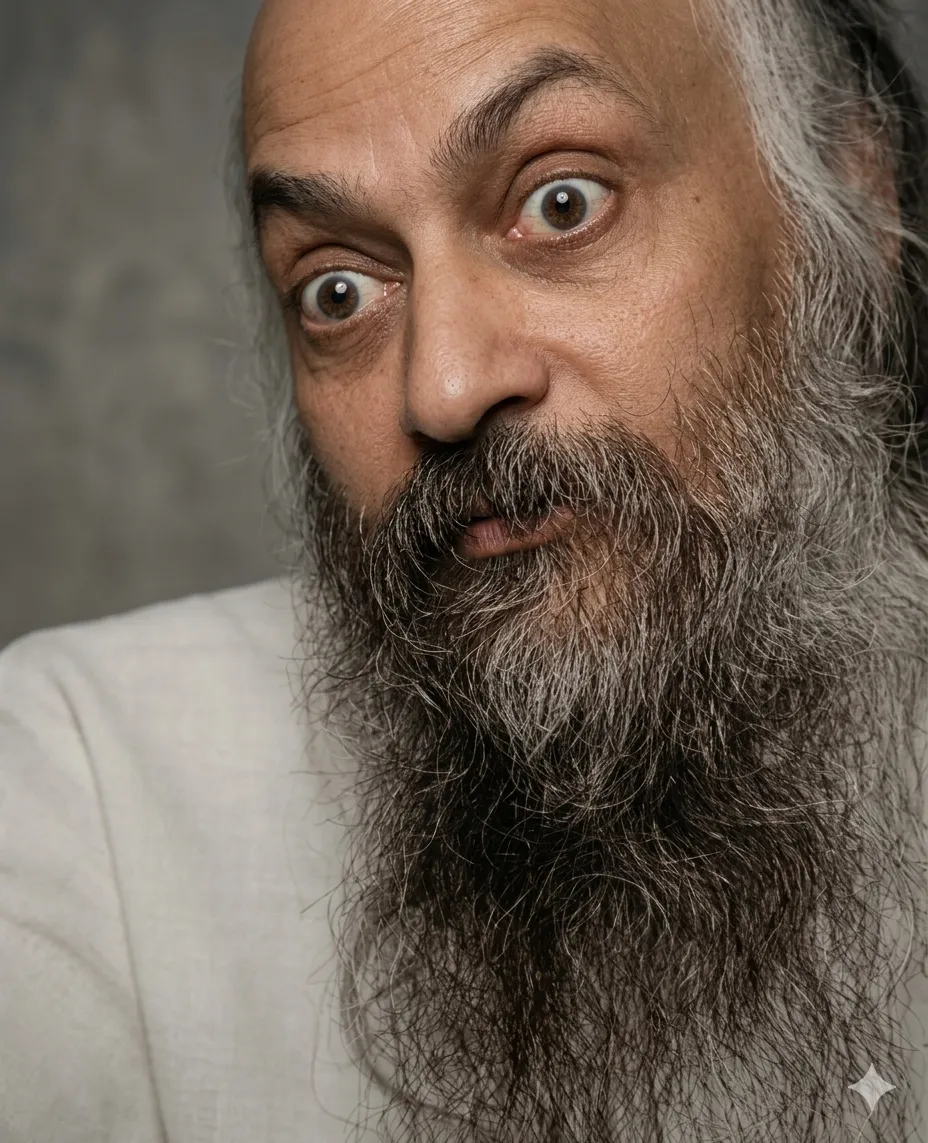
Yes—babies can see auras until they learn to talk, and adults can recover that clarity by quieting the mind through meditation.
From the Discourses
Passages where Osho speaks to this question — each links to the complete discourse.
Do babies see auras?
Yes, but only up to the time when they start talking. When a baby starts talking everything disappears. By talking a child becomes part of the society. When the baby is silent, nontalking, then the baby sees the same things that a saint sees, that an enlightened man sees exactly the same thing. The baby is almost a saint. But it remains only up to a point. If the baby is silent for six months, nine months, one year -- then up to that time, the baby will see the auras, will feel deeply. Once the baby starts talking, the baby is no longer there. The baby has entered into the world, the world of language, reason, mind. Then, by and by, those qualities disappear. In India we have a myth, and a very true thing is hidden in it. In India it is said that up to the sixth…
A white and small aura is visible just over your head. Why is not a colored one visible?
IT IS a colored one -- but all the colors are there, hence it looks white. White is not colorless. White is the presence of all the colors together. White is the most colorful thing in the world -- hence it looks white. When a white ray passes through a prism it divides into seven colors. That's how a rainbow is created in the rainy season. Small particles of water hanging in the air function as prisms. White rays of sun enter through those hanging particles of water and are divided into seven colors. If you mix all the colors in the right proportions, you will create white. White is all the colors together. I am not a Buddhist, I am not a Hindu, I am not a Christian, I am not a Jain, I am not a Mohammedan -- and I am all. All colors together! Hence white is…
Osho, in yesterday’s talk you said that a seeker should first be concerned with becoming a vessel, and should not go about begging from place to place. But the very meaning of a seeker is that he has obstacles in practice. He doesn’t know how to become a vessel, how to prepare. So if he does not go asking, what should he do? How difficult it is to meet the right guide!
But searching and begging are two different things. In fact, the one who does not want to search is the one who begs. Searching and begging are not the same; they are opposites. He who wants to avoid searching begs; a seeker never begs. And the processes of searching and begging are entirely different. In begging you have to keep your attention on the other—the one who will give. In searching you have to keep your attention on yourself—the one who is to receive. It is true that there are obstacles on the path of the seeker. But if we understand rightly, saying there are obstacles on the path of the seeker means the obstacles are within the seeker; the path too is within. And to understand one’s obstacles is not very difficult. So we will have to speak a little more extensively on what the obstacles are and how…
प्रश्न: ओशो, कल की चर्चा में आपने कहा कि साधक को पात्र बनने की पहले फिकर करनी चाहिए, जगह-जगह मांगने नहीं जाना चाहिए। लेकिन साधक अर्थात खोजी का अर्थ ही है कि उसे साधना में बाधाएं हैं। उसे पता नहीं है कि कैसे पात्र बने, कैसे तैयारी करे। तो वह मांगने न जाए तो क्या करे? सही मार्गदर्शक से मिलना कितना मुश्किल से हो पाता है!
लेकिन खोजना और मांगना दो अलग बातें हैं। असल में, जो खोजना नहीं चाहता वही मांगता है। खोजना और मांगना एक तो हैं ही नहीं, विपरीत बातें हैं। खोजने से जो बचना चाहता है वह मांगता है, खोजी कभी नहीं मांगता। और खोज और मांगने की प्रक्रिया बिलकुल अलग है। मांगने में दूसरे पर ध्यान रखना पड़ेगा--जिससे मिलेगा। और खोजने में अपने पर ध्यान रखना पड़ेगा--जिसको मिलेगा। यह तो ठीक है कि साधक के मार्ग पर बाधाएं हैं। लेकिन साधक के मार्ग पर बाधाएं हैं, अगर हम ठीक से समझें तो इसका मतलब होता है कि साधक के भीतर बाधाएं हैं; मार्ग भी भीतर है। और अपनी बाधाओं को समझ लेना बहुत कठिन नहीं है। तो इस संबंध में थोड़ी सी विस्तीर्ण बात करनी पड़ेगी कि बाधाएं क्या हैं और साधक उन्हें कैसे दूर कर सकेगा।
Osho, I keep meeting people who can see auras, and I feel I am missing. What can I do to share this sight?
Anand Buddha, God is not an experience. No experience as such is spiritual; all experiences are mind games. Beware of it. Whatsoever can be seen will be part of the illusory world. The seer is the truth, not the seen. You can see auras and you can see angels and you can see kundalini rising and you can see inner lights -- but they are all seen. They are not you. The seer is the witness, and only the witness is the truth. All else is a dream. And there are worldly dreams and there are other-worldly dreams; there are materialistic dreams and there are spiritualistic dreams. One thing has to be remembered always, that whatsoever is seen is worthless -- even if it is God. The God that is seen is worthless. When all experiences disappear and you are left utterly alone, nothing to see, only emptiness in the…
Osho, if an enlightened person cannot lose his buddhahood, how does a baby born as a buddha lose his?
Innocence plus consciousness is equal to Buddhahood. Innocence minus consciousness is equal to childhoodness. And how one can be conscious? The only way -- and let me emphasize -- the ONLY way is to lose it and gain it again. You ask me, Hajo: IF AN ENLIGHTENED PERSON CANNOT LOSE HIS BUDDHAHOOD, HOW DOES A BABY BORN AS A BUDDHA LOSE HIS? The enlightened person has lost it and found it. The baby has not lost it, and has not yet found it; he is born with it, oblivious of it. Hence you will see in the eyes of small children something of the saints, something of the same beauty; but also a deep ignorance. The innocence is there but full of ignorance. The saint is innocent but full of awareness, knowing. His innocence is not mixed with ignorance; it is wisdom. And the children are bound to lose their…