
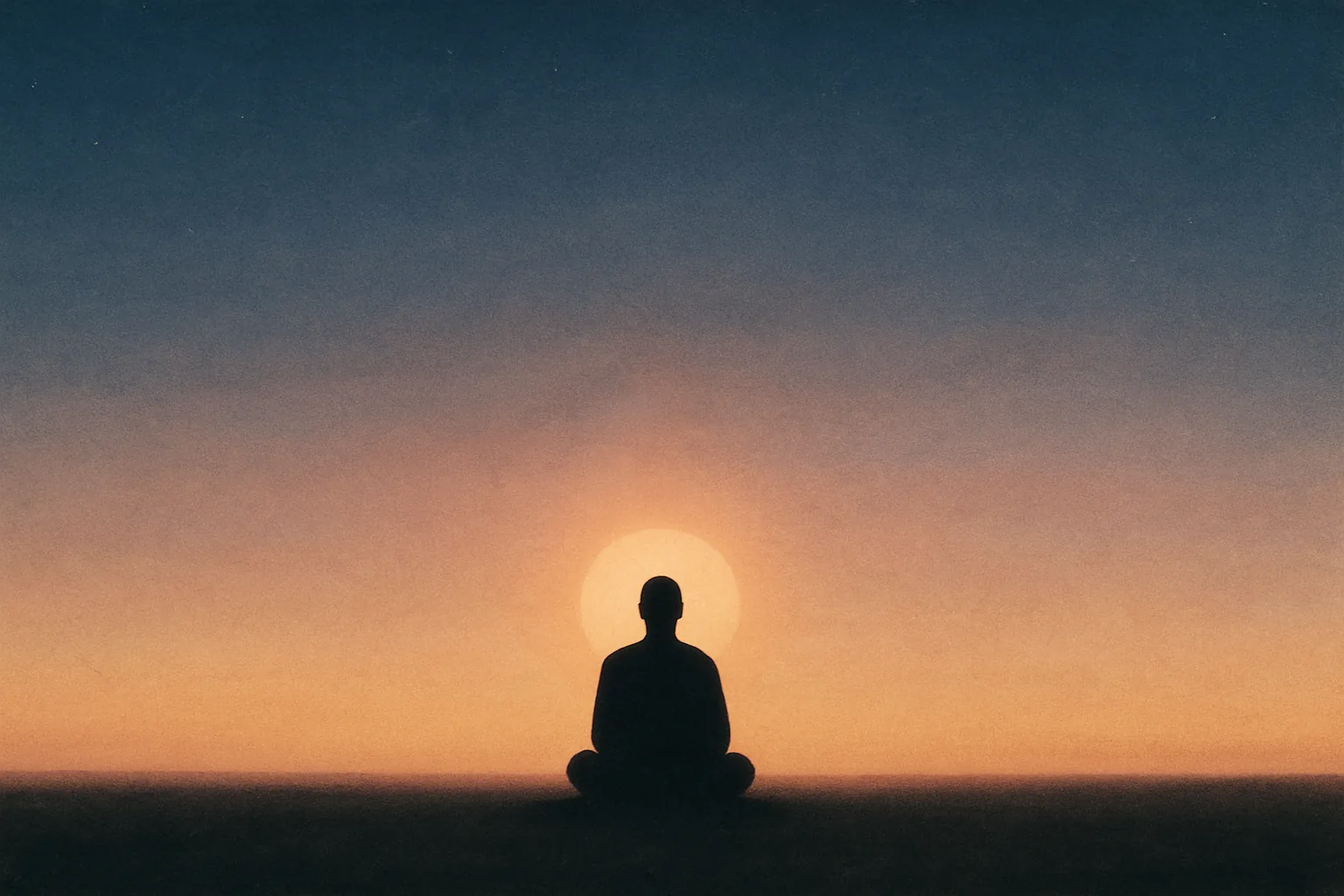
Nobody’s Copyright, Everybody’s Birthright is a Tantra meditation inspired by Osho’s insight that real meditation grows slowly, like trees at night, and belongs to everyone. There is no hurry here; eternity is the atmosphere. This method invites you to relax the fever of speed, say a total yes to existence, and allow silence, beauty, and gratitude to deepen on their own—“so slowly that you don’t know that you are moving at all.”
The meditation unfolds as an inner initiation: opening your doors and windows to the fresh breeze and the cleansing sun, letting the very word “no” drop from your vocabulary, and becoming one with your breath until blissfulness feels as natural as breathing. In four gentle stages, you rest, say yes, open, and silently grow—like a tree receiving light—until sannyas becomes a fragrance moving through your life, effortless as a fish in the sea.
Phase Instructions
First Stage: Unhurrying Into Silence (15 minutes)
Choose a quiet place. If possible, sit where fresh air can touch you—near an open window or beneath a tree. Sit comfortably with an upright, relaxed spine (chair or cushion), hands resting on your thighs, eyes closed. Let the world’s clocks fall away; there is nothing to achieve. Breathe naturally. With each exhale, feel any inner rush dissolving. Notice sensations, sounds, and thoughts without trying to change them. Simply witness. Allow the body to settle and the breath to find its own depth. Remember: existence does not believe in speed—only in slow, silent growth.
Second Stage: Saying Yes to Existence (15 minutes)
Place one hand on your heart. With every out-breath, softly whisper or feel the word “Yes.” Let the word “no” fall away—no argument with thoughts, no resistance to feelings. If a thought, memory, or sensation arises, meet it with a gentle, total “Yes,” and let it pass. On each inhale, receive; on each exhale, consent. After a few minutes, let the arms open slightly to the sides, palms forward, as if you are opening inner doors and windows. Sense a fresh breeze entering on the inhale and a warm cleansing sun flowing through you on the exhale. Allow trust to become simple and bodily—nothing forced, only yes.
Third Stage: Becoming the Tree (15 minutes)
Now sit utterly still. Imagine roots descending from your base deep into the earth—steady, nourishing, patient. Feel your spine as a trunk rising effortlessly; the crown of your head receives the sky. Let the breath be the sap that moves silently, almost imperceptibly. There is nowhere to go and infinite time to grow. If the mind asks for progress, smile inwardly and return to the felt sense of rooting and rising. Sense silence, beauty, and gratitude spreading like branches. Allow blissfulness to become part of your breathing—unhurrying, natural, your very climate.
Fourth Stage: Gratitude and Integration (15 minutes)
Keep the eyes closed. Bring both hands over the heart. Feel how saying yes has cleansed and opened you. Rest in simple gratitude—for the breath, for the body, for the space that holds you. For a few breaths, silently affirm: “Yes.” Let the attitude of sannyas—a total openness—permeate your whole field. In the last 3–5 minutes, gently lower the hands, let the breath be effortless, and sit in choiceless awareness. When you are ready, bow your head slightly, open your eyes softly, and remain unhurried as you stand or walk. Carry this yes into your day, moving like a fish in the sea of existence.
Core Benefits
- Encourages a slow, natural growth in meditation practice.
- Promotes relaxation and reduces the sense of urgency.
- Facilitates deepening of silence, beauty, and gratitude.
- Fosters a sense of unity with your breath and existence.
- Cultivates sannyas as a natural, effortless part of life.
What Osho Said About This Technique
He would not like to know the truth through others, he would like to experience it himself -- because unless you drink the water your thirst is not going to be quenched. Buddha may have drunk the whole Ganges -- that is not going to make any difference to you. Just a glass of water will do for you but you have to drink it. But people are so foolish that they go on worshipping Buddha and Krishna and Christ, and hoping that their thirst will be quenched they go on worshipping scriptures -- Dhammapada, Koran, Bible. It is like a thirsty man worshipping a book of chemistry which explain that water is H2O. You can go on worshipping the book; you will remain thirsty. You are simply proving yourself silly and nothing else. Or you can go on repeating the mantra "H2O, H2O, H2O...
It is saying that blissfulness is always young. The body may become old, the body may die, but bliss-fulness never dies. It never becomes old -- how can it die? It is impossible. Death never happens to blissfulness. In fact blissfulness is not part of time at all. Anything that is part of time is bound to become old sooner or later, because time always becomes past. It is always on the way towards the past. But bliss is part of eternity. So is now part of eternity. What I call meditation is nothing but being utterly herenow, putting the past aside, dropping all dreams of the future, abiding in the moment... and suddenly, the spring bursts forth, suddenly there are flowers and flowers in your being. Suddenly life has taken a quantum leap, from time to eternity, from the physical to the metaphysical, from the outer to the inner.
So my sannyas can be reduced to a simple definition: non-identification with any role you are playing, whatsoever it is. One can be a doctor or a businessman, one can be an engineer or a painter -- whatsoever role you are playing, remember it is a play. Don't get serious about it. Success and failure are the same when it is a play. Whether you succeed or fail does not matter; what matters is that you remained alert all the time. Success comes, you watch it; failure comes, you watch it. Life is there, you watch it; death comes, you watch it. Your whole work is to remain a witness to all that happens around you, within and without. This is the foundation for my sannyas. And the second thing to remember is: this witnessing is possible only if you slowly move into meditation.
(As Susana sits in front of Osho listening to the explanation of her new name, Anand Archano, her eyes close and her head slowly falls back. Moments later a tear plops off her cheek onto her lap.) I know only one prayer and that is being blissful. Nothing has to be said to god, one has simply to be blissful and all is said through one's bliss. People can pray but if they are sad, miserable, their prayer is only words, empty words with no content. If one is blissful then words are not needed at all; one can simply dance and sing or just sit silently, joyously -- and that's enough. That gratitude reaches to the ultimate source of light. So that is going to be your prayers no words but a silent joy pervading your whole being. -- How long will you be here? -- Forever.
Mahesh has the greatest number of temples. It shows one thing, that the East understood very correctly the beauty of destruction. To worship the god of destruction is to accept the fundamental of revolution . (The light your eyes perceive is not real illumination, Osho tells us.) It only reveals objects. It only reveals the superficial, it does not reveal the innermost core of things; the subjectivity remains unrevealed by it. The definition of true light is that which reveals your interiority -- and it is possible only through meditation. There is no other way to reveal your inner world, to make it full of light, to see what it is. And once you have seen your inner world you have seen everybody else's inner world too, because it is the same reality. If you have seen one rose flower you have seen all rose flowers.
Common Questions
It is inspired by Osho’s insight that meditation grows slowly and belongs to everyone.
It unfolds in four gentle stages: rest, say yes, open, and grow silently like a tree.
The atmosphere is one of eternity, with no hurry, allowing a natural, slow growth.
Participants are invited to let the word 'no' drop from their vocabulary.