
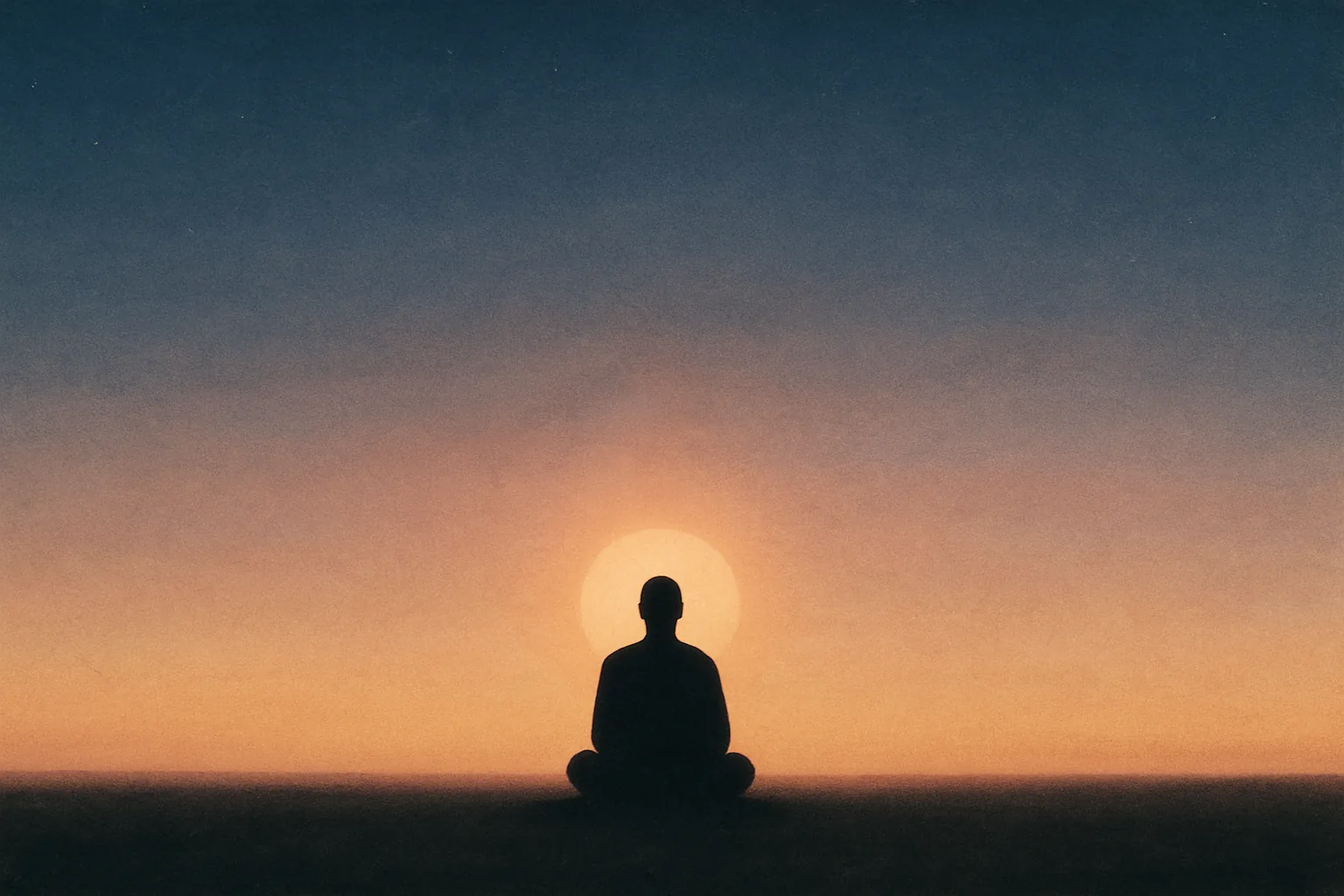
Energy Turning Inwards is a tantric arc from fullness to stillness: first you gather and celebrate your vitality until it overflows; then, in ripeness, that very overflow curls back upon itself and sinks into silence. In Osho’s poetic language, flowers come only when the tree is rich with sap; in the same way, meditation becomes effortless when your life-energy is abundant, playful, and unafraid. Rather than suppressing desire or disciplining the body into obedience, you allow energy to enjoy itself. From that joy, it naturally turns within and reveals the inner kingdom.
This meditation is inspired by Osho’s discourse imagery—the rebel intelligence that refuses lifeless goodness, the parable of the shepherd who brings the wandering one home, and the insight that compassion, intelligence, and meditation are flowerings of affluence in being. You first nourish, shake, and dance to free the energy; then you let awareness pivot inward, gathering the “one that went astray”—your scattered attention—back to the source at the navel/heart. The result is a felt shift from weakness to strength, from effort to effortless witnessing.
Phase Instructions
First Stage: Prepare and Nourish
Choose a quiet space where you can move and then sit undisturbed. Make the body comfortable—use loose clothing, sip water if needed, and ensure basic needs are met so the body does not keep calling you back. Stand with feet hip-width apart, knees soft, jaw relaxed. Close the eyes or keep a soft downward gaze. Set a simple intent: “Let my energy become full and turn inward on its own.”
Second Stage: Gather Energy with Breath and Subtle Movement
Begin breathing through the nose into the belly; let the abdomen expand on the in-breath and soften on the out-breath. Let exhalations be a little longer than inhalations, releasing any stale tension. Add gentle shaking: allow ankles, knees, hips, shoulders, and wrists to tremble lightly, as if dusting the body from the inside. Let the face loosen; sigh or hum if it comes. Feel warmth in the belly (navel center) and a quiet glow along the spine. Do not force; allow energy to wake up by itself.
Third Stage: Overflow and Celebration
Let the shaking blossom into free movement or dance. Follow whatever the body wants—slow circles, swift sways, stillness punctuated by bursts—without choreography or judgment. Keep attention rooted in the belly and heart so movement is born from the core, not from the head. Sense energy becoming a surplus, like a river rising to its banks. Let it enjoy itself: smile from the navel, let the chest open, hands trace the air. If sound arises—humming, toning, a soft ‘ahh’—allow it. The only rule: remain aware while you celebrate.
Fourth Stage: Turning the Stream Inward
Gradually let movement come to stillness and sit upright, spine at ease, chin slightly tucked. Keep eyes closed. Without suppressing anything, withdraw interest from outer sensations as if dimming the room from within. Now, with each inhalation, feel energy gathering at the navel and rising gently up the spine; with each exhalation, feel it shower into the heart, spreading warmth in the chest. If attention wanders, use a simple image: the shepherd within brings the one wandering sheep (your scattered energy) back to the fold (your center). Let all doing subside into sensing—a soft current turning back to its source.
Fifth Stage: Rest in the Inner Kingdom
Remain unmoving and simply witness. Let breath find its own rhythm. Notice the after-glow of movement and the inward curve of attention. Thoughts may pass like distant traffic—do nothing about them. Rest as the one who knows, not as the known. If gratitude appears, allow it to spread through the body. When you feel complete, lie down for a few minutes, eyes closed, and let the practice dissolve by itself before opening the eyes.
Core Benefits
- Effortless meditation from abundance of life-energy.
- Transformation from weakness to strength.
- Shift from effort to effortless witnessing.
- Natural turning inward of energy.
- Revealing of the inner kingdom through joy.
What Osho Said About This Technique
Tantra says man has to make an effort to take it out, but to take ;t within man has to be effortless. One has to make many efforts to take it out because it is unnatural to be in, while no effort is necessary to take it within. There is only one way to take it within and that is, to give up the efforts which take it outwards. But both the pleasure seeker and the renouncer fight against it outside. One pushes energy outward, the other draws it within. He pushes it out as much as he draws it within. Energy tries to go within as much as it is pushed out. Just as a ball dashed against a wall returns to you, similarly our conflict with energy leads us to absurdities.
Osho, in the Nargol camp you said that through intense breathing and the effort of asking “Who am I?” one must tire oneself completely so that entry into deep meditation becomes possible. But to enter meditation extra energy is needed; then how can one enter meditation through the energy-depletion of fatigue?
No, no—fatigue does not mean being without energy. In truth, when you tire yourself out—what do I mean by “yourself”? By “yourself” I mean those doors and gateways, those senses through which your energy flows in its daily routine—the setup that you are right now, the you that you presently are. I am not talking about the you that you can become. So when you tire yourself out, two simultaneous events occur. On the one hand, as you exhaust yourself, all your senses, your mind, your body get tired. They refuse to carry any kind of energy; they decline. In fatigue you show no readiness to bear any energy; you say, “I’m tired right now.” Thus this experiment tires your body, your mind, your senses; and at the same time it strikes your kundalini—there energy is stirred. Here you tire; there energy awakens—both happen together. Do you follow? They happen…
प्रश्न: ओशो, नारगोल शिविर में आपने कहा है कि तीव्र श्वास-प्रश्वास और ‘मैं कौन हूं’ पूछने के प्रयत्न से अपने को पूरी तरह से थका डालना है ताकि गहरे ध्यान में प्रवेश संभव हो सके। लेकिन ध्यान में प्रवेश के लिए अतिरिक्त ऊर्जा चाहिए, तो थकान की ऊर्जा-क्षीणता से ध्यान में प्रवेश कैसे संभव होगा?
नहीं-नहीं, थकान का मतलब ऊर्जाहीनता नहीं है। असल में, जब तुम अपने को थका डालते हो.‘अपने’ से मतलब क्या? ‘अपने’ से मतलब तुम्हारे वे द्वार-दरवाजे, तुम्हारी वे इंद्रियां, जिनसे तुम्हारी ऊर्जा के बहने का दैनिक क्रम है--तुम्हारा जो संस्थान है, तुम अभी जो हो। उस तुम की बात नहीं कर रहा जो तुम हो सकते हो। जो तुम हो। तो जब तुम अपने को थका डालते हो, तो दोहरी घटनाएं घटती हैं। इधर तुम अपने को थका डालते हो, तो तुम्हारी सारी इंद्रियां, तुम्हारा मन, तुम्हारा शरीर थक जाता है। और किसी तरह की ऊर्जा को वहन करने के लिए तैयार नहीं होता, इनकार कर देता है। थकान में तुम किसी तरह की ऊर्जा को वहन करने की तैयारी नहीं दिखलाते; तुम कहते हो, अभी मैं थका हूं। तो एक तरफ तो यह प्रयोग तुम्हारे शरीर को, तुम्हारे मन को, तुम्हारी इंद्रियों को थकाता है, और दूसरी तरफ तुम्हारी कुंडलिनी पर चोट करता है; वहां से ऊर्जा जगती है और यहां से तुम थकते हो--यह दोनों एक साथ चलता है। समझे न! …
The tao, the undivided, great one, gives rise to two opposite reality principles, the dark and the light, yin and yang. From yin comes the receptive feminine principle; from yang comes the creative masculine principle; from yin comes ming, life; from yang, hsing or human nature.
EACH INDIVIDUAL CONTAINS A CENTRAL MONAD, WHICH, AT THE MOMENT OF CONCEPTION, SPLITS INTO LIFE AND HUMAN NATURE, MING AND HSING. IN THE PERSONAL BODILY EXISTENCE OF THE INDIVIDUAL THEY ARE REPRESENTED BY TWO OTHER POLARITIES, ANIMA AND ANIMUS. ALL DURING THE LIFE OF THE INDIVIDUAL THESE TWO ARE IN CONFLICT, EACH STRIVING FOR MASTERY. IF THE LIFE-ENERGY FLOWS DOWNWARD, THAT IS, WITHOUT LET OR HINDRANCE INTO THE OUTER WORLD, THE ANIMA IS VICTORIOUS OVER THE ANIMUS; NO GOLDEN FLOWER IS DEVELOPED. IF THE LIFE-ENERGY IS LED THROUGH THE 'BACKWARD-FLOWING' PROCESS, THAT IS, CONSERVED, AND MADE TO 'RISE' INSTEAD OF ALLOWED TO DISSIPATE, THE ANIMUS HAS BEEN VICTORIOUS. A MAN WHO HOLDS TO THE WAY OF CONSERVATION ALL THROUGH LIFE MAY REACH THE STAGE OF THE GOLDEN FLOWER, WHICH THEN FREES THE EGO FROM THE CONFLICT OF THE OPPOSITES, AND IT AGAIN BECOMES PART OF THE TAO, THE UNDIVIDED, GREAT…
Tantra says: do not suppress—see, know, recognize. Escape this dual conflict. This duality is false. Neither praise nor condemn. Because if you praise now, after a little while you will condemn; as day follows night and night follows day, praise follows condemnation and condemnation follows praise—their wheel keeps turning. Tantra says: see that both are futile. See energy neutrally—neutral. Indeed, all energy is neutral: neither auspicious nor inauspicious, neither to be renounced nor to be indulged. If one could look at one’s life-energy saved from this double conflict, what would be the result? Tantra says: the very moment someone sees life-energy as energy—as just energy—without valuation, without evaluation, in that very moment the energy becomes still. It neither goes forward nor backward; neither outward nor inward. Because we send energy: praise drives it outward, condemnation drives it inward.
तंत्र कहता है, दमन मत करो, देखो, जानो, पहचानो। इस दोनों के द्वंद्व से बचो। यह द्वैत गलत है। न तो प्रशंसा करो, न निंदा करो। क्योंकि अभी प्रशंसा करोगे तो थोड़ी देर बाद निंदा करोगे। जैसे दिन के पीछे रात और रात के पीछे दिन, ऐसे ही प्रशंसा के पीछे निंदा और निंदा के पीछे प्रशंसा उनका वर्तुल घूम रहा है। तो तंत्र कहता है, तुम देखो कि दोनों ही व्यर्थ हैं। ऊर्जा को तटस्थ देखो, न्यूट्रल। है भी, समस्त ऊर्जा तटस्थ है। न शुभ है, न अशुभ है। न त्यागने योग्य है, न भोगने योग्य है। अगर कोई व्यक्ति अपनी जीवन-ऊर्जा को इस दोहरे द्वंद्व से बचा कर देख पाए, तो क्या परिणाम होगा? तो तंत्र कहता है, जैसे ही जीवन-ऊर्जा को कोई ऊर्जा की भांति, जस्ट ए़ज एनर्जी, बिना किसी वैल्युएशन के, बिना किसी मूल्यांकन के देखता है, वैसे ही ऊर्जा ठहर जाती है। न तो वह आगे की तरफ जाती है, न वह पीछे की तरफ जाती है। न वह बाहर की तरफ जाती है, न वह भीतर की तरफ जाती है। …
At the start of sexual union keep attentive on the fire in the beginning, and so continuing, avoid the embers in the end.
WHEN IN SUCH EMBRACE YOUR SENSES ARE SHAKEN AS LEAVES, ENTER THIS SHAKING. EVEN REMEMBERING UNION, WITHOUT THE EMBRACE, TRANSFORMATION. ON JOYOUSLY SEEING A LONG ABSENT FRIEND, PERMEATE THIS JOY. WHEN EATING OR DRINKING, BECOME THE TASTE OF FOOD OR DRINK, AND BE FILLED. ... Once you know this, even the partner is not needed. You can simply remember the act and enter into it. But first you must have the feeling. If you know the feeling, you can enter into the act without the partner. This is a little difficult, but it happens. And unless it happens, you go on being dependent, a dependency is created. For so many reasons it happens. If you have had the feeling, if you have known the moment when you were not there but only a vibrating energy had become one and there was a circle with the partner, in that moment there was
Common Questions
You first nourish, shake, and dance to free the energy.
It is inspired by Osho's discourse imagery of an affluent being through compassion, intelligence, and meditation.
Flowers come only when the tree is rich with sap, just as meditation becomes effortless with abundant life-energy.
It gathers the 'one that went astray'—your scattered attention—back to the source at the navel/heart.
It allows energy to enjoy itself instead of suppressing desire or disciplining the body into obedience.