
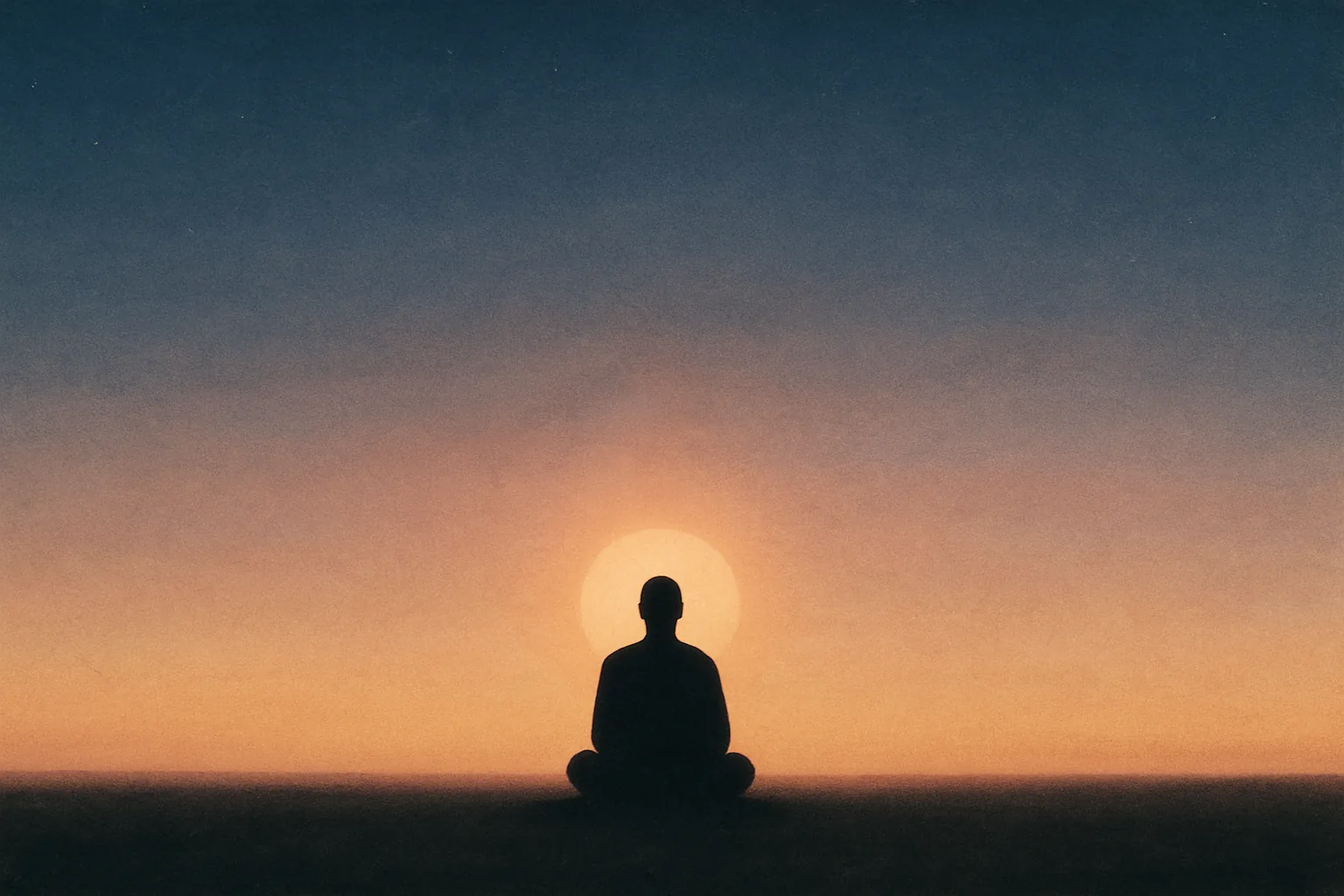
Meditation in the Marketplace is Osho’s insistence that true meditation matures in the storms of ordinary life, not in escape from it. Drawing on Lu-tsu’s teaching of the “circulation of the light,” this method invites you to accept your present circumstances as a precise, compassionate field given by existence for your growth. When occupations arrive, receive them; when situations press in, understand them from the ground up. In this way, the inner light is not scattered by outer things but begins to circulate by its own law.
The practice orients you to your inner center at dawn and again before sleep, so that throughout the day you can act without becoming the doer—responding like a clear reflex, without admixture of thoughts about yourself or others. You move through the marketplace like a lotus leaf in water: surrounded, touched, yet untouched. This is not renunciation but ripening; in such watchfulness the noise of the world recedes into a distant echo, integrity crystallizes, and one day the whole existence seems to celebrate as you find yourself at home within.
Phase Instructions
First Stage: Morning Orientation to the Center
At first light, before the day begins, sit comfortably with spine at ease and eyes closed or gently lowered. Breathe naturally. Let attention settle inward until a quiet, steady center is felt—no need to choose a place in the body; simply notice the most silent point within and rest there. Watch thoughts, feelings, and body sensations come and go without involvement; do not push anything away and do not follow anything. Sense that by mere watchfulness, an inner brightness gathers and begins to circulate on its own. Let a simple remembrance form: through the coming day, remain close to this center. Open your eyes softly, stand up, and carry this thread of witnessing into activity.
Second Stage: Marketplace Practice—Witnessing in Action
Enter your day exactly as it is, accepting your occupations as the right field for growth. In each situation, take clear note of what is needed and do precisely that—no more, no less. Act like a clean reflex: responsive, efficient, and free of the extra weight of thinking about yourself or others. While acting, do not become the doer; let the action happen and be finished with it, without clinging to results. Keep a slender thread of attention resting at the inner center, as if you dwell a step back from the scene. Use disturbances as reminders to deepen witnessing: notice a surge of emotion or noise, feel it fully, and remain untouched—like a lotus leaf in water. If you forget and get entangled, simply recognize the moment of forgetting and return to the center without judgment. Behave objectively, handle what is before you with correct thought and clear perception, and allow the inner light to circulate by its own law even amidst traffic, meetings, and chores.
Third Stage: Night Reorientation—Sleep in the Light
Before bed, dim the lights and sit or lie quietly. Let the day play back for a few moments as passing images; do not evaluate, defend, or condemn—only witness. Gather attention again at the inner center, as in the morning. Feel how, in simple watchfulness, agitation subsides and a gentle brightness pervades. Rest as the witness and let this remembrance accompany you into dreams and deep sleep, so that even in unconsciousness you remain closer to the center. Release the day completely and drift to sleep within the circulation of the light.
Core Benefits
- Meditation matures in the ordinary storms of life, not in escape.
- The inner light circulates by its own law despite external circumstances.
- Acts can be performed without becoming the doer, like a clear reflex.
- Maintains a state of being surrounded, touched, yet untouched.
- Integrity crystallizes and presence feels at home within existence.
What Osho Said About This Technique
In 1969 followers of the Maharishi Mahesh Yogi invited Osho to talk to them. This was the first occasion on which Osho addressed a western audience, and the first time he talked publicly at length in English. The discourse has been published in OTI January 1 & 16, 1991; and February 1, 1991. Osho: Really, there can be no method as far as meditation is concerned. Meditation is not a method. Through technique, through method, you cannot go beyond mind. When you leave all methods, all techniques, you transcend mind. So meditation itself is not a method. Truth cannot be achieved through method. Method is our own invention. We, who are ignorant, have achieved knowledge through methods constructed, created, projected, in our ignorance. Through method you can achieve a sort of self-hypnosis, a sort of auto-hypnosis. Any method, whatsoever it's name, can only give you an illusory kind of peace.
Osho, to abide in oneself beyond the knower, knowledge, and the known—can one live in that state for an entire lifetime? Just as a lake is sometimes calm, sometimes playful, and sometimes stormy, does the self-realized one remain unaffected by worldly circumstances in the same way? Osho, dispel my ignorance!
Spring means harmony between season and mood. Meditation means harmony between you and the whole. You become harmonious. Whatever is, is perfectly okay—accepted. Nowhere any refusal, nowhere any opposition. Whatever is happening is auspicious. That is trust; that is meditation. Such meditation naturally takes you into an altogether new experience. Storms will rise; they will not stop because you meditate. Diseases will not stop coming to the body because you meditate. They will come. A thorn will sometimes pierce the foot. Raman had cancer; so did Ramakrishna—great storms came! Ramakrishna got cancer of the throat; he could neither eat nor drink. Vivekananda said to him, “What is not in your power! Why don’t you pray to the Lord at least to allow food and water to pass? We suffer watching you writhe.” Ramakrishna said, “Ah, it never even occurred to me to pray. How could it occur—to one whose prayer…
Osho, what is the first experience of samadhi like?
You will know only when it happens. It cannot be said; at most a few hints can be given. It is as if, in the dark, a lamp is suddenly lit. Or as if a dying patient, right at the edge of death, suddenly finds a medicine that works; life’s wave, life’s thrill spreads again—so it is. As if a corpse becomes alive—such is the first experience of samadhi. It is the taste of nectar. The experience of the ultimate music. But it will be only when it happens; and only then will you understand. You will not understand by my saying it. It is as with love. How can anyone explain it? To someone who has never loved, never known love, no matter how many explanations you offer—he will hear it all and still ask, “I haven’t understood; please explain a little more.” It is like explaining light to…
Osho, you say that if there is awareness, then how are the two to be brought into harmony?
That is precisely the practice of active meditation: awareness. Awareness is the very means of going into emptiness in relation to all actions, to the movements of the mind as well. For example, if you lie there for half an hour—what will you do? In that half hour, whatever thoughts are moving in your mind, you are to be simply aware of them. Simply a witness—what else will you do? Just become a witness. Keep silently watching; let them move. But obstacles arise in our seeing. We become absorbed. We fail to remain a witness. We don’t even notice when we have become one with those very thoughts. That sense of awareness fades; a kind of stupor, a moorchha, comes in. A thought comes, a memory arises, and we stop being the watcher. We become part of that thought and of its flow. That is moorchha. And the opposite is…
He would not like to know the truth through others, he would like to experience it himself -- because unless you drink the water your thirst is not going to be quenched. Buddha may have drunk the whole Ganges -- that is not going to make any difference to you. Just a glass of water will do for you but you have to drink it. But people are so foolish that they go on worshipping Buddha and Krishna and Christ, and hoping that their thirst will be quenched they go on worshipping scriptures -- Dhammapada, Koran, Bible. It is like a thirsty man worshipping a book of chemistry which explain that water is H2O. You can go on worshipping the book; you will remain thirsty. You are simply proving yourself silly and nothing else. Or you can go on repeating the mantra "H2O, H2O, H2O...
Common Questions
It invites you to accept your current circumstances and understand them from the ground up, allowing your inner light to circulate without being scattered.
Practicing at these times helps orient you to your inner center, sustaining clarity and reflexive action throughout the day.
No, it is not renunciation but ripening, where the noise of the world becomes a distant echo and presence matures.