
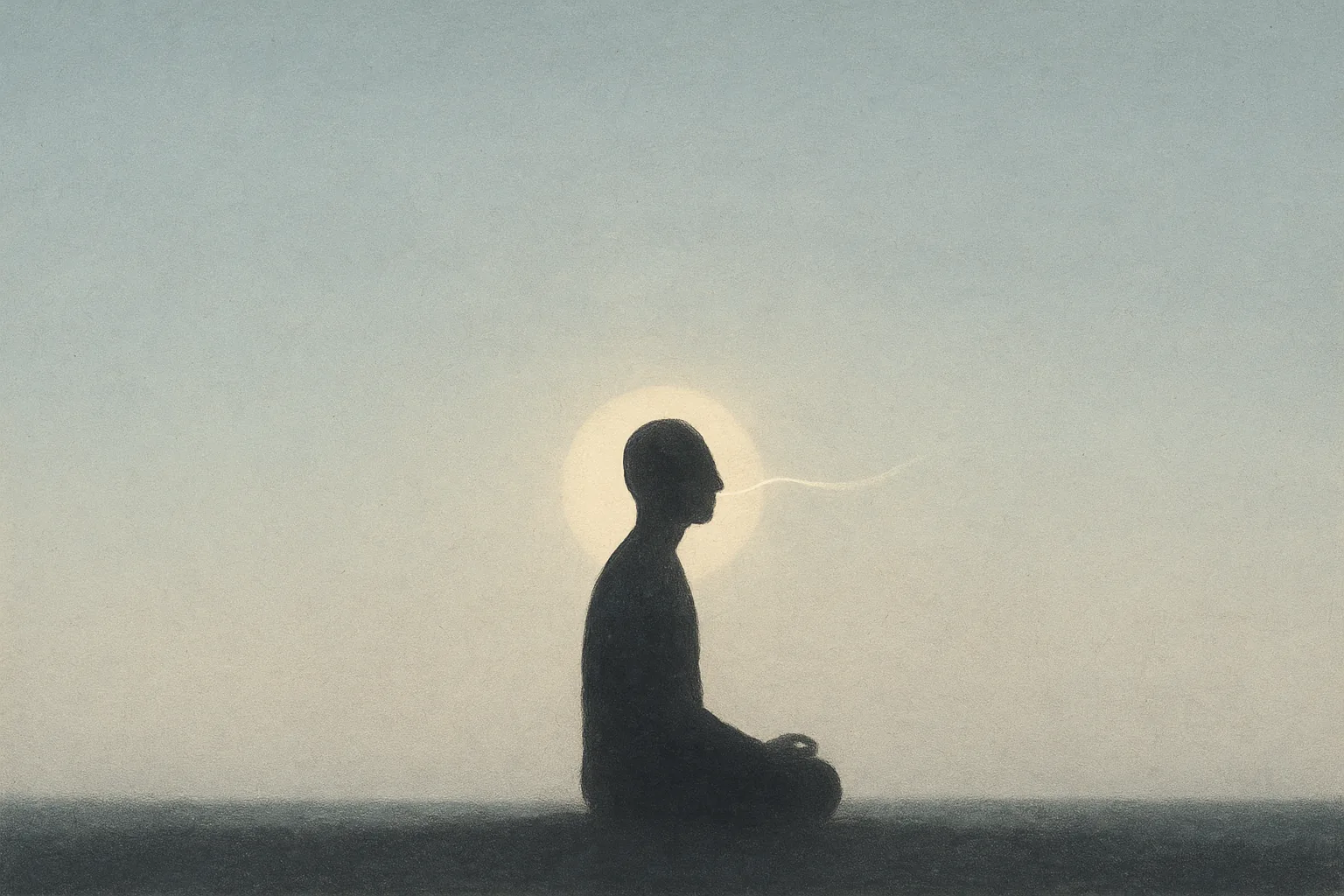
Anapanasati is Buddha’s timeless method of awareness through the incoming and outgoing breath—an inner alchemy that kindles a sun of consciousness and lets it permeate the very cells of your being. Osho presents this classic practice in a simple, potent progression that begins with breath awareness, opens into effortless listening, and culminates in dissolving the sense of "me" into the vastness of existence.
Practice in the early morning for a clear, luminous start to the day, or at night as you drift into sleep. Sit comfortably—lotus posture if it suits you—and at night you may simply lie in bed and continue the practice into sleep. The tone is gentle yet precise: breathe consciously, welcome every sound, and allow the boundaries of the self to melt in gratitude and ease.
Phase Instructions
First Stage: Breath Awareness
10 minutes. Sit comfortably (lotus posture if you wish). Let the breathing be deep yet relaxed. As the breath comes in, move with it—know clearly, "breath is coming in." As it goes out, move with it—know, "breath is going out." Do not allow a single in-breath or out-breath to pass without consciousness. Keep attention on the felt flow of breathing; whenever thoughts appear and attention leaves the breath, notice that you have missed it and gently return to being in with the in-breath and out with the out-breath.
Second Stage: Open Listening with Total Acceptance
10 minutes. Continue the same conscious breathing. Now add effortless listening: receive all sounds in every direction without any resistance—birds, wind in the trees, children playing, traffic—everything. Let the world’s sounds wash through you with total acceptance and a quiet gratitude toward existence. Do not label sounds as disturbances; remain at ease, breathing consciously while allowing hearing to be utterly open and unselective.
Third Stage: Dissolving into Existence
25 minutes. Continue breath awareness and open, accepting listening. Now add a deep feeling-tone: you are no more as a separate entity. Like a drop merging into the ocean, sense your boundaries melting; only existence is. Let the breath breathe itself, let sounds be as they are, and rest in the felt dissolution of the personal "I" into the infinite. If a sense of self reappears or thoughts arise, simply return to the breath, to open listening, and to the felt understanding: the wave is the ocean.
Core Benefits
- Increases awareness through breath
- Kindles a sun of consciousness
- Permeates the very cells with consciousness
- Culminates in dissolving the sense of 'me'
- Facilitates a clear, luminous start to the day
What Osho Said About This Technique
Questioner: how does the buddhist technique of anapansati--constantly watching one's breath--affect the state of oxygen in our bodies?
Anapansati has great effect on our body oxygen. This is a good question which needs to be rightly understood. Every activity of life, every function of our body is accelerated when you pay attention to it. Most of the bodily functions are autonomic; you don't have to pay attention to them, but when you pay attention they are affected. For instance, when a doctor puts his finger on your pulse, your pulse beat does not remain the same, it immediately quickens a little; it is more than what it was before. It is so because it has received attention, the attention of two persons--the doctor's and yours. And it will quicken a lot if the doctor happens to belong to the opposite sex, because now it will receive more attention. You can try it like this: check your own pulse first, and then watch for ten minutes how it beats…
Osho, in the Buddhist practice of anapanasati, when one meditates on the breath, what effect does it have on the amount of oxygen?
A great deal. In fact—this is very amusing and worth understanding—whatever functions of life there are, if you take your attention to any one of them, its speed increases. The functions of life are going on outside your attention. For example, your pulse is beating. When your doctor checks your pulse, it is not exactly what it was before he checked; it goes up a little, because your attention and the doctor’s—both—have gone to it. And if a lady doctor is checking, it will go up even more; because even more attention goes there. You understand, don’t you? It isn’t exactly what it was; a slight difference appears. Try this experiment: first check your own pulse; then keep your attention on the pulse for ten minutes—how it is beating—and check again; you will find its vibrations have increased. In truth, whatever processes are running inside the body are running outside…
Sutras: shiva replies:
1. RADIANT ONE, THIS EXPERIENCE MAY DAWN BETWEEN TWO BREATHS. AFTER BREATH COMES IN (DOWN) AND JUST BEFORE TURNING UP (OUT) -- THE BENEFICENCE. 2. AS BREATH TURNS FROM DOWN TO UP, AND AGAIN AS BREATH CURVES FROM UP TO DOWN -- THROUGH BOTH THESE TURNS, REALIZE. 3. OR, WHENEVER IN-BREATH AND OUT-BREATH FUSE, AT THIS INSTANT TOUCH THE ENERGY-LESS, ENERGY-FILLED CENTER. 4. OR, WHEN BREATH IS ALL OUT (UP) AND STOPPED OF ITSELF, OR ALL IN (DOWN) AND STOPPED -- IN SUCH UNIVERSAL PAUSE, ONE'S SMALL SELF VANISHES. THIS IS DIFFICULT ONLY FOR THE IMPURE. You were afraid in the city. Everywhere there were others present and you were controlling. You could not scream, you could not laugh. What a misfortune! You could not sing on the street and dance. You were afraid -- a policeman was somewhere around the corner, or the priest or the judge or the…
Chidaditya swaroopam deepah "to be established in the sun of awareness is the only lamp."
That is why a Tantra practitioner, if he is a man, will always worship the partner. The partner is not just a sex object. She is Divine! She is a goddess! And the act is not carnal at all. If you can go into it consciously, it is the deepest spiritual act possible. But the deepest is bound to be virtually impossible. So use either breath or sex. Mahavir has used hunger. That again is a very deep thing. Hunger is not just hunger for your taste or for something else -- it is for your very survival. Mahavir used hunger, fasting, as a method of awareness. It is not an austerity. Mahavir was not an ascetic. People have misunderstood him completely. He was not an ascetic at all. No wise man ever is. But he was using fasting, hunger, as a vehicle for awareness. You might have stumbled upon…
Beloved Osho! Yesterday, for the very first time I did Vipassana meditation at the camp. I felt such a flight! Please shed more light on Vipassana.
Buddha says: if you try to regulate the breath in any way, great fruit never comes from effort. The effort is yours; you are small. Your effort cannot be bigger than you. Your hands are small; wherever the imprint of your hand falls, smallness will remain. Therefore Buddha did not say: change the breath. Buddha did not endorse pranayama. He said: you simply sit; the breath is already moving—just sit and watch it as it is moving. As one sits by the roadside and watches the passersby, or sits on a riverbank and watches the flowing current. What will you do? If a big wave comes, you will watch; if no wave comes, you will watch. Cars and buses pass on the road—you watch; if none pass, you watch. Cows and buffaloes pass—you watch. Whatever is there, as it is, keep looking at it just so. Do not impose even…
Common Questions
Practice in the early morning for a clear, luminous start to the day, or at night as you drift into sleep.
Sit comfortably in lotus posture if it suits you, or at night, you may lie in bed and continue the practice into sleep.
The main focus is to breathe consciously, welcome every sound, and allow the boundaries of the self to melt.