
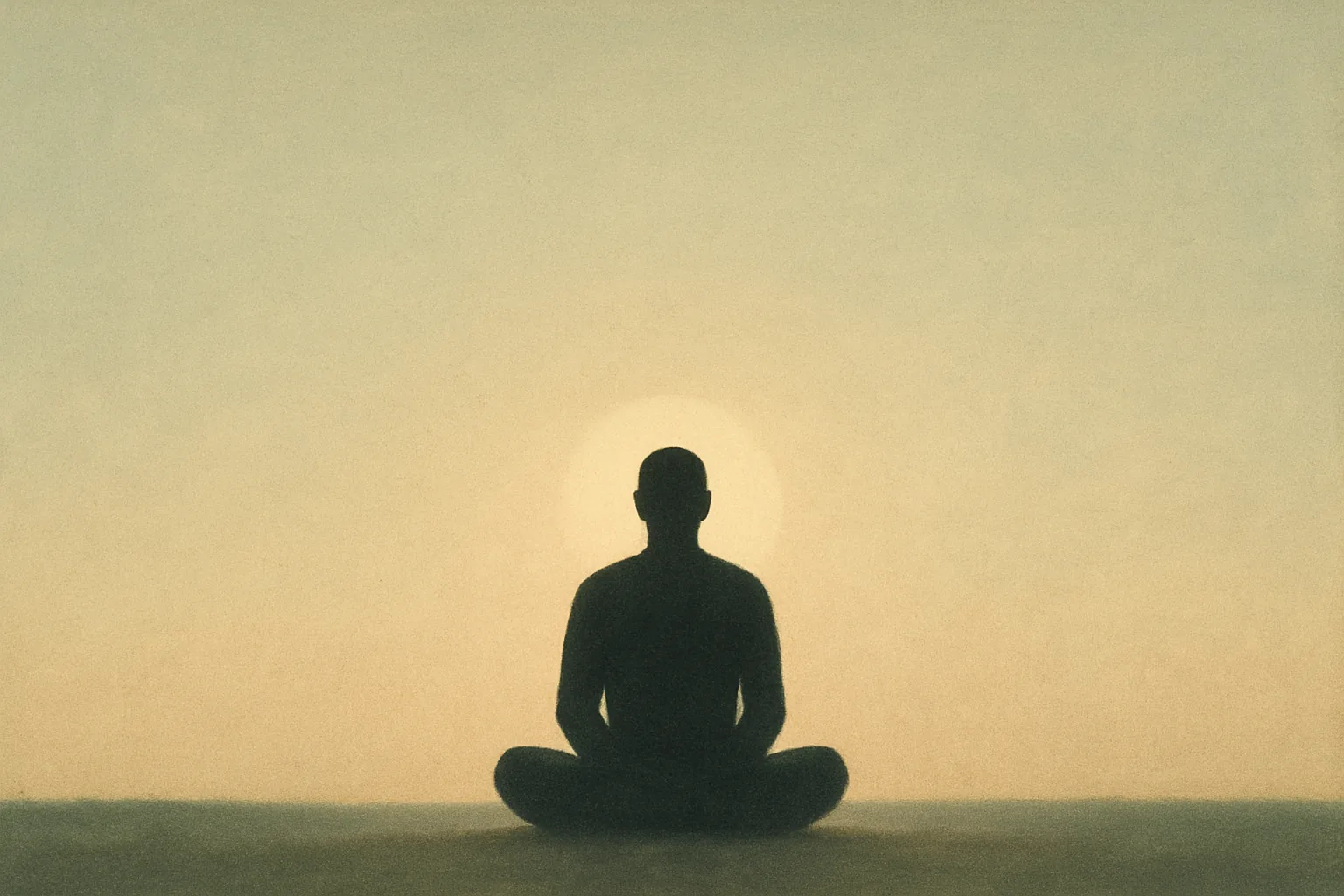
Tathata means suchness—the unarguable is‑ness of life. In this passive meditation guided in Osho’s spirit, you don’t try to change anything; you learn surrender, total letting go. Through vivid inner images—a mountain river that carries you, a funeral pyre that dissolves you—you taste what it means to stop resisting and to allow existence to move you. When resistance falls, the witness appears on its own, serene and clear.
The practice unfolds in three gentle movements: floating instead of controlling, dying instead of clinging, and relaxing into suchness where everything is allowed to be exactly as it is—the green of the grass, the blue of the sky, the calls of birds, even the cawing of crows. From this acceptance, a quiet transformation happens: the mind falls silent, and a natural blissfulness enters. Practiced especially before sleep, this method lets meditation deepen effortlessly through the night.
Phase Instructions
Preparation: Settle and Relax
Sit where no one touches you. Close your eyes slowly. Keep the whole body loose—face, jaw, shoulders, belly, hands, legs—until there is no strain anywhere. Let go of all doing. Allow the intention of surrender to be present: nothing to achieve, nothing to force.
First Stage: Float in the River of Life
Imagine a river running fast between two mountains, full of force and sound. Watch it, then dive in—yet do not swim. Make no movements; simply let your body float. There is nowhere to reach and no destination. Feel like a dry leaf carried effortlessly by the current. Sense how the river holds you, turns you, and moves you without your effort. Experience this clearly, learning with your whole body what “surrender” and “total letting go” mean.
Second Stage: Die on the Pyre — Dissolve Completely
Keeping the eyes closed and the body loose, visualize a funeral pyre blazing—wood piled high, flames reaching for the sky. Know you are not just watching: you have been placed upon the pyre. Friends and relatives stand around. Feel the flames take the body; let the scene unfold naturally. After a while the fire dies down by itself, people disperse, and the cemetery grows empty and silent. Sense that everything is utterly quiet and only ashes remain—you have dissolved completely. Remember this flavor of being dissolved; meditation is also a kind of death. Rest in the understanding that before you were, things were as they are, and they will be so even after you die. There is nothing to do.
Third Stage: Tathata — Suchness and Non-Resistance
Now feel that whatever is happening is simply happening. It can only be this way. Drop all resistance and all expectations that anything be otherwise. Let the grass be green, the sky blue, the ocean roar; let birds sing and crows caw. What once seemed a disturbance becomes amiable. You are not against anything. Remain a receptive, watchful witness as the body relaxes more deeply and the breath becomes quiet and subtle. Sense yourself continuing to dissolve—burnt completely, not even ashes remain—while you allow everything to be as it is.
Completion: Silence, Return, and Integration
Stay until you feel an inner transformation and a sudden stillness—the mind silent and empty. Simply witness this nothingness; a gentle blissfulness (divinity) enters on its own. Then take two or three slow breaths, feeling freshness, peace, and a quiet joy. Open your eyes slowly and return. For deepening: practice nightly before going to bed and drift directly into sleep; gradually, your sleep will turn into meditation.
Core Benefits
- Surrender and total letting go
- Experience non-resistance and allowing existence to flow
- Witness consciousness appears naturally
- Mind falls silent
- Natural blissfulness enters effortlessly
What Osho Said About This Technique
First Tathata. Tathata means to be in a state of suchness -- it is a buddhist word... to live life as it is without hankering for any improvement, because all improvement is a desire of the ego. To think of oneself in terms of becoming is to create misery. So Tathata means whatsoever is, is -- live it. Don't compare it with the past and don't compare it with the future. Let that moment, the present moment, be all, as if there is no other time -- in fact there is not, only the present is. Tathata means living in the present, and living so totally that the past and the future disappear, so you are passionately herenow, intensely herenow. You become a burning flame -- your torch burns from both ends together. And in those moments one exists at the optimum.
[To a sannyasin, who had just arrived from the States, Osho recommended the Tathata group, describing it as 'suchness' -- just being totally in the moment... ] ... as if all bridges are broken and there is no past and no future. Time is only this moment, herenow. And whatsoever happens is the only way that life can happen to you. There is no 'should', no 'oughts', no goal, no ideal... just being existential, almost like an innocent animal: not knowing any memory, any imagination. Animals don't know that they have been yesterday and they don't know that they are going to be tomorrow. They just live this day. The only life they have is of the moment. Tathata is a group in which you have to live like an animal, in the immediate, in the pure present, and without any 'should', because all 'shoulds' bring in the future.
See—the faces are slowly turning away; those who had gathered at the cremation ground are going back. Their backs are now visible; they have begun to walk away; the sound of their footsteps can be heard. They are gone. The cremation ground is left alone; the pyre remains; and a heap of ashes is accumulating. Be erased, be burned, be finished—so that only that remains which does not burn, does not perish, does not end. The flames are shrinking now; only a heap of ashes will remain. Soon there will be no flames, the embers too will die; the cremation ground will be solitary, sinking into darkness, and there will remain a heap of ashes. See this heap well; see this erasure. This is the second step of meditation: the disappearance of the self. Erased, burned, all is finishing. The embers are dying; a heap of ashes lies there.
देखें.चेहरे धीरे-धीरे वापस लौटने लगे, मरघट पर जो इकट्ठे थे वे वापस जा रहे हैं, वे लौट रहे हैं, उनकी पीठ दिखाई पड़ने लगी है, वे वापस चल पड़े हैं, उनके पैरों के पदचाप सुनाई पड़ने लगे हैं। वे जा चुके हैं। मरघट अकेला रह गया, चिता ही रह गई। और राख का ढेर इकट्ठा हुआ चला जा रहा है। मिट जाएं, जल जाएं, समाप्त हो जाएं, ताकि वही शेष रह जाए जो न जलता है, न मिटता है, न समाप्त होता है। तो आग की लपटें भी छोटी होने लगी हैं। राख का ढेर ही पड़ा रह जाएगा। थोड़ी देर में लपटें भी नहीं होंगी, अंगारे भी बुझ जाएंगे, मरघट एकांत अकेला अंधेरे में डूबा और राख का एक ढेर पड़ा रह जाएगा।
Osho, in the context of the practice of heedfulness (apramad), please explain the similarities and differences among the practices of witnessing, awareness, and tathata.
One more thought on tathata. A Zen fakir wrote a small song: “The geese fly across the sky. They have no desire that their reflections be formed in the still lake below. Yet the reflections form. The blue lake has no desire to catch the reflections of the geese. Yet the reflections are caught. Then the geese fly on and the reflections also fly away. The geese do not know they were caught in the lake; the lake does not know that the reflections aroused any curiosity, any stir, any disturbance in its bosom.” Tathata means such a being. Things happen. He is ready for all—wants to do nothing and has no complaint. That is why one of Buddha’s names is Tathagata. He loved that name. Even speaking of himself he would say, “The Tathagata passed through a certain village.” Tathagata means one who has attained tathata—thus come, thus gone.…
ओशो, अप्रमाद की साधना के संदर्भ में कृपया समझाइए कि साक्षी, सजगता और तथाता की साधना में क्या-क्या समानताएं व भिन्नताएं हैं।
तथाता का एक खयाल और मुझे आया वह आपसे कहूं। एक झेन फकीर ने एक छोटा सा गीत लिखा है। उस गीत में लिखा है कि आकाश में हंस उड़ते हैं। उनकी कोई इच्छा नहीं होती कि नीचे की शांत झील में उनका प्रतिबिंब बने। लेकिन प्रतिबिंब बन जाता है। नीचे की नीली झील पर से ऊपर जब हंस उड़ कर निकलते हैं, झील की कोई इच्छा नहीं होती कि हंसों का प्रतिबिंब पकड़े, लेकिन प्रतिबिंब पकड़ लिए जाते हैं। फिर हंस उड़ जाते हैं और प्रतिबिंब भी उड़ जाते हैं। न हंसों को पता चलता है कि झील में पकड़े गए थे, न झील को पता चलता है कि हंसों के प्रतिबिंबों ने झील की छाती में कुछ कुतूहल, कुछ हलचल, कुछ उपद्रव पैदा किया है। तथाता का अर्थ है ऐसा व्यक्तित्व। चीजें हो जाती हैं। सबके लिए राजी है। कुछ करना भी नहीं चाहता, कोई शिकायत भी नहीं है। इसलिए बुद्ध का एक नाम तथागत है। बुद्ध का एक नाम तथागत है। बुद्ध को बहुत प्रेम था उस नाम से। खुद भी वे कहते थे, तो वे कहते थे, तथागत एक गांव से गुजरे। तथागत का मतलब है: तथाता को उपलब्ध। …
Please explain the difference between witnessing and tathata.
One who stops with attaining firmness of resolve would of course become very powerful, but he won't be able to attain wisdom. And therefore, the ability to make a resolve can be misused, because wisdom is not required to attain it. One will surely gain a lot of power, but that is precisely why he can abuse it. The entire black magic is a product of willpower. One who practices it gains a lot of power, but he lacks wisdom totally. He can end up using that power without any discrimination. A man of will becomes filled with power. It is difficult to predict right away what use he will make of it. He can obviously put it to bad use. Power in itself is neutral. Nevertheless, it is necessary -- whether one intends to use it for good or for evil. And as I see it, rather than remaining…
Common Questions
Tathata Meditation focuses on surrender and allowing life to flow without resistance.
It allows the mind to fall silent and invites natural blissfulness.
This is a passive meditation guided in the spirit of Osho.
It is especially beneficial to practice before sleep as it deepens meditation through the night.
Imagery includes a mountain river that carries you and a funeral pyre that dissolves you.