
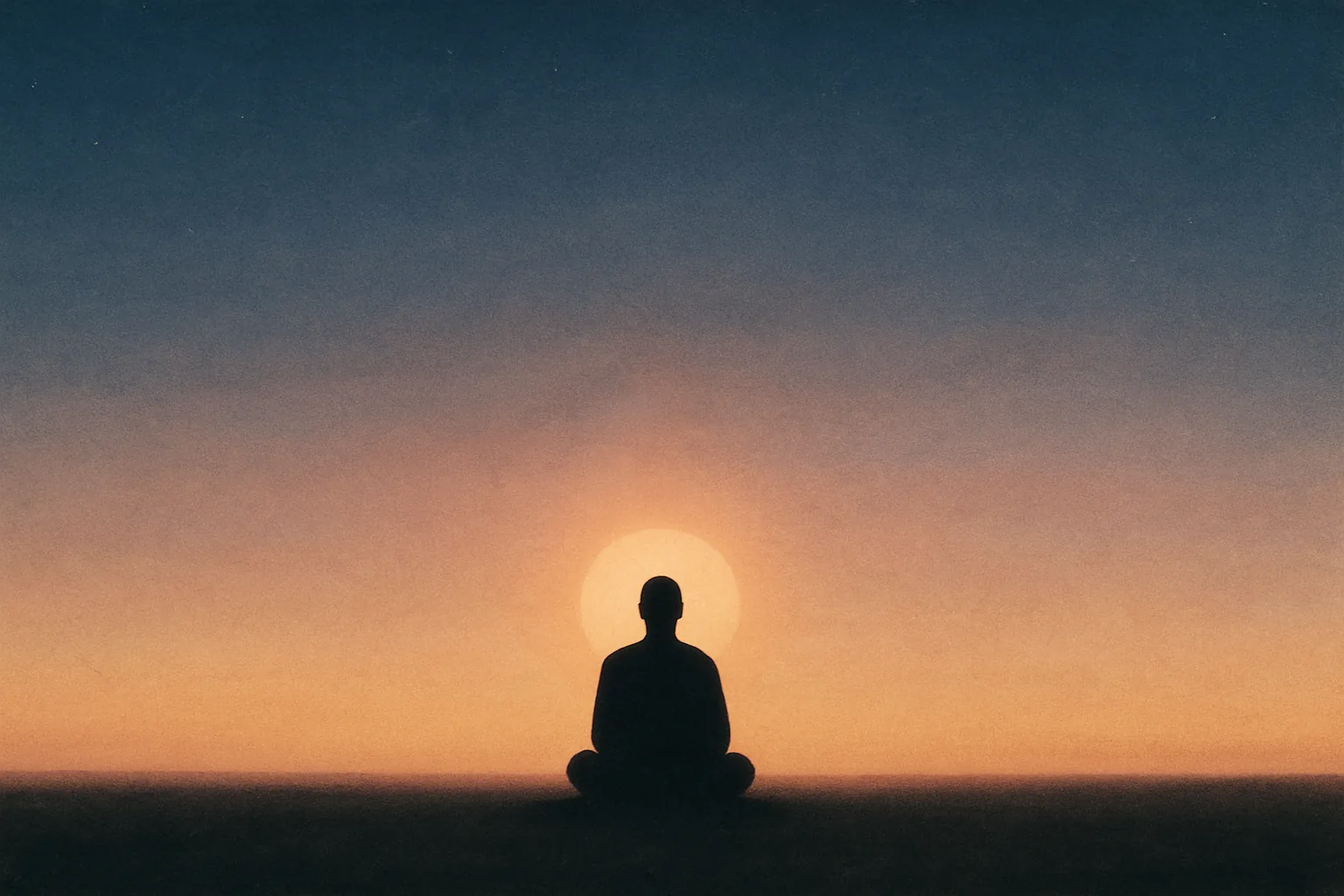
A Man of Love and Meditation is a dawn practice that blends devoted daily discipline with the tenderness of the heart. Inspired by a master musician’s relentless early-morning riyaz, this method invites you to "tune" your inner instrument every day so that awareness remains fresh and resonant. The emphasis is not on complexity but on returning, again and again, to the simple note of presence until it begins to sing through you.
True to the spirit of Tantra as taught by Osho, this meditation restores the right order inside: the heart leads, awareness witnesses, and the mind serves. You will cultivate loving attention, interrupt compulsive patterns with a clear, direct word, and sit in quiet ripening. The method is simple, the commitment continuous: a gentle but uncompromising daily yes to love and meditation.
Phase Instructions
First Stage: Tune at Dawn — The Inner Raga of Breath
Begin at dawn if possible. Sit with an erect yet relaxed spine, either on a cushion or chair, feet or sit bones grounded. Rest one hand lightly on the heart and the other on the belly. Close the eyes. Breathe through the nose, smooth and unforced. For 20 minutes, listen to the breath as though it were a single note being played—soft, continuous, barely moving. Let attention stay intimate with the natural inhalation and exhalation, as if you are tuning a sitar string within the chest. Each time the mind wanders, return without irritation to the felt movement of breath under your palms. Allow the feeling-tone to be loving and devotional, as if you are preparing yourself to meet the day with a freshly tuned heart.
Second Stage: Make It Simple — Return to the Essential
For the next 15 minutes, keep sitting. Notice how the mind tries to complicate experience—commentary, plans, analyses. Each time complexity arises, whisper inwardly once: "Simple." On that cue, soften the jaw, relax the shoulders, and feel the breath return to its unadorned flow. Do not argue with thoughts; do not complete their sentences. Let the body be the reminder: relaxed throat, open chest, grounded pelvis. If emotions surface, include them tenderly in awareness without story. Your only movement is the gentle return to the essential sensation of breathing and the warmth around the heart.
Third Stage: The Direct Word — Drop the Habit
Choose one small, repetitive habit you wish to release today (for example, mindless scrolling, nail-biting, reflex criticism). Stand up for a moment, feel your feet, and make a clear inner agreement: "When the urge appears, I will pause, breathe, and say a direct no." For 10 minutes, sit again and rehearse this in real time: when any urge or impulse arises, do three things in sequence: (1) Pause and take one slow, deep breath; (2) Say inwardly, with kindness and firmness, a simple instruction tailored to the urge—"Stop," or "Don’t do this now"; (3) Feel gravity in your feet or sit bones for a count of ten, letting the wave pass. If the pull persists, stand, take three mindful steps forward and back, and sit again. Let the body’s clarity and the direct word interrupt the pattern without self-violence.
Fourth Stage: Silent Ripening — Love and Patience
For the final 15 minutes, rest in silence without method. Let breath breathe itself. Sense a spacious, patient presence pervading the whole body, as if the heart’s music now plays on its own. If thoughts appear, smile inwardly and allow them to drift through open sky. Offer quiet goodwill to yourself and to all beings. End by placing both hands over the heart, bowing the head slightly, and affirming your daily commitment: "I will tune this awareness each day." Then rise slowly and carry the tone of simplicity and love into your first action of the day.
Core Benefits
- Cultivates loving attention
- Interrupts compulsive patterns
- Promotes a heart-led awareness
- Fosters a sense of inner harmony
- Encourages daily commitment to meditation
What Osho Said About This Technique
This is what I mean by true contentment. And if one can be in such a space, nothing else is needed. Meditation arrives on its own, because mind dies. You need not do anything to destroy it, it disappears of its own accord. Mind is like darkness and contentment is like light. Bring contentment in and the darkness disappears. And then you can see. For the first time you can see and for the first time you can hear and for the first time you can feel. Because mind is hindering everything, it does not allow you to see, it does not allow you to hear. It is standing between you and existence. Once it is not there you are available to god and god is available to you. That is liberation, nirvana, enlightenment. This is your name: Swami Anugito. It means a song.
A wise man is not necessarily a man of knowledge; he may be, he may not be. A man of knowledge is not necessarily wise; he may be, he may not be. More is the possibility that he is not going to be, because when the mind is too full of knowledge the heart starts non-functioning. The mind possesses so much of you that it does not allow any space for the heart to function. Knowledge is of the head, wisdom is of the heart. There are schools, colleges, universities, to give you knowledge; but nobody can give you wisdom, it is untransferrable. You have to achieve it on your own, jumping into the madness of love. It needs guts, because it is going to be a love affair with existence itself. Prem Dhyano. Prem means love; dhyano means meditation. These are the two most important things in life.
As this love grows in you, you start feeling a new experience: that is prayer. Prayer is the highest form of love, the peak. And once prayer has entered your life, then love is not something that you do or you don't do, it becomes your very presence; you are simply loving. Then it is just like breathing. A man of prayer even while asleep is loving. He is love. Love is not an act for him but his being. When love becomes being it is prayer. And at that point great fragrance is released. Your flower has blossomed. In the East we call it a one-thousand-petalled lotus. One-thousand-petalled because in the East we have given god one thousand names. Each petal of the lotus represents one quality of god. The opening of the one-thousand-petalled lotus means you have attained to all the qualities of god.
And people are doing transcendental meditations in all kinds of places -- in bathrooms, sitting on their toilets because they can find no other place in the home. At least in the bathroom you are left alone for ten minutes, nobody will disturb you. It may give you a certain consolation, a certain happiness that you are doing something for the other world too. But it cannot transform you. Transformation is possible only when the twenty-four hours of your day become a constant meditation, a continuum. So whatsoever you are doing -- walking you are meditating, eating you are meditating, listening, talking you are meditating... because to me meditation simply means awareness, not repeating a mantra. Because how can you repeat a mantra? -- if you are doing some work and you repeat a mantra your work will be disturbed.
You can dance, you can sing, you can play on a guitar -- that may be far better than using language because that will be more existential. You can laugh, you can weep... yes, that may be closer to the truth, but only closer; even that cannot contain the truth as it is. One has to enter into love utterly mindless, wordless. Hence love has become a rarity, because people have forgotten how to be still, how to be silent, how to put the constantly chattering mind aside. They have completely forgotten. The mind has possessed them absolutely, the mind has become the master. Day in, day out, awake or asleep it continues; it goes on secreting thoughts. In the day you call them thoughts, in the night, dreams, but they are the same phenomenon.
Common Questions
The primary purpose is to 'tune' your inner instrument daily so that awareness remains fresh and resonant.
It restores the right order inside by letting the heart lead, awareness witness, and the mind serve.
It requires a gentle but uncompromising daily commitment to love and meditation.