
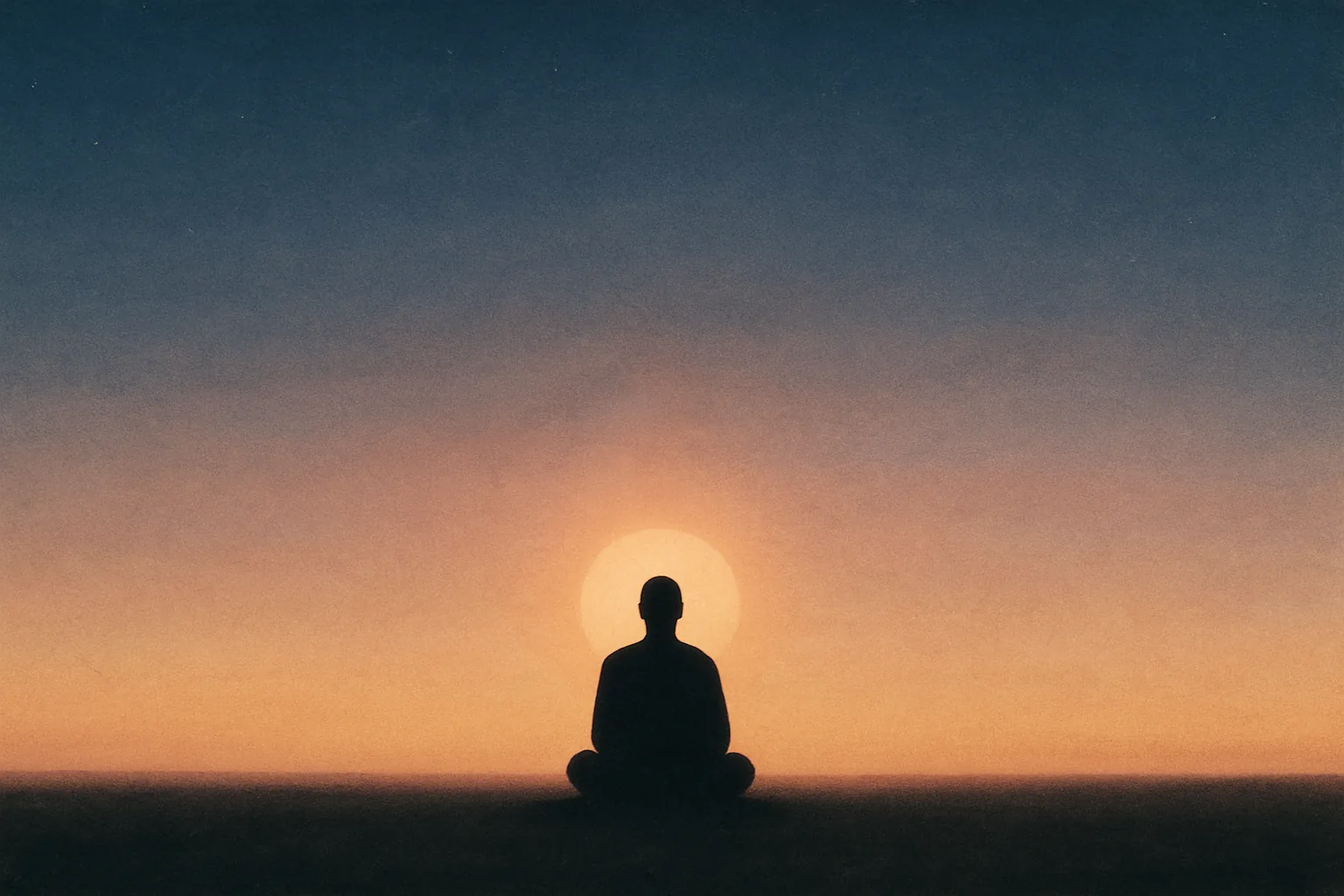
Jumping Out of the Mind is a direct path from problem-making to presence. Echoing Osho’s insight that psychotherapies polish the mind while meditation steps out of it, this method turns away from analysis and toward immediate awareness. Inspired by the spirit of Gestalt’s “here and now” yet going beyond it, the practice skillfully frustrates the mind’s habits and then moves through catharsis into clear witnessing, where problems dissolve because the very source of their momentum — identification with thought — is no longer fed.
The meditation unfolds in four movements: first, a conscious refusal to bargain with the past; second, a lively burst of nonsense (gibberish) that empties the verbal center; third, a deep, luminous mindfulness that neither chooses nor condemns; and finally, a soft let-go where being rests in itself. Osho called it a constant remembrance — a watchfulness that prevents repetition — so the whole arc of the hour trains you to remember and remain, rather than analyze and repair.
Phase Instructions
First Stage: Skillful Frustration — Drop the Past
15 minutes. Stand with feet shoulder-width apart, eyes closed. Breathe a little faster and deeper through the nose or gently through the mouth; let the body be loose and free to shake. Invite the mind to parade its usual scenes — memories, plans, arguments. Each time a thought, image, or storyline appears, cut it at the root with a clear inner ‘No’ and a small shake of the body, as if throwing it off. Do not analyze, justify, or sort the past into right and wrong; simply reject the entire bargaining of the mind and drop it. Feel the heat and tingling as energy unhooks from thinking and returns to the body. Keep the breath alive, the body responsive, the refusal total.
Second Stage: Gibberish — Outrun the Mind
15 minutes. With eyes closed, start speaking in complete nonsense sounds — no known words, no grammar, no meaning. Let the voice be playful, the face expressive, the hands and body moving freely. Throw out everything the mind tries to form into sense; if a real word slips in, switch immediately back to pure gibberish. Allow volume and tempo to rise and fall naturally. This is catharsis: empty the verbal center without harming the voice (keep the jaw soft, the throat open). Don’t interpret, don’t translate — just pour it all out in joyous rubbish until there is nothing left to say.
Third Stage: Witnessing — Here and Now
20 minutes. Sit with spine erect, eyes closed, hands resting open on your thighs. Let the breath find its natural rhythm. Watch the cool touch of inhalation at the nostrils and the warm flow of exhalation; feel the subtle gap between breaths. Thoughts will pass — do nothing about them. Neither follow nor fight; see each as a cloud crossing a vast sky. Treat love and hate, success and failure, pride and shame with the same even gaze — all are movements of the mind. Each time you notice you’re involved, gently return to the breath and spaciousness. Sense the simple fact: I am the witness, not the mind.
Fourth Stage: Let-Go — Rest Beyond the Mind
10 minutes. Lie on your back, eyes closed. Drop all technique; no effort, no control. Let the body melt into the ground, breath unforced, awareness open and without focus. If small movements or sighs come, allow them and then settle into stillness again. Do nothing — be. Before rising, taste the silence and make a soft inner resolve to carry this remembrance through the day. Roll to one side and come up slowly.
Core Benefits
- Provides a direct path from problem-making to presence.
- Moves participants from analysis to immediate awareness.
- Skillfully frustrates the mind's habits, leading to clear witnessing.
- Problems dissolve as the identification with thought is no longer fed.
- Trains participants to remember and remain, avoiding repetitive patterns.
What Osho Said About This Technique
For example, it brings you the experience that not the body, so clearly, so solidly, so categorically, that even if the whole world denies it, it cannot make any difference: you know from your innermost core you are not the body. It brings you the experience that you are not the mind either. And the moment you know you are neither the body nor the mind, suddenly a door opens. You have never been born and you are never going to die because only that which is born can die. The body was born, the mind was born -- they will die -- but you were before your birth and you will be after your death. Once this reality is revealed to you all fears and all miseries disappear. You become part of eternity. Only one thing remains and that is pure consciousness. And pure consciousness is nothing but godliness.
In 1969 followers of the Maharishi Mahesh Yogi invited Osho to talk to them. This was the first occasion on which Osho addressed a western audience, and the first time he talked publicly at length in English. The discourse has been published in OTI January 1 & 16, 1991; and February 1, 1991. Osho: Really, there can be no method as far as meditation is concerned. Meditation is not a method. Through technique, through method, you cannot go beyond mind. When you leave all methods, all techniques, you transcend mind. So meditation itself is not a method. Truth cannot be achieved through method. Method is our own invention. We, who are ignorant, have achieved knowledge through methods constructed, created, projected, in our ignorance. Through method you can achieve a sort of self-hypnosis, a sort of auto-hypnosis. Any method, whatsoever it's name, can only give you an illusory kind of peace.
In the cavity of the heart, which is situated in the body, dwells the unborn who is eternal.
THE EARTH IS ITS BODY. IT DWELLS IN THE EARTH, BUT THE EARTH DOES NOT KNOW IT. WATER IS ITS BODY. IT DWELLS IN WATER,BUT WATER DOES NOT KNOW IT. FIRE IS ITS BODY. IT DWELLS IN FIRE BUTFIRE DOES NOT KNOW IT. AIR IS ITS BODY. IT DWELLS IN THE AIR, BUT THE AIR DOES NOT KNOW IT. THE SKY IS ITS BODY. IT DWELLS IN IT,BUT THE SKY DOES NOT KNOW IT. THE MIND IS ITS BODY. IT DWELLS IN THE MIND, BUT THE MIND DOES NOT KNOW IT. THE INTELLECT IS ITS BODY. IT LIVES IN THE INTELLECT, BUT THE INTELLECT DOES NOT KNOW IT. THE EGO IS ITS BODY. IT DWELLS IN THE EGO,BUT THE EGO DOES NOT KNOW IT. THE CONSCIOUSNESS IS ITS BODY. IT DWELLS IN THE CONSCIOUSNESS, BUT THE CONSCIOUSNESS DOES NOT KNOW IT. THE UNMANIFEST IS ITS BODY. IT DWELLS IN THE…
So I don't teach purity, I don't teach morality -- that is all nonsense. I only teach meditation so you can get rid of the mind. The mind belongs to society and meditation belongs to you. With meditation you are absolutely free, and suddenly you start discovering your intrinsic treasures. And then begins a great pilgrimage of joys, beauty, beauties, songs, celebrations. And it is an unending process. It gives you the vision of eternity. It gives you the certainty that you are immortal. And to know it is to become part of god, is to be divine. (And continuing the theme, Osho turned to the next sannyasin -- a taxi driver from Germany.) Mind is a bondage, it is a prison, but a very subtle, invisible one; and a very strange one too, because ordinarily the prison is outside you and you are inside the prison.
Mind is a hoarder of bitterness. It collects sounds, hurts, insults. It goes on sulking over them for years. Psychologists are very aware of the fact that something said when you were only four years old may have hurt you so much that it is still there like a wound, still oozing pus. You don't allow it to be healed. You go on fingering the wound so you make it hurt again and again, again and again you create it, never giving it an opportunity to be healed by itself. If we look at our mind, it is nothing but wounds and wounds. Hence life becomes a hell; we collect only thorns. A man may have been loving to you for years, he may have been compassionate, kind and everything, and he says just one thing which hurts you, and years of love and friendship disappear.
Common Questions
While traditional psychotherapy focuses on analyzing and polishing the mind, this meditation steps out of the mind and shifts towards immediate awareness.
The gibberish phase empties the verbal center, frustrating the mind's habitual patterns and paving the way for deeper mindfulness.
It is called 'Jumping Out of the Mind' because it moves participants away from the habit of feeding identification with thought, encouraging a state of clear witnessing and presence.
The 'soft let-go' refers to a state where being rests in itself, free from choosing or condemning, allowing a natural relaxation into presence.
Through constant remembrance and watchfulness, it trains the participant to remember and remain present rather than repeating habitual patterns.