
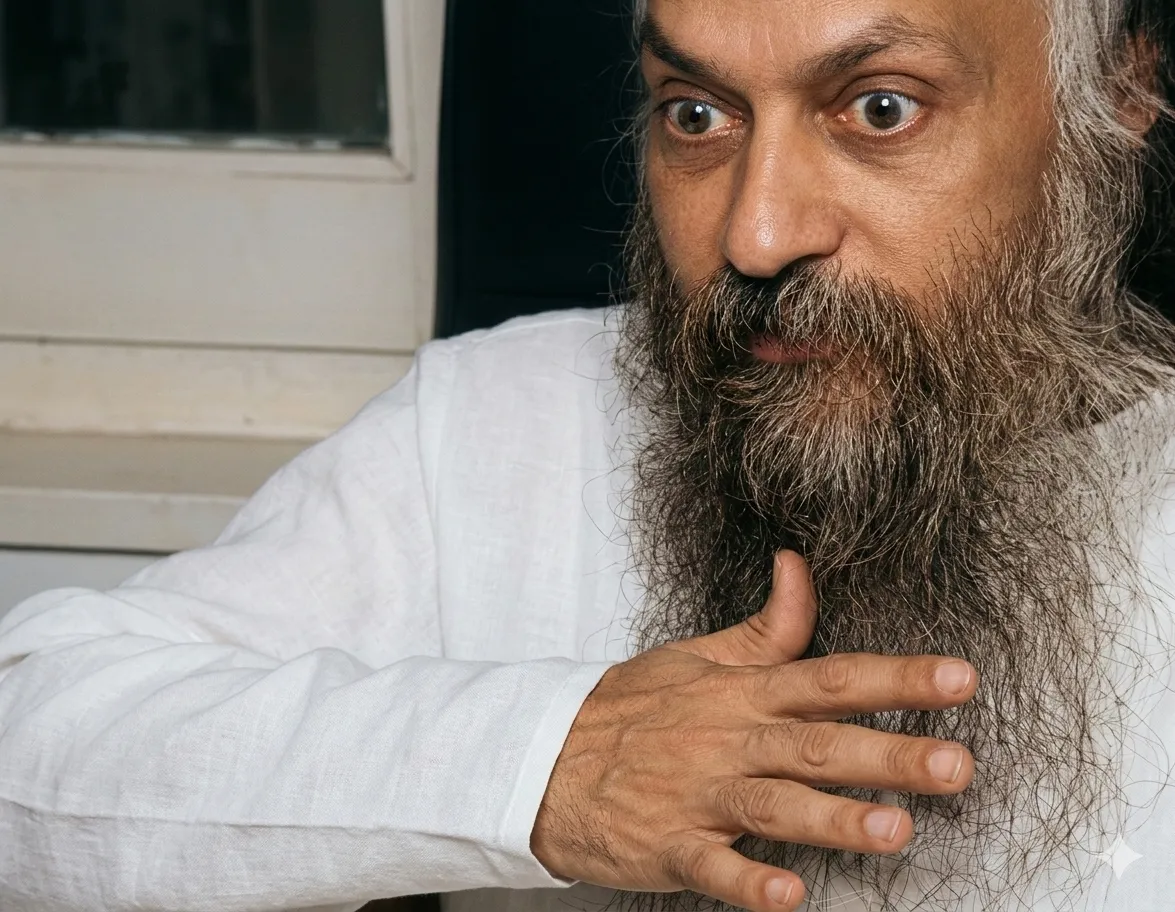
Osho's original Hindi beside Osho Live's English translation, matched passage by passage.
Someone is a dagger, another a naked sword.
खंजर है कोई, तो तेगे-उरियां कोई
सरसर है कोई, तो बादे-तूफां कोई
One is a soft rustle, another a tempest wind.
इंसान कहां है? किस कुर्रे में गुम है?
Where is the human being? In what corner is he lost?
यां तो कोई हिंदू है, मुसलमां कोई
Here one is Hindu, another Muslim.
जिस वक्त झलकती है मनाजिर की जबीं
When the brow of the vistas glimmers,
रासिख होता है जाते-बारी का यकीं
certainty of the Creator’s being becomes firm.
करता हूं जब इंसान की तबाही पे नजर
Whenever I look at the ruin of man,
दिल पूछने लगता है, खुदा है कि नहीं?
my heart begins to ask, Is there God, or not?
जीना है तो जीने की मुहब्बत में मरो
If you must live, then die in love with living—
fill the mud-pit of existence by becoming naught, again and again.
गारे-हस्ती को नेस्त हो-हो के भरो
नौ-ए-इन्सां का दर्द अगर है दिल में
If the pain of the new human is alive in your heart,
अपने से बुलंदतर की तखलीक करो
create what is higher than yourself.
मखलूक की खिदमत से बहुत डरता है
He greatly fears serving the created;
अपने ही लिए आठ पहर मरता है
अफसोस तेरा इना-ए-जामिद ऐ शख्स
for his own self he dies all eight watches of the day.
Alas, O rigid stone of a man,
अपने से तजावुज ही नहीं करता है
you never transgress yourself.
मनुष्य को देखो, जैसा मनुष्य है, जैसा मनुष्य आज हो गया है, तो सच ही परमात्मा पर भरोसा नहीं आता कि परमात्मा भी हो सकता है।
Look at man—as he is, as man has become today—and indeed, trust does not arise that even God could be.
वृक्षों को देख कर शायद आस जगे, पक्षियों को देख कर शायद तुम्हारे भी पंख फड़फड़ाएं, पशुओं की आंखों में झांक कर शायद परमात्मा की थोड़ी झांई पड़े। पर आदमी! आदमी इतने दूर निकल गया है, आदमी ने परमात्मा की तरफ पीठ कर ली है।
Looking at trees perhaps hope stirs; looking at birds perhaps your own wings flutter; peering into the eyes of animals perhaps a faint gleam of the Divine falls upon you. But man! Man has gone so far; man has turned his back upon God.
Someone is a dagger, another a naked sword.
खंजर है कोई, तो तेगे-उरियां कोई
सरसर है कोई, तो बादे-तूफां कोई
One is a soft rustle, another a tempest wind.
Where is the human being? In what corner is he lost?
Here one is Hindu, another Muslim.
इंसान कहां है? किस कुर्रे में गुम है?
यां तो कोई हिंदू है, मुसलमां कोई
मुसलमान मिल जाएगा, हिंदू मिल जाएगा, ईसाई मिल जाएगा, जैन मिल जाएगा, बौद्ध मिल जाएगा; मगर आदमी! आदमी मिलना बहुत कठिन है। और जो आदमी है वह हिंदू नहीं हो सकता, मुसलमान नहीं हो सकता। आदमियत उतनी छोटी सीमाओं में बंध नहीं सकती। आकाश को कैसे बंद करोगे आंगनों में? सत्य को कैसे जंजीरें पहनाओगे शब्दों की? अनिर्वचनीय के कैसे शास्त्र निर्मित करोगे? हार्दिक को बुद्धि से कैसे समझोगे? कैसे समझाओगे?
You will find a Muslim, you will find a Hindu, a Christian, a Jain, a Buddhist; but a man—a man is very hard to find. And one who is truly a man cannot be a Hindu, cannot be a Muslim. Humanity cannot be bound within such small borders. How will you shut the sky inside courtyards? How will you shackle truth in chains of words? How will you manufacture scriptures for the ineffable? How will you understand the heart with the intellect? How will you explain?
सब शास्त्र ओछे पड़ जाते हैं। सब मंदिर-मस्जिद छोटे पड़ जाते हैं। परमात्मा इतना बड़ा है, उस बड़े परमात्मा को तो सिर्फ आकाश जैसा हृदय ही सम्हाल सकता है। और आकाश जैसे हृदय पैदा हो सकते हैं; संभावना हमारी है; बीज हममें है।
All scriptures fall short. All temples and mosques are too small. God is so vast—only a sky-like heart can contain that vastness. And such sky-like hearts can be born; this is our possibility, the seed is within us.
जिस वक्त झलकती है मनाजिर की जबीं
When the brow of the vistas glimmers,
रासिख होता है जाते-बारी का यकीं
certainty of the Creator’s being becomes firm.
करता हूं जब इंसान की तबाही पे नजर
Whenever I look at the ruin of man,
दिल पूछने लगता है, खुदा है कि नहीं?
my heart begins to ask, Is there God, or not?
आज अगर परमात्मा पर संदेह उठा है तो उसका कारण यह नहीं है कि परमात्मा नहीं है; उसका कारण यह है कि आदमी परमात्मा का कोई प्रमाण ही नहीं दे रहा है। आदमी को देख कर परमात्मा के अस्तित्व की आशा नहीं बंधती। आदमी को देख कर, कुछ आशा रही भी हो, तो बुझ जाती है; कोई दीया टिमटिमाता भी हो भीतर, तो समाप्त हो जाता है, अमावस की रात घिर जाती है।
If today doubt has arisen about God, the reason is not that God is not; the reason is that man offers no evidence of God. Looking at man, hope for God’s existence does not arise. Looking at man, whatever hope might have been, is extinguished; if some lamp flickers within, it goes out, and a night of new moon descends.
जीना है तो जीने की मुहब्बत में मरो
If you must live, then die in love with living.
आदमी होने की कला एक ही है और वह है प्रेम--जीवन से प्रेम--इतना कि मरना भी पड़े उस प्रेम के लिए तो कोई हंसते हुए मर जाए, कोई गीत गाते हुए मर जाए, कोई नाचते हुए मर जाए!
जीना है तो जीने की मुहब्बत में मरो
There is only one art of being human, and that is love—love for life—so much so that even if one must die for that love, one dies laughing, dies singing, dies dancing.
और जीने की भी कला यही है। बड़ा उलटा लगेगा: जीने की कला है जीने की मुहब्बत में मरना। जो जीवन को जोर से पकड़ता है उसका जीवन नष्ट हो जाता है। जो जीवन को भी जीवन के लिए छोड़ने को तत्पर होता है उसके ऊपर विराट जीवन उतर आता है।
If you must live, then die in love with living—
and this is also the art of living. It will seem upside-down: the art of living is to die for love of life. The one who clutches at life, loses it. The one who is ready even to renounce life for life—upon him the Vast descends.
जीना है तो जीने की मुहब्बत में मरो
गारे-हस्ती को नेस्त हो-हो के भरो
अभी तो तुम्हारी जिंदगी क्या है? गारे-हस्ती! एक गड्ढा है अस्तित्व का! एक खालीपन! एक सूनापन! एक रिक्तता! जहां न फूल खिलते हैं, न पक्षियों के गीत गूंजते हैं, न आकाश के तारे झलकते हैं। तुम्हारे भीतर अभी है क्या? सिर्फ एक उदासी है, एक ऊब है! किसी तरह जिंदगी को ढोए जाते हो, यह दूसरी बात है। सिर्फ श्वास लेते रहने का नाम जीना नहीं है। जब तक जीवन एक नृत्य न हो, एक रक्स न बने, एक उत्सव न हो, एक समारोह न हो; जब तक जीवन फूलों की एक माला न बन जाए; जब तक जीवन तारों की एक दीपावली न बन जाए--तब तक तुमने जीवन जाना ही नहीं जानना; समझ रखना कि जीवन समझा ही नहीं अभी; अभी जीवन में प्रवेश ही नहीं हुआ, जीवन के मंदिर के बाहर ही बाहर घूमते रहे हो।
If you must live, then die in love with living.
Fill the mud-pit of existence by becoming naught, again and again.
What is your life right now? A mud-pit of existence! A pit, a hollow, an emptiness, a void—where no flowers bloom, no birdsong echoes, no stars glimmer. What is within you now? Only a sadness, a boredom! Somehow you drag your life along—that is another matter. Merely breathing is not living. Until life becomes a dance, a rapture, a festival, a celebration; until life becomes a garland of flowers; until life becomes a Diwali of stars—you have not known life at all. Understand: you have not yet understood life; you have not even entered it—you have been circling outside the temple of life.
जीना है तो जीने की मुहब्बत में मरो
गारे-हस्ती को नेस्त हो-हो के भरो
If you must live, then die in love with living.
और जीवन का यह जो गड्ढा तुम्हें अनुभव होता है--यह खालीपन, यह रिक्तता, यह अर्थहीनता, यह शून्यता--इसे भरने का उपाय जानते हो? इसे भरने का उपाय बड़ा अनूठा है। इसलिए संतों की वाणी अटपटी है। अपने को मिटा-मिटा कर ही इसको भरा जा सकता है। और तुम अपने को बचा-बचा कर भरना चाहते हो।
Fill the mud-pit of existence by becoming naught, again and again.
And this pit you experience—this emptiness, this hollowness, this meaninglessness, this void—do you know how it is to be filled? The way is uncanny. That is why the language of the saints sounds strange. Only by erasing yourself again and again can it be filled. And you want to fill it by saving yourself.
बचाओगे तो खाली रह जाओगे--जीसस कहते हैं--और मिट सको तो आज ही भर जाओ।
Save yourself and you will remain empty—Jesus says—and if you can dissolve, today itself you will be filled.
मिटने को मैंने संन्यास का नाम दिया है--मिटने की कला, मरने की कला। लेकिन मरने की कला केवल कदम है जीवन की कला की तरफ। मिटने की कला होने की कला का सूत्र है।
To dissolving I have given the name sannyas—the art of dissolving, the art of dying. But the art of dying is only a step toward the art of living. The art of dissolving is the formula for the art of being.
नौ-ए-इन्सां का दर्द अगर है दिल में
अपने से बुलंदतर की तखलीक करो
और अगर सच में ही मनुष्य होना चाहते हो, मनुष्य को जन्म देना चाहते हो अपने भीतर, एक नये मनुष्य का आविर्भाव करना चाहते हो...क्योंकि पुराना तो सड़-गल गया। तुम्हें जो पाठ पढ़ाए गए थे सब व्यर्थ साबित हुए। तुम्हें जो सूत्र समझाए गए थे वे काम नहीं आए। जिन्हें तुम सेतु समझ कर चले थे वे ही तुम्हें डुबाने का कारण हो गए हैं। तुमने कागज की नावों पर सवारी की है। तुमने शब्दों और ज्ञान के जाल से ही जीवन को जीने की कोशिश की है। और इसलिए जीवन तो तुम्हारे हाथ में नहीं है; जीवन के नाम पर एक धोखा है, एक आत्मवंचना है। अगर सच्चे जीवन को जीना हो, अगर अपने भीतर एक नये मनुष्य को जन्म देना हो तो एक काम करना पड़ेगा--
If the pain of the new human is alive in your heart,
create what is higher than yourself.
And if truly you want to be human, to give birth within to a human being, to usher in a new man—because the old has rotted away. The lessons taught to you proved useless. The axioms explained to you have not worked. The bridges you trusted became the cause of your drowning. You have ridden paper boats. You have tried to live life through nets of words and knowledge. Therefore life is not in your hands; in the name of life there is a deception, a self-cheating. If you want to live true life, if you want to give birth within to a new man, one thing must be done—
अपने से बुलंदतर की तखलीक करो
जो तुमसे विराट है उसका आविष्कार करो। और तुमसे विराट तुम्हें घेरे हुए है। उसी का नाम परमात्मा है। परमात्मा कोई व्यक्ति नहीं है। परमात्मा उस विराट का नाम है जो तुम्हें घेरे हुए है; जो तुममें श्वास बन कर आता है; जो तुममें रक्त बन कर बहता है; जो तुम्हारे हृदय की धड़कन है; जो तुम्हारी आंखों की ज्योति है, चमक है; जो तुम्हारा प्रेम है, प्रार्थना है, तुम्हारा काव्य है, तुम्हारा संगीत है; जो तुम्हारा अस्तित्व है; जो तुम्हारे प्राणों का प्राण है; जिसने तुम्हें बाहर और भीतर सब तरफ से घेरा है--उस विराट का नाम ही परमात्मा है!
Create what is higher than yourself.
Discover that which is vaster than you. And the vast surrounds you. Its name is Paramatman. Paramatman is not a person. Paramatman is the name of that Vast which encompasses you; which enters you as breath; which flows in you as blood; which is the heartbeat of your heart; the light, the sheen in your eyes; which is your love, your prayer, your poetry, your music; which is your very being; the life of your life; which has encircled you without and within—this Vast is called Paramatman.
लेकिन आदमी अपने में बंद है। आदमी सोचता है मैं काफी। जिसने सोचा ऐसा कि मैं काफी, उसने अपनी कब्र बना ली जीते जी। उसकी जिंदगी सिर्फ सड़ने की एक लंबी प्रक्रिया होगी। उसके जीवन से दुर्गंध उठेगी, सुगंध नहीं। वह बीज की तरह ही आया और बीज की तरह ही सड़ जाएगा। फूल नहीं खिलेंगे, सुवास नहीं मुक्त होगी। वह अंडे में ही मर जाएगा, अंडे के कभी बाहर न आ पाएगा--कि पंख फैलाता, खुले आकाश की स्वतंत्रता का आनंद लेता, कि चांद-तारों को छूने की अभीप्सा से भरता, कि बदलियों के पार उठता! उसके लिए कभी सूरज नहीं ऊगेगा। उसकी जिंदगी अमावस की रात ही रहेगी, जिसमें तारे भी नहीं; तारे तो दूर, एक टिमटिमाता दीया भी नहीं।
But man is enclosed within himself. Man thinks, I am enough. Whoever thinks, I am enough, has dug his grave while alive. His life will be a long process of rotting. Stench will rise from his life, not fragrance. He came like a seed and will rot like a seed. No flowers will bloom, no perfume be released. He will die within the egg, never emerging—never spreading wings, never tasting the freedom of the open sky, never brimming with the longing to touch the moon and the stars, never rising beyond the clouds. For such a one the sun will never rise. His life will remain a night of new moon—without stars; far from stars, not even a flickering lamp.
अपने से विराट का आविष्कार, अपने से बड़े की खोज...
The discovery of what is vaster than yourself, the search for what is greater than you…
लेकिन आदमी डरता क्यों है अपने से बड़े की खोज के लिए?
But why does man fear the search for the greater?
अपने से बड़े की खोज के लिए खुद को झुकना होता है। सिर झुकाने की कला, समर्पण की कला--तो ही अपने से विराट को पाया जा सकता है।
Because to seek the greater, one must bow. The art of bowing the head, the art of surrender—only then can the Vast be found.
आज के पलटू के सूत्र उसी दिशा में बहुत अदभुत सूत्र हैं। खूब प्यार से सुनना! खूब प्रीति से अपने भीतर लेना!
Today’s sutras of Paltu move wonderfully in that direction. Listen with great love! Take them into your heart with much affection!
सोई सिपाही मरद है, जग में पलटूदास।
मन मारै सिर गिरि पड़ै, तन की करै न आस।।
कह रहे हैं: वही सिपाही है मर्द--मन मारै सिर गिरि पड़ै! अपने मन को मिटा दे। अपने मैं को मिटा दे। अपने अहंकार को मिटा दे। ऐसा कि सिर गिर पड़े भूमि पर। बचे ही नहीं अस्मिता का कोई बोध। मैं हूं, यह भाव ही न रह जाए। और जहां मन मिटा वहां तन की आस मिट जाती है। मन ही तो तन की आस है। यह मन ही तो तुम्हें जन्मों-जन्मों में लाया है। यह मन ही तो तुम्हें चौरासी करोड़ योनियों में भटकाया है। यह मन ही तो तुम्हें कहां-कहां नहीं ले गया! इस मन ने तुम्हें जन्मों-जन्मों में कितनी यात्राएं करवाईं! और सब व्यर्थ! हाथ कुछ भी नहीं लगा। मुकाम आया नहीं, मंजिल आई नहीं। चलते रहे, चलते रहे, चलते रहे। थक गए हो, ऊब गए हो, मगर चले जाते हो, क्योंकि मन नई आशाएं बंधाए जाता है।
He alone is a true warrior—says Paltu—who kills the mind, who knocks the head to the ground. When the mind is erased, when the “I” is erased, when ego is erased—so utterly that the head falls to the earth, that no sense of identity remains. I am—this feeling disappears. And where the mind is erased, the hopes of the body are erased. The mind is the hope for body. This mind has brought you through births upon births. This mind has driven you through 8.4 million wombs. This mind—where has it not dragged you! In birth after birth how many journeys it has made you take—and all in vain. Nothing was gained. The destination never came. You kept walking… tired, bored, yet still walking—because the mind goes on weaving new hopes.
मन बड़ा कुशल है आशाएं बंधाने में। एक बार टूटती है आशा, जल्दी ही दूसरी जगा देता है। हजार बार टूटती हैं आशाएं, लेकिन मन नई-नई आशाओं का आविष्कार करता जाता है। वह कहता है: रुको, थोड़ा और रुको; कल! आज जो नहीं हुआ, कल होगा। कभी जो नहीं हुआ वह भी हो सकता है। मन बड़ा राजनीतिज्ञ है; वह आश्वासन पर जीता है। और आश्चर्य तो यह है कि तुम धोखे पर धोखा खाए जाते हो! कब जागोगे? यह तन की आशा कब छूटेगी? और-और नई देहें लेने का भाव कब विदा होगा?
The mind is very skilled at forging hopes. When one hope breaks, it conjures another right away. A thousand times hopes break, yet the mind invents fresh ones. It says, Wait—a little more; tomorrow! What did not happen today will happen tomorrow. What has never happened may also happen. The mind is a politician; it lives on promises. And the wonder is that you go on being deceived by deceptions! When will you awake? When will the hope for the body fall away? When will the urge to take yet another body say farewell?
मन मारै सिर गिरि पड़ै, तन की करै न आस।
यह सिपाही की परिभाषा की है पलटूदास ने। यह तो संन्यासी की परिभाषा है। संन्यासी ही असली सिपाही है। संन्यासी ही मर्द है।
मुहब्बत को हम एक दरियाए-बेसाहिल समझते हैं
किनारा उसका गिरदाबे-बला में डूब कर जाना
He who kills the mind, who lets his head fall to the ground, who hopes nothing of the body—that is the warrior. This is the definition of the sannyasin. The sannyasin is the real warrior. The sannyasin is the man.
प्रेम को हम एक ऐसा सागर समझते हैं जिसका कोई किनारा नहीं है। लेकिन उसका भी किनारा जाना जाता है, मगर केवल वे ही जान पाते हैं जो बीच भंवर में डूब जाते हैं; जो मझधार में डूब जाते हैं; जिन्हें डूबना आ गया; जिनकी श्रद्धा इतनी प्रगाढ़ है कि जो जानते हैं मृत्यु के पार अमृत है; जो जानते हैं अगर मझधार में डूब गए तो किनारा मिल जाएगा--उस सागर का किनारा जिसका कोई किनारा नहीं है! उसका किनारा भी मझधार में डूबने वाले को मिल जाता है।
We think of love as a shoreless sea.
Its shore is known only by those who drown in the whirlpool—
who drown in midstream—who have learned how to drown; whose trust is so deep they know that across death is nectar; who know that if they drown in the mid-current, they will find the shore—even the shore of the shoreless sea! The one who drowns in the midst finds the shore.
कैसे मन मारें? क्या अर्थ है मन को मारने का? कहां है तलवार जिससे मन मारें?
How to kill the mind? What does it mean to kill the mind? Where is the sword with which to slay it?
ध्यान से मरता है मन। ध्यान है तलवार। ध्यान का अर्थ होता है: विचार के प्रति साक्षी-भाव। मैं विचार नहीं हूं, ऐसे बोध की प्रगाढ़ता। देखो विचार की धारा को। आते हैं विचार, जाते हैं विचार। जैसे दिन आता और रात आती; और वर्षा आती और गरमी आती; जैसे वसंत आता और पतझड़ आता; फूल खिलते और झरते--ऐसे ही विचार की सतत धारा है। तुम देखो। तुम सिर्फ द्रष्टा हो। तुम न कर्ता बनो न भोक्ता, बस--और तुम्हारे हाथ तलवार लग गई जो काट देगी मन को और गिरा देगी शीश को और मिटा देगी अहंकार को। मझधार में डूब जाओगे और पा लोगे किनारा।
मन मारै सिर गिरि पड़ै, तन की करै न आस।
By meditation the mind dies. Meditation is the sword. Meditation means: a witnessing toward thought. The deepening clarity that I am not thought. Watch the stream of thought. Thoughts come and go: as day comes and night comes; as the rains come and the heat comes; as spring arrives and the fall; as flowers bloom and wither—so is the ceaseless stream of thought. You watch. You are only the seer. Become neither the doer nor the enjoyer—just this—and the sword is in your hands that cuts the mind, drops the head, annihilates the ego. You will drown in midstream, and you will find the shore.
ना मैं किया न करि सकौं, साहिब करता मोर।
करत करावत आपु है, पलटू पलटू सोर।।
I have never done anything, nor can I do anything. My Lord does on my behalf.
कर्ता-भाव जाने दो। करने वाला तो मालिक है। तुम नाहक ही सोच रहे हो कि मैं करने वाला हूं। करने वाला कोई और है, जो छिपा है। जैसे कठपुतलियां नाच रही हों और परदे के पीछे कोई उनके धागों को हाथ में लेकर नचा रहा हो। कठपुतलियों में भी अगर मन पैदा हो जाए तो वे भी सोचेंगी कि हम नाच रहे हैं। नाचती कठपुतली अहंकार से भर जाएगी। और जब लोग तालियां बजाएंगे तो कठपुतली की छाती फूल जाएगी। और उसे पता नहीं कि पीछे कोई धागे हाथ में लिए नचा रहा है, जो जब चाहेगा तब धागे खींच लेगा और नाच बंद हो जाएगा।
He himself does, he makes it all be done—yet people keep shouting, Paltu, Paltu!
Let the feeling of doership go. The Doer is the Master. You are needlessly thinking, I am the doer. The doer is someone else, hidden behind—like puppets dancing while a hand behind the curtain holds the strings. If mind were to arise even in the puppets, they too would think, We are dancing. The dancing puppet would be puffed up with ego. When people clap, the puppet’s chest would swell. Unaware that behind the curtain someone holds the strings, and whenever he wishes he will tug them and the dance will stop.
और तुम रोज देखते हो--आज किसी का नाच बंद हुआ, कल किसी का नाच बंद हुआ--और फिर भी तुम यह भरोसा किए चले जाते हो कि हम कर्ता हैं! इस जगत में सबसे बड़ी भ्रांति है यह भाव कि मैं कर्ता हूं। और कर्ता का ही दूसरा पहलू भोक्ता है। कर्ता और भोक्ता एक सिक्के के दो पहलू हैं। और इन दोनों के पार एक साक्षी का भाव है--कि मैं केवल द्रष्टा हूं, मैं सिर्फ देख रहा हूं।
And you see it daily—today someone’s dance ended, tomorrow another’s—yet you go on believing, I am the doer! The greatest delusion in this world is the feeling that I am the doer. Its other face is I am the enjoyer. Doer and enjoyer are two sides of the same coin. Beyond both is witnessing: I am only the seer, I only watch.
पलटू ने प्यारा सूत्र कहा:
Paltu’s sweet sutra:
ना मैं किया न करि सकौं...
मैंने कभी कुछ किया ही नहीं। और न करना मेरी सामर्थ्य है, न मैं कुछ कर सकता हूं।
I have never done anything, nor can I do anything.
ना मैं किया न करि सकौं, साहिब करता मोर।
वह साहिब, वह मालिक कर रहा है। मैंने देख लिए वे धागे, मैंने देख लिए वे हाथ जो पीछे छिपे हैं परदे के।
My Lord does on my behalf.
I have seen the strings, seen the hands behind the screen.
जो द्रष्टा बनता है उसे दिखाई पड़ जाता है यह रहस्य। क्योंकि द्रष्टा बनते ही तुम मालिक हो जाते हो; तुम नहीं रहते, मालिक ही बचता है। द्रष्टा होते ही तुम परमात्मा के साथ लीन हो जाते हो। जब तक तुम कर्ता और भोक्ता हो, कठपुतली हो। जैसे ही द्रष्टा हुए, तुम कठपुतली नहीं हो। कठपुतली तो फिर देह है, मन है, और सब कुछ है; तुम हट गए पीछे; तुमने तो स्रष्टा के साथ अपना तादात्म्य पा लिया।
Who becomes the witness sees this mystery. Because in witnessing you become one with the Master; you are not—only the Master remains. The moment you are the seer, you are merged with the Divine. As long as you are the doer and enjoyer, you are a puppet. The moment you are the witness, you are no longer a puppet. The puppet remains the body, the mind, and all the rest; you have stepped back. You have found your identity with the Creator.
करत करावत आपु है, पलटू पलटू सोर।
खुद करता है और इस बेचारे पलटू का शोर मचता है। लोग कहते हैं: पलटू ने ऐसा किया, पलटू ने वैसा किया!
He himself does, he makes it all be done—yet the noise resounds, Paltu, Paltu!
करत करावत आपु है, पलटू पलटू सोर।
और जिसने ऐसा जान लिया, उसके जीवन में साधना के बड़े नये अर्थ हो जाते हैं। फिर साधना भी कृत्य नहीं रह जाती, करने की बात नहीं रह जाती। फिर साधना भी वही कर रहा है, करा रहा है। फिर भजन और कीर्तन भी वही कर रहा है और करा रहा है।
And one who knows this has entirely new meanings of sadhana in his life. Then sadhana also is no longer an act of doing. He also is doing sadhana, causing it to be done. Then bhajan and kirtan—he does and he causes to be done.
रामकृष्ण को ऐसा होता था कि रास्ते चलते धुन बंध जाती थी। उनको कहीं ले जाना मुश्किल होता था। क्योंकि चले जा रहे रास्ते पर और किसी ने कह दिया--जयरामजी! और बस काफी था उनके लिए। इतनी सी शराब, जयरामजी, बस एक घूंट--और वे वहीं बीच सड़क पर नाचने लगें! राम की जय हो तो बिना नाचे कैसे अंगीकार की जाए! तमाशा हो जाए। भीड़ लग जाए। ट्रैफिक रुक जाए। पुलिस का आदमी आकर लोगों को हटाने लगे। और जो भक्त उनके साथ गए होते थे उनको बड़ी बेइज्जती मालूम पड़े कि वे भी रामकृष्ण के साथ तमाशा बन रहे हैं। बीच बाजार में भद्द होती। रामकृष्ण को बहुत समझाया भक्तों ने कि आप ऐसा न किया करें।
It used to happen to Ramakrishna: walking along the road, a melody would seize him. It was difficult to take him anywhere. Walking, and if anyone said, Victory to Ram!—that was enough. That one sip of wine, Victory to Ram!—and there in the middle of the street he would begin to dance! How accept Ram’s victory without dancing! A spectacle would erupt, a crowd gather, traffic stop. The police would come to clear the way. And the devotees would feel embarrassed—becoming a spectacle with Ramakrishna in the bazaar. They tried much to explain to him, Don’t do this.
रामकृष्ण ने कहा, तुम समझते ही नहीं।
Ramakrishna said, You don’t understand.
I have never done anything, nor can I do anything. My Lord does on my behalf.
He himself does, he makes it all be done—yet people keep shouting, Paltu, Paltu!
ना मैं किया न करि सकौं, साहिब करता मोर।
करत करावत आपु है, पलटू पलटू सोर।।
मैं कुछ करता हूं? रामकृष्ण कहते। तुम सोचते हो मैं भजन कर रहा था? तुम सोचते हो मैं नाच रहा था? वही नाचता है, अब मैं क्या करूं? परमात्मा को रोकूं? ऐसा जघन्य अपराध मुझसे नहीं हो सकता है। जो होगा सो होगा। जब होगा तब होगा। जैसा वह चाहेगा वैसा होगा। मैं बीच में नहीं आ सकता हूं। मैं हूं कौन? मेरी सामर्थ्य क्या? मेरा बल क्या? मैं तो केवल माध्यम हूं। एक बांसुरी हूं; जो गीत चाहे गाए! एक वाद्य हूं; जो राग चाहे छेड़े!
वो खुद अता करे तो जहन्नुम भी है बहिश्तमांगी हुई निजात मेरे काम की नहीं
Do I do anything? he would say. You think I was singing? You think I was dancing? He alone dances—what can I do? Shall I stop God? Such a heinous crime I cannot commit. Whatever will be, will be; whenever it will be, it will be; as he wills, so it will be. I cannot come in between. Who am I? What is my strength? I am only a flute—let him play whatever song he wishes! I am only an instrument—let him evoke whatever raga he wills!
इसलिए किसी सूफी ने ठीक कहा है कि वह खुद दे दे तो मैं नरक भी लेने को राजी हूं, उसका दिया हुआ नरक भी स्वर्ग है।
If he himself bestows, even hell becomes paradise.
Salvation that is begged is of no use to me.
Thus a Sufi has said well: if he himself gives, I am ready even to accept hell; hell given by him is heaven.
वो खुद अता करे तो जहन्नुम भी है बहिश्त
मांगी हुई निजात मेरे काम की नहीं
मैं मांगूंगा भी नहीं, क्योंकि मांगने में भी कर्ता-भाव आ जाता है। और मांग कर अगर मुझे स्वर्ग भी मिलता हो तो किसी काम का नहीं, दो कौड़ी का है। मांगते ही वे हैं जिन्हें इस बात का पता नहीं कि वह तो स्वर्ग देने को प्रतिपल राजी है; तुम्हारी मांग के कारण स्वर्ग अटका हुआ है। क्योंकि तुम्हारी मांग के कारण तुम नहीं मिट पाते हो, मन नहीं मिट पाता है।
If he himself bestows, even hell becomes paradise.
Salvation that is begged is of no use to me.
I will not even ask—because in asking, too, the sense of doership arises. And if by asking I even get heaven, it is of no use—worth two pennies. Asking is only for those who do not know that he is ready at every instant to give heaven; it is your asking that holds heaven back. Because by asking you cannot disappear, the mind cannot fall away.
मन यानी मांग। मन यानी वासना। मन यानी आकांक्षा। यह मिले, वह मिले! और मिले, और मिले! इस सबके जोड़ का नाम मन है। फिर चाहे तुम बैकुंठ मांगो, चाहे मोक्ष मांगो, फर्क नहीं पड़ता। यह वही मन है जो धन मांगता था, पद मांगता था। मांग संसार है।
Mind means asking. Mind means desire. Mind means craving: this should be mine, that should be mine! More and more! The sum of these is called mind. Whether you beg for wealth and rank, or beg for heaven and even moksha—it makes no difference. It is the same mind that used to beg for money and position. Begging is the world.
If he himself bestows, even hell becomes paradise.
Salvation that is begged is of no use to me.
वो खुद अता करे तो जहन्नुम भी है बहिश्त
मांगी हुई निजात मेरे काम की नहीं
पलटू हरिजन मिलन को, चलि जइए इक धाप।
हरिजन आए घर महैं, तो आए हरि आप।।
Paltu says: If you hear that a harijan has come—a lover of the Lord, go at one leap to meet him. If a harijan comes to your house, then Hari himself has come.
पलटू कहते हैं: खबर मिल जाए कहीं कि कोई हरिजन आया, कोई प्रभु का प्यारा आया, कोई प्रभु को जाना, कोई प्रभु को पहचाना हुआ आया, कोई प्रभु के रंग में रंगा हुआ आया, डूबा हुआ आया...
पलटू हरिजन मिलन को, चलि जइए इक धाप।
Paltu says: Let some news reach you that a harijan has come—one dear to Hari, one who has known Hari, recognized him, dyed in his color, drowned in him—
तो छलांग मार कर जाना, धीरे-धीरे मत जाना, देर मत करना। कहीं चूक न हो जाए।
To meet a harijan, go in a single leap.
Then leap—don’t go slowly, do not delay. Lest you miss.
पलटू हरिजन मिलन को, चलि जइए इक धाप।
To meet a harijan, go in a single leap.
एक ही छलांग में पहुंच जाना। ऐसा मत कहना कि कल मिल लेंगे, परसों मिल लेंगे, अभी क्या जल्दी पड़ी है!
Reach in a single bound. Do not say, We will meet tomorrow, the day after, what is the hurry now?
ऐसे ही लोग हैं। मैं बंबई इतने वर्ष था, वहां मुझे नहीं मिले, यहां मिलने आते हैं। कहते हैं, जब आपने बंबई छोड़ा तब हमें याद आई। तुम देखते हो चैतन्य और चेतना को! बंबई में ही नहीं थे वे, जिस मकान में मैं था, वुडलैंड में, उसी मकान में रहते थे। लेकिन सोचा होगा--मिल लेंगे। अब यहीं तो हैं, रोज तो मौजूद हैं। कल मिल लेंगे, परसों मिल लेंगे। जब मैं बंबई छोड़ दिया तब उन्हें स्मरण आया। और फिर आए पूना सो बंबई नहीं गए। फिर रुके सो रुके रह गए। फिर मैं ही उनका घर, फिर मैं ही उनका सब कुछ हो गया। ऐसा समझो कि चेतना और चैतन्य के लिए मुझे बंबई छोड़ना पड़ा। पूना में भी बहुत होंगे कि जब तक मैं उनके लिए पूना न छोडूं तब तक उनसे मेरा मिलन न हो सकेगा। क्या जल्दी है, रोज इसी रास्ते से तो गुजरते हैं!
People are like this. I lived in Bombay for so many years; they did not come to meet me there, they come here to meet me. They say, When you left Bombay then we remembered. Do you see Chaitanya and Chetna? They were in the same building in which I lived, Woodland. But they must have thought, We will meet. He is here, present every day. We will meet tomorrow, the day after. When I left Bombay, then they remembered. And then they came to Poona, but did not go back to Bombay. Then they stayed and stayed. Then I became their home, I became their everything. You can say I had to leave Bombay for Chaitanya and Chetna. In Poona too there will be many—until I leave Poona, we will not meet; what is the hurry, he passes here daily!
एक बार लंदन में एक बात का सर्वेक्षण किया गया कि लंदन में टावर है, जिसे देखने दूर-दूर से लोग आते हैं। लंदन का टावर लंदन की प्रसिद्ध देखी जाने वाली चीजों में एक है। सर्वेक्षण किया गया कि एक करोड़ आदमी लंदन में रहते हैं, इनमें से कितने लोगों ने लंदन का टावर देखा और कितने लोगों ने नहीं देखा? दस लाख आदमियों ने नहीं देखा! लंदन में रहते हैं। रोज बस से या कार से या ट्रेन से टावर के पास से गुजरते हैं, मगर टावर पर चढ़ कर नहीं देखा। देख लेंगे, कभी भी देख लेंगे, जल्दी क्या है! और सारी दुनिया से लोग लंदन का टावर देखने आते हैं। हजारों मील का सफर करके लंदन का टावर देखने आते हैं। आदमी अजीब है!
Once in London a survey was done. The Tower of London is there, for which people come from far away. Of the ten million who live in London, how many have seen the Tower and how many have not? A million had not seen it! They live in London, pass the Tower daily by bus, car, or train, but have never climbed it. We will see—what is the hurry! And from all over the world people travel thousands of miles to see the Tower. Man is strange!
एक बार तीन अमरीकी यात्री पोप से मिलने वैटिकन गए। पोप ने पूछा, कितनी देर रुकेंगे इटली में?
Once three American tourists went to meet the Pope in the Vatican. The Pope asked, How long will you stay in Italy?
पहले यात्री ने कहा, तीन महीने रुकने का इरादा है।
The first said, I plan to stay three months.
पोप ने कहा, थोड़ा-बहुत देख लोगे।
The Pope said, You will see a little.
सुन कर यात्री थोड़ा हैरान हुआ। तीन महीने कुछ कम समय होता है! और अमरीकी रफ्तार से देखने वाला आदमी तीन महीने में सारी दुनिया देख ले, चांद-तारे होकर आ जाए। अमरीकनों के बाबत कहा जाता है कि एक फ्रेंच एक अमरीकी से कह रहा था कि प्रेम सीखना हो तो फ्रांसीसियों से सीखो--कि वे पहले माथा चूमते, फिर आंखें चूमते, फिर ओंठ चूमते, फिर गर्दन चूमते। अमरीकी ने कहा, ठहरो-ठहरो, इतनी देर में तो अमरीकी सुहागरात मना कर वापस आ जाते हैं।
The American was surprised—three months, a short time? An American, moving at American speed, in three months would see the whole world, go to the moon and back! About Americans it is said: a Frenchman told an American, If you want to learn love, learn from the French—we kiss the forehead first, then the eyes, then the lips, then the neck. The American said, Wait, wait—in that much time an American celebrates the wedding night and returns.
अमरीकी तो गति से जाता है। तीन महीने, इटली जैसा छोटा देश और थोड़ा-बहुत देख लूंगा! पोप होश में है? लेकिन अमरीकी शिष्टाचारवश कुछ बोला नहीं।
Americans go at speed. Three months—Italy so small—and I will see only a little! Is the Pope in his senses? But he said nothing.
दूसरे से पूछा, तुम कितनी देर रुकोगे?
He asked the second, How long will you stay?
उसने कहा, मैं तो केवल एक महीने ही रुकने आया हूं।
He said, Only a month.
पोप ने कहा, तुम काफी देख पाओगे।
The Pope said, You will see a lot.
अब तो बात और जरा उलझी हो गई। पहले से कहा, कुछ थोड़ा-बहुत देख लोगे, जो तीन महीने रुकेगा। और दूसरे से कहा, तुम काफी देख लोगे। इसके पहले कि वह कुछ कहता, उसने तीसरे से पूछा। तीसरे ने कहा कि मैं तो केवल एक सप्ताह के लिए आया हूं।
Now things became more puzzling. To the first—three months—you will see a little; to the second—one month—you will see a lot. Before he could speak, he asked the third. The third said, I will stay just one week.
पोप ने कहा, तुम कुछ भी न छोड़ोगे, तुम पूरा इटली देख लोगे।
The Pope said, You will miss nothing, you will see the whole of Italy.
और बात महत्वपूर्ण है। जो सहज उपलब्ध होता है, हम सोचते हैं--कल, परसों, कभी भी देख लेंगे! जो सहज उपलब्ध नहीं होता, लगता है क्षण भी खोना उचित नहीं है। और हरिजन सहज उपलब्ध नहीं हैं।
The point is important. What is readily available, we think—we will see someday. What is not readily available, not a moment should be lost. And harijans are not readily available.
महात्मा गांधी ने तो इस अदभुत शब्द को खराब कर दिया। यह शब्द पुराना है। इसका अर्थ होता था: जिसने हरि को जान लिया। इसका वही अर्थ होता था जो बुद्धत्व का होता है--जो बुद्ध हो गया। उन्होंने इस प्यारे शब्द को खराब कर दिया। इसको जोड़ दिया शूद्रों से। इसकी महिमा खो गई। इस शब्द को आकाश से उतार कर धूल में डाल दिया।
Mahatma Gandhi spoiled this wonderful word. It is an ancient word. It meant: one who has known Hari. The same meaning as Buddhahood—one who has become Buddha. He spoiled this dear word—tied it to the shudras. Its glory was lost. He dragged a word from the sky into the dust.
ब्राह्मण भी हरिजन नहीं है, शूद्र तो क्या खाक हरिजन होगा! हरिजन कोई ऐसे होता है? सभी पैदाइश से शूद्र होते हैं। अगर मेरा गणित समझो तो सभी पैदाइश से शूद्र होते हैं। यहां दो ही वर्ण हैं दुनिया में--शूद्र और हरिजन। पैदाइश से सभी शूद्र होते हैं। लेकिन कुछ लोग अथक खोज से, आविष्कार से, अपने से बुलंदतर की तलाश से, विराट की तरफ आंखें उठाने से, मन को मारने से, सिर को चढ़ा देने से--हरिजन हो जाते हैं। हरिजन तो कोई कभी होता है--कोई बुद्ध, कोई कृष्ण, कोई महावीर, कोई कबीर, कोई नानक, कोई पलटू--कभी मुश्किल से कोई हरिजन होता है। महात्मा गांधी ने एक अदभुत शब्द को भ्रष्ट कर दिया, खराब कर दिया। शब्द की महिमा जाती रही। कहां शिखर था मंदिर का और कहां सड़क के किनारे पड़ा हुआ पत्थर हो गया!
Even a brahmin is not a harijan—what to say of a shudra! Is one a harijan by birth? All are shudras by birth. If you understand my arithmetic, all are shudras by birth. There are only two varnas in the world—shudra and harijan. By birth all are shudras. But some, by relentless seeking, by discovery, by seeking what is higher than oneself, by turning the eyes toward the Vast, by killing the mind, by laying down the head—become harijans. A harijan is rare—some Buddha, some Krishna, some Mahavira, some Kabir, some Nanak, some Paltu—rarely someone becomes a harijan. Gandhi corrupted a wondrous word. Its glory vanished. From being the temple’s pinnacle it became a stone lying by the roadside.
पलटू ठीक कहते हैं:
Paltu is right:
To meet a harijan, go in a single leap.
पलटू हरिजन मिलन को, चलि जइए इक धाप।
अगर पता चल जाए कि कहीं कोई हरि को उपलब्ध मौजूद है, तो फिर देर मत करना, इतनी भी देर मत करना। हजार काम छोड़ देना, अधूरे ही छोड़ देना। जो वाक्य बोल रहे हो, उसको भी आधे में छोड़ देना। उसका मतलब था--चलि जइए इक धाप! एक छलांग में निकल भागना। क्योंकि पता नहीं, हरिजन तो हवा की तरह आते हैं, हवा की तरह चले जाते हैं! कहीं ऐसा न हो कि हरिजन को बिना देखे जिंदगी बीत जाए।
If you learn a harijan is present somewhere, then delay not; not even a little. Leave a thousand tasks half done. Even the sentence you are speaking—leave it mid-word. That was his meaning—go in a single leap! In one bound run. For harijans come like the wind and go like the wind. It could be that without seeing a harijan your life passes by.
क्यों हरिजन को देखने का इतना मूल्य है? क्योंकि काश तुम किसी व्यक्ति में खिले कमल को देख सको तो तुम्हें अपने भीतर के कमल की याद आ जाए!
Why is it so valuable to see a harijan? Because if you could see the lotus blossomed in someone, perhaps you would remember the lotus within you.
लोग ताजमहल देखने आते हैं हजारों मील से, अजंता-एलोरा देखने आते हैं हजारों मील से। पश्चिम का बहुत बड़ा मनोवैज्ञानिक कार्ल गुस्ताव जुंग भारत आया तो अजंता गया, एलोरा गया, ताजमहल देखा, दिल्ली देखी, बंबई देखी, कलकत्ता देखा। जहां भी गया, जिनके पास भी गया, उन्होंने कहा कि एक काम जरूर करो, दक्षिण भारत में अरुणाचल पर महर्षि रमण हैं, उन्हें बिना देखे मत चले जाना। लेकिन वहां नहीं गया जुंग। अहंकारी था। वह सोचता था, मैं तो सब जानता ही हूं मन के संबंध में। रमण के पास जाने से क्या होगा? रमण मुझे और क्या बता देंगे? वह तो सोचता होगा कि मैं ही रमण को कई बातें बता सकता हूं जो उनको पता नहीं होंगी। मन के संबंध में मैं जितना जानता हूं, कौन जानता है!
People travel thousands of miles to see the Taj Mahal, to see Ajanta–Ellora. The great Western psychologist Carl Gustav Jung came to India; he went to Ajanta, to Ellora, saw the Taj Mahal, Delhi, Bombay, Calcutta. Wherever he went people told him, Do one thing before you leave: in South India at Arunachala, Maharshi Ramana is there—do not leave without seeing him. But Jung did not go. He was proud. He thought he already knew everything about the mind. What will happen by going to Ramana? Perhaps he thought he could tell Ramana a few things he did not know. About the mind, who knows more than I!
और मन के संबंध में जरूर ही जुंग खूब जानता था, लेकिन एक बात नहीं जानता था कि मन को कैसे मारा जाए। और मन के संबंध में जानना एक बात है और मन को मारना और बात है। नहीं गया रमण को मिलने। और भारत कोई आए और किसी हरिजन को बिना खोजे चला जाए तो समझना कि भारत आया ही नहीं। क्योंकि भारत न अजंता है, न एलोरा है, न ताजमहल है, न दिल्ली, न बंबई, न कलकत्ता। भारत अगर कहीं जीता है तो किसी हरिजन के हृदय की धड़कन में जीता है। भारत भूगोल नहीं है, इतिहास नहीं है। भारत तो किसी हरिजन के हृदय की धड़कन है। भारत अध्यात्म है। भारत तो, मनुष्य से जो बुलंदतर है, उसकी खोज का एक प्रतीक है। भारत राजनीति नहीं है। लेकिन भारत के तथाकथित राजनीतिज्ञ घसीट-घसीट कर उसे राजनीति की कीचड़ में डाल रहे हैं।
About the mind Jung certainly knew much, but he did not know one thing—how to kill the mind. And knowing about the mind is one thing; slaying the mind is another. He did not go to see Ramana. One who comes to India and goes without seeking a harijan—understand, he never came to India. India is not Ajanta, not Ellora, not the Taj Mahal, not Delhi, Bombay, Calcutta. If India lives anywhere, it lives in the heartbeat of some harijan. India is not geography, not history. India is the heartbeat of a harijan. India is spirituality. India is a symbol of the search for what is higher than man. India is not politics. Yet the so-called politicians drag it into political mud.
और हरिजन को तुम्हें खोजना पड़ेगा। प्यासे को कुएं के पास आना पड़ता है। कुआं चाहे भी तो भी प्यासे के पास नहीं जा सकता। और अगर चला भी जाए तो भी प्यासा ऐसे कुएं से पानी नहीं पीएगा जो उसके पास आ गया हो। वह तो दुत्कार देगा। प्यासा तो जब खोजता है और लंबी यात्राएं करता है और अनेक-अनेक तरह के कष्ट सहता है यात्रा में--चढ़ाइयों पर, पहाड़ों पर, पर्वतों पर, जहां पहुंचना दुर्लभ है पहुंचता है--तब प्यास जगती है! ज्वलंत प्यास! और तब पानी के स्वाद का और पानी में छिपे जीवन का पता चलता है। तभी पीने का मजा है।
पलटू हरिजन मिलन को, चलि जइए इक धाप।
And you will have to search for a harijan. The thirsty must come to the well. The well cannot come to the thirsty. And even if it does, the thirsty will not drink from a well that came to him. He will spurn it. Only when he himself has sought, traveled long journeys, borne hardships—climbed hills and mountains, reached where reaching is difficult—then thirst kindles! A blazing thirst! Then alone the taste of water and the life hidden in it is known. Then it is a joy to drink.
To meet a harijan, go in a single leap.
If a harijan’s feet step into your home, Hari himself has come.
हरिजन आए घर महैं, तो आए हरि आप।।
और खयाल रखना, अगर हरिजन के पैर तुम्हारे घर में पड़ जाएं, तुममें पड़ जाएं, तो स्वयं परमात्मा आ गया। क्योंकि हरिजन में और हरि में कोई भेद नहीं है। हरिजन में हरि से थोड़ा ज्यादा है। चौंकोगे तुम! हरि तो अप्रकट है। हरिजन अप्रकट भी है और प्रकट भी। हरिजन में हरि से थोड़ा ज्यादा है। हरि तो अदृश्य है। हरिजन अदृश्य भी और दृश्य भी। हरि तो बोलता नहीं, चुप है। हरिजन चुप भी है और बोलता भी। तो हरिजन में थोड़ा कुछ धन है; ऋण नहीं, थोड़ा धन।
And remember, if the foot of a harijan steps into your house—within you—then the Divine himself has arrived. For between harijan and Hari there is no difference. In the harijan there is a little more than Hari—you will be startled! Hari is unmanifest. The harijan is both unmanifest and manifest. Hari is invisible; the harijan is invisible and visible. Hari does not speak, he is silent. The harijan is silent and speaks too. So in the harijan there is a certain richness—an addition, not a subtraction.
और देर न करना, क्योंकि हरिजन जल्दी ही सरक जाएगा और हरि में विलीन हो जाएगा। कब यह बूंद कमल के पत्ते से सरक जाएगी और झील में खो जाएगी, नहीं कहा जा सकता। अब सरकी, अब सरकी। सरकी सरकी है। यह कभी भी हो सकता है। जरा सा हवा का झोंका आएगा और बूंद खो जाएगी। इसके पहले कि बूंद खो जाए झील में, देख लो उसके रूप को! भर लो उसके रूप से आंखें! देख लो उसके परम सौंदर्य को! उसके प्रसाद को पी लो जी भर कर! पलक-पांवड़े बिछा दो जब हरिजन का पता चले! बुला लाओ उसे, निमंत्रण दे दो! कोई भी कीमत चुकानी पड़े, चुका दो। लेकिन हरिजन के पैर के चिह्न तुम्हारे हृदय पर बन जाने दो।
हरिजन आए घर महैं, तो आए हरि आप।।
वृच्छा बड़ परस्वारथी, फरैं और के काज।
भवसागर के तरन को, पलटू संत जहाज।।
And do not delay, because the harijan will soon slip and be absorbed into Hari. When this drop will slide off the lotus leaf and vanish in the lake—no one can say. Now it is about to slip, about to slip. It may happen anytime. A slight breeze and the drop is lost. Before the drop dissolves into the lake, see its form! Fill your eyes with its form! See its supreme beauty! Drink its prasada to the full! Spread a carpet of eyelids when you hear of a harijan! Invite him, call him! Pay any price, but let the mark of his feet be imprinted upon your heart.
जैसे वृक्ष फलते हैं, लेकिन अपने लिए नहीं, सारे फल औरों के लिए--ऐसे ही संत भी फलते हैं, अपने लिए नहीं, सारे फल औरों के लिए। अपना काम तो पूरा हो चुका है। सच पूछो तो परार्थ तभी हो सकता है जब स्वार्थ पूरा हो चुका हो। जिसने स्वयं को जान लिया हो और स्वयं के अर्थ को जान लिया हो और स्वयं के अर्थ को सिद्ध कर लिया हो, उसमें से ही यह संभावना है कि अब ऐसे फल लगें जो दूसरों के हित लगें। जो आनंद को उपलब्ध हुआ है वह आनंद को बांट सकेगा। जिसके भीतर की वीणा बज उठी है, अब ये स्वर जाएंगे दूर-दूर! दूर-दूर तक जाएंगे! और जहां भी कोई हृदय थोड़ा भी जीवंत होगा उसमें तरंगें उठाएंगे। इन फूलों की गंध अब यात्रा करेगी हवाओं पर चढ़ कर, हवाओं का अश्व बनाएगी और जाएगी उन नासापुटों तक जिन्हें गंध की थोड़ी भी सुधि है, थोड़ा भी बोध है। यह जो दीया संत के भीतर जला है, यह जो हरि का दीया जला है जिससे वह हरिजन हो गया है, इसकी रोशनी जरूर पहुंचेगी उन आंखों तक जो देखने में समर्थ हैं, जो भीतर की तरफ मुड़ी हैं, जो अंतर्मुखी हैं।
If a harijan comes into your house, Hari himself has come.
The great tree bears fruit for others—
for crossing the ocean of becoming, saints are ships, says Paltu.
As trees bear fruit not for themselves but for others, so do saints. Their own work is complete. Truly, parārtha happens only when svārtha is fulfilled. One who has known himself, realized the meaning of himself—only from him is it possible that fruits grow for others’ good. One who has attained bliss will be able to share bliss. When the inner veena has begun to play, its notes will travel far—far and wide! Wherever there is a heart even a little alive, waves will arise. These flowers’ fragrance will travel riding the winds, making the winds their steed, to those nostrils that have a little sensitivity to scent. This lamp lit within the saint—this lamp of Hari by which he has become harijan—its light will reach those eyes that are capable of seeing, that have turned inward, that are introvert.
और जब किसी व्यक्ति में फल लगने लगते हैं औरों के लिए, तभी समझना आदमी होना सफल हुआ। सफल शब्द प्यारा है। सफल का अर्थ है जिसमें फल लगे। और फल तो सदा दूसरों के लिए लगते हैं। संत ही सफल है; शेष सब तो निष्फल; शेष सब तो बांझ हैं।
आदमी हैं शुमार से बाहर
कहत है फिर भी आदमियत का
And when fruits begin to grow in someone for others, then understand that being human has succeeded. Beautiful word: successful—safal—one in whom fruit ripens. Fruit always ripens for others. The saint alone is fruitful; the rest are fruitless; barren.
ऐसे तो भीड़ है आदमियों की और फिर भी आदमी की कमी है।
Men are beyond number,
yet we lament a dearth of humanity.
आदमी हैं शुमार से बाहर
कहत है फिर भी आदमियत का
दुनिया भरी है, भीड़ ही भीड़ है, चार अरब आदमी हैं, भीड़ रोज बढ़ती जा रही है। मगर आदमी कहां! खोजते फिरो तो एक भी आदमी मुश्किल से मिलता है। मिल जाए तो समझना हरिजन मिला।
Crowds everywhere, the world crammed—four billion people, growing daily—but where is man! Search and you will scarcely find one. If you do, understand—a harijan has come.
वृच्छा बड़ परस्वारथी...
वृक्ष हैं, वे तो बड़े परस्वार्थी हैं।
The great tree bears fruit for others—
...फरैं और के काज।
भवसागर के तरन को, पलटू संत जहाज।।
for crossing this ocean, saints are ships.
इस भवसागर से अगर तरना हो तो सिवाय संतों के कोई और नाव नहीं बन सकता, न कोई और माझी बन सकता है। जिन्होंने मझधार में डूब कर बे-किनारे वाले सागर का किनारा पा लिया है; जिन्होंने अपने में डूब कर, जिसे नहीं देखा जा सकता उसे देख लिया है--उनका ही सहारा मिल जाए। और उस सहारे के लिए कोई भी कीमत चुकानी पड़े तो कम है। जीवन भी देना पड़े तो कम है, क्योंकि जीवन तो वैसे ही चला जाएगा, वैसे ही जा रहा है।
If you would cross the ocean of becoming, there is no boat but the saints, no boatman but they. Those who, drowning in midstream, found the shore of the shoreless sea; those who have plunged within and seen the Unseeable—find their support. And for that support, any price is small. Even your life is a small price, for life will go anyway, is going anyway.
पलटू तीरथ को चला, बीच मां मिलिगे संत।
Paltu set out for pilgrimage—on the way he met a saint.
एक मुक्ति के खोजते, मिलि गई मुक्ति अनंत।।
Seeking one liberation, he found liberation without end.
पलटू कहते हैं: मैं तो गया था तीर्थ की यात्रा को, मगर कृपा उसकी, अनुकंपा उसकी कि रास्ते में ही संत मिल गए, फिर तीरथ-वीरथ भूल गया। फिर तीरथ इत्यादि कौन पागल जाए! जीवित तीर्थ मिल गए!
पलटू तीरथ को चला, बीच मां मिलिगे संत।
एक मुक्ति के खोजते, मिलि गई मुक्ति अनंत।।
Paltu says: I had gone on pilgrimage, but by his grace, his compassion, I met a saint on the way—and forgot all about the pilgrimage. Who would go to dead shrines when he has found the living!
और पलटू ने कहा: हम तो सोचते थे एक मोक्ष मिलेगा, एक मुक्ति मिलेगी, तो धन्यभागी हो जाएंगे। लेकिन संतों को पाकर हमें अनंत मुक्ति मिल गई, अनंत मोक्ष मिल गए!
Paltu set out for pilgrimage—on the way he met a saint.
Seeking one liberation, he found liberation without end.
We thought one moksha would suffice, one liberation would bless us. But finding the saints, we found infinite liberation.
कुछ जज्बए-सादिक हो, कुछ इखलासो-इरादत
इससे हमें क्या बहस, वो बुत है कि खुदा है
असली बातों पर ध्यान दो!
कुछ जज्बए-सादिक हो...
Let attention be on the essentials!
कुछ सत्य की झलक हो। कुछ सत्य का प्रसाद हो, सौंदर्य हो। कुछ सत्य साकार हुआ हो।
Let there be some true passion,
some pure intent—
then what do we care to argue whether it is an idol or God?
कुछ जज्बए-सादिक हो...
निर्गुण सगुण बना हो, सत्य ने रूप धरा हो--उसी को हरिजन कहते हैं।
कुछ जज्बए-सादिक हो, कुछ इखलासो-इरादत
Let there be a taste of truth, a glimpse of beauty; let truth become embodied—that one is called harijan.
और कुछ प्रेम प्रकट हो रहा हो, ज्योतिर्मय हुआ हो। सत्य प्रकट हुआ हो और प्रेम प्रकट हुआ हो, बस। वही प्रेम प्रकट कर सकते हैं जिनके भीतर सत्य का दीया जला हो, बाकी तो सब प्रेम झूठ। सब बातें हैं। प्रेम तो तभी सच्चा हो सकता है जब तुम्हारे भीतर सत्य का पदार्पण हुआ हो। जब तुमने अपने को जाना हो तभी तुम औरों को प्रेम दे सकोगे, अन्यथा नहीं। अन्यथा प्रेम के नाम पर सब शोषण है।
Let there be true passion,
let there be pure intent—
and let love be manifest, luminous. Only those can manifest love whose inner lamp of truth is lit; the rest is talk. Love is true only when truth has entered within. Only when you have known yourself will you be able to give love to others—otherwise not. Otherwise in the name of love it is all exploitation.
कुछ जज्बए-सादिक हो, कुछ इखलासो-इरादत
इससे हमें क्या बहस, वो बुत है कि खुदा है
फिर कोई फर्क नहीं पड़ता कि तुम मस्जिद गए कि मंदिर। फिर कोई फर्क नहीं पड़ता कि तुमने मूर्ति के सामने सिर झुकाया कि खुदा के सामने सिर झुकाया, कोई फर्क नहीं पड़ता। तुम्हारे पास समझ साफ होनी चाहिए। जहां सत्य हो और जहां प्रेम हो, जहां प्रेम की तरंगें आंदोलित हो रही हों, जहां सत्य की किरणें जगमगा रही हों--वहां झुक जाना।
Let there be true passion, pure intent—
then what do we care to argue whether it is idol or God?
Then it matters not whether you bent your head before an image or before the formless—no difference. Only that your understanding be clear. Wherever truth is and love is—where love’s waves are stirring, where truth’s rays are glittering—there, bow.
To live and die in your lane is acceptable to me—
but to sift the dust of temples and mosques, I can no longer do.
तेरे कूचे में रह कर मुझको मर मिटना गवारा है
मगर दैरो-हरम की खाक अब छानी नहीं जाती
और एक बार हरिजन मिल जाए तो एक ही भाव उठता है फिर--
And once a harijan is found, only one feeling remains—
तेरे कूचे में रह कर मुझको मर मिटना गवारा है
To live and die in your lane is acceptable to me.
अब तो तेरी गली में पड़ा-पड़ा मर जाऊं तो भी आनंद है।
To lie in your alley and die there—joy enough.
To live and die in your lane is acceptable to me—
but to sift the dust of temples and mosques, no more.
तेरे कूचे में रह कर मुझको मर मिटना गवारा है
मगर दैरो-हरम की खाक अब छानी नहीं जाती
अब कौन जाए मस्जिद और मंदिर, काबा और कैलाश, और काशी और गिरनार! कौन खाक को छानता फिरे! जिसे हरिजन मिल गया उसे तो परमात्मा का द्वार मिल गया। अब सब तीर्थ फीके हैं और मुर्दा हैं। अब सब मंदिर खाली हैं, सब मस्जिदें सूनी हैं।
Who will go now to mosque and temple, to Kaaba and Kailash, to Kashi and Girnar! Why sift dust! One who has found a harijan has found the gate of God. All pilgrimages are now pallid and dead. All temples empty, all mosques deserted.
पलटू मन मूआ नहीं, चले जगत को त्याग।
ऊपर धोए क्या भया, भीतर रहिगा दाग।।
और पलटू कहते हैं: ध्यान रखना, जब तक मन न मर गया हो...
पलटू मन मूआ नहीं, चले जगत को त्याग।
Paltu says: If the mind has not died, do not go about renouncing the world. What use washing the outside—inside the stain remains.
Beware: until the mind has died—
तब तक जगत को त्याग कर भागने की कोशिश मत करना। जहां जाओगे वहीं जगत बन जाएगा। क्योंकि तुम्हारा मन ही तो जगत का सूत्र है। इस मन को लेकर तुम हिमालय पर भी बैठोगे तो जगत ही बनेगा। इस मन से जगत ही बन सकता है। यह मन संसार का मूल आधार है। तुम जहां बैठोगे वहीं यह मन उपद्रव करेगा, वहीं यह मन अपने फैलाव शुरू कर देगा। यह हर कहीं अपनी दुकान लगा लेगा। यह मन तो बनिया है, पलटू ने कहा। इस वणिक से सावधान रहना।
If the mind has not died, do not go about renouncing the world—
then do not try to flee. Wherever you go, there the world will be—because your mind is the thread of the world. With this mind you will sit on the Himalayas and the world will form. From mind, only the world can be formed. Wherever you sit, this mind will create its turmoil, spread its wares. This mind is a trader, says Paltu. Beware this merchant.
एक व्यक्ति मरने के करीब था। उसने अपने शिष्य से कहा कि देख, बिल्ली भर मत पालना। मरते वक्त! शिष्य ने पूछा, गुरुदेव, इस सूत्र का अर्थ भी समझा जाइए! किससे पूछूंगा? वेद के ज्ञाता हैं, उपनिषद के ज्ञाता हैं, गीता के ज्ञाता हैं। लेकिन यह, बिल्ली मत पालना, यह कौन सा अध्यात्म? लोग हंसेंगे अगर मैं किसी से पूछूंगा। इसका अर्थ बता जाइए जाने के पहले जल्दी से।
A man, near death, said to his disciple, Look—do not keep even a cat. At the time of dying! The disciple asked, Master, tell me the meaning of this sutra, too. Whom shall I ask? You know the Vedas, the Upanishads, the Gita. But, Do not keep a cat—what spirituality is this? People will laugh if I ask someone. Tell me the meaning quickly before you go.
गुरु ने कहा, अब तू पूछता है तो बताए देते हैं। मेरे गुरु जब मरे थे तो मुझे यही कह गए थे कि बिल्ली मत पालना। लेकिन मैंने उनसे अर्थ नहीं पूछा। तू ज्यादा होशियार है, तू अर्थ पूछ रहा है। और मैंने उनकी बात पर कुछ ध्यान नहीं दिया, मैंने समझा सठिया गए हैं। बूढ़े हो गए थे काफी। ब्रह्मज्ञान की चर्चा करते-करते, यह भी कोई बात है--बिल्ली मत पालना! लेकिन तूने पूछा तो ठीक किया, मैं तुझे अपनी कहानी कह दूं। गुरु तो कह गए थे कि बिल्ली मत पालना, मैंने कुछ ध्यान दिया नहीं, मैं तो हंसा। मैंने कहा, हो गए बिलकुल...दिमाग से गए, काम से गए, इनकी बुद्धि भ्रष्ट हो गई। यह कोई बात है! आई-गई हो गई। मैंने बात विस्मरण कर दी। फिर मैं जंगल में ध्यान करने लगा, तपश्चर्या करने लगा। लेकिन रोज मुझे गांव भिक्षा मांगने जाना पड़ता। और जब मैं गांव जाता तो चूहे मेरी लंगोटी कुतर जाते। जब तक मैं रहता तो लंगोटी पर नजर रखता, डंडा लिए बैठा रहता। लेकिन आखिर भीख मांगने मुझे जाना ही पड़ता गांव और चूहे कुतर जाते। या रात कभी मैं सोता तो चूहे कुतर जाते। मैंने गांव के लोगों से पूछा कि इन चूहों का क्या करें?
The guru said, Now that you ask, I will tell you. When my guru died he told me the same—do not keep a cat. But I did not ask the meaning. You are wiser—you ask. I paid no heed; I thought, He’s gone dotty—too old. Talking of Brahman and now this—do not keep a cat! I forgot it. Then I began meditation in the forest. But daily I had to go to the village for alms. When I went, the mice gnawed my loincloth. While I was there I watched the loincloth with a stick; but I had to go for alms, and the mice gnawed it. Or at night when I slept they gnawed it. I asked the village folk, What to do about these mice?
उन्होंने कहा, इसमें क्या है! एक बिल्ली पाल लो।
They said, What’s the problem! Keep a cat.
मैं अभागा कि मुझे तब भी याद न आई कि मेरा गुरु मुझसे कह गया है कि बिल्ली भर मत पालना। मैंने गांव वाले मूढ़ों की बात मान ली। गुरु को तो मैंने समझा सठिया गए हैं और गांव वालों को समझा कि समझदार हैं, सयाने हैं। बात तो सीधी है, एक बिल्ली पाल लो। बात खतम, बिल्ली चूहे खा जाएगी। न रहेगा बांस न बजेगी बांसुरी। सो मैं एक बिल्ली पाल लिया।
Unfortunate me—still I didn’t remember that my guru had told me, Do not keep a cat. I took the advice of the villagers. The guru I thought had gone senile, and the villagers wise. A simple matter—keep a cat. So I kept a cat.
बिल्ली चूहे तो खा गई, लेकिन एक झंझट, अब बिल्ली के लिए मुझे दूध मांगने जाना पड़ता। क्योंकि बिल्ली को कुछ खाने को तो चाहिए, नहीं तो बिल्ली मर जाए। बिल्ली मरे, चूहे फिर आ जाएं।
The cat ate the mice, but now I had to fetch milk for the cat. If the cat dies, the mice will return.
गांव के लोग भी थक गए। उन्होंने कहा कि महाराज, एक काम करो, हम आपको एक गाय ही भेंट दिए देते हैं। आप वहीं गाय रख लो, आप भी पीओ दूध, बिल्ली भी पीए दूध। यह रोज-रोज दूध मांगते फिरना और भिक्षा!
The villagers tired. They said, Maharaj, do one thing: we’ll gift you a cow. Keep it there; you drink, the cat drinks. Enough of asking for milk daily!
This sounded good. I kept a cow. But then I had to get grass for the cow…
बात जंची, गाय पाल ली। मगर गाय के लिए घास लेने फिर गांव वालों के सामने...।
गांव वालों ने कहा कि महाराज, आप पीछा ही नहीं छोड़ते। अब आप घास के लिए आने लगे! अरे इतनी जमीन पड़ी है जंगल में, हम साफ-सुथरी कर देते हैं। थोड़े में गेहूं बो दो, थोड़े में घास ऊगने दो। गाय के काम आ जाएगी घास, तुम्हारे काम आ जाएंगे गेहूं। आने की जरूरत न रहेगी।
The villagers said, You don’t let us be! So much land lies in the forest—clear it. Sow wheat in some, grow grass in some. The grass will serve the cow, the wheat will serve you. No need to come daily.
बात जंची। फिर भी याद न आई कि बूढ़ा गुरु कह गया था कि बिल्ली मत पालना। अब तो बात बिल्ली से बहुत आगे भी निकल चुकी थी। सो गांव वालों ने जमीन साफ कर दी, कुछ में घास उगवा दिया, कुछ में गेहूं डलवा दिए, कुछ में चावल, दालें। मगर यह फैलाव बड़ा हो गया, अकेले से सम्हले नहीं। पानी भी सींचना है, रखवाली भी करनी है, जानवरों से भी बचाना है। गांव वालों से कहा कि भइया, एक बहुत झंझट बढ़ा दी। अब तपश्चर्या, ध्यान इत्यादि का मौका ही नहीं मिलता। चौबीस घंटे ये खेत के पीछे लग जाते हैं।
That sounded good. Still I didn’t remember: the old guru had said, Do not keep a cat. Now the matter had gone far beyond cats. They cleared the land, I grew grass, wheat, rice, pulses. The sprawl grew—too big to manage alone. Watering, guarding, saving from animals. I told them, Brothers, you have given me a great bother. No time for tapas, meditation. Twenty-four hours I am after the fields.
गांव वालों ने कहा, ऐसा करो, एक विधवा है गांव में...
They said, Do one thing: there’s a widow in the village…
देखते हो बिल्ली कहां तक पहुंची! चीजें ऐसे चलती हैं, बिल्ली से विधवा हो गई।
See how far the cat goes! Things proceed like this—cat to widow.
बड़ी साध्वी है, सच्चरित्र है। अकेली है, उसका कोई है भी नहीं। शरीर से भी मजबूत है। आप विधवा को वहीं अपने आश्रम पर रख लो। वह खेती-बाड़ी भी जानती है, आप जानते भी नहीं खेती-बाड़ी, वह खेती-बाड़ी भी कर देगी, आपकी भी सेवा कर देगी, सुख-दुख में काम पड़ेगी, भोजन भी बना देगी, गाय की भी फिक्र कर लेगी। किसान की बेटी है। और आप अपनी तपश्चर्या इत्यादि जो करना है सो करना, वह सब सम्हाल लेगी।
She is virtuous, chaste, strong. Alone. Keep her in your ashram. She knows farming; a farmer’s daughter. She will do the fields, serve you, cook, milk the cow. You do your tapas.
यह बात जंची। और फिर जो होना था सो हुआ। फिर विधवा से धीरे-धीरे प्रेम हो गया। विधवा पैर भी दबाए, रोटी भी खिलाए, स्नान भी करवाए। स्वभावतः, प्रेम हो गया। फिर बच्चे हुए। जो होना था सो हुआ! बिल्ली कहां तक पहुंची! फिर बच्चों के विवाह करने पड़े। बात बढ़ती ही गई, बढ़ती ही गई, बढ़ती ही गई। इस दुनिया में बात कोई रुकती ही नहीं, बढ़ती ही चली जाती है। फिर बात में से बात, बात में से बात।
This sounded good. And then what had to happen, happened. Slowly I fell in love with the widow. She massaged my feet, fed me, bathed me. Naturally, love arose. Then children came. What was to happen, happened! See how far the cat went. Then the children needed to be married. The matter went on and on. In this world nothing stops; it goes on and on. Then one thing leads to another.
तो उस मरते हुए गुरु ने कहा कि देख, तुझे मैं समझाए जाता हूं। यह मत समझना कि मैं सठिया गया हूं। बिल्ली भर मत पालना। यह भूल मैंने की, जिंदगी गई यह। अगली जिंदगी खयाल रखूंगा कि बिल्ली नहीं पालनी।
So, dying, my guru said: Understand. Do not think I am senile. Do not keep even a cat. I made this mistake; the life was wasted. Next life, I will remember not to keep a cat.
मन साथ होगा तो बिल्ली नहीं पालोगे तो कुत्ता पालोगे। इससे क्या फर्क पड़ने वाला है कि क्या पालोगे? कुछ पालोगे। मन होगा, खेती न करोगे तो दुकान करोगे; फिर चाहे वह दुकान पूजा की ही क्यों न हो, यज्ञ-हवन की ही क्यों न हो। मन कुछ न कुछ करवाएगा। मन बिना कर्ता हुए नहीं रह सकता है। मन के प्राण ही उसके कर्ता होने में हैं।
If the mind is with you, if you do not keep a cat you will keep a dog. What difference? You will keep something. If the mind is, if you do not farm, you will open a shop—even if the shop is of rituals, yajnas, havans. The mind will make you do something. The mind cannot remain without being a doer. Its very life is in being the doer.
इसलिए पलटू ठीक कहते हैं:
Therefore Paltu is right:
पलटू मन मूआ नहीं, चले जगत को त्याग।
ऊपर धोए क्या भया, भीतर रहिगा दाग।।
ऊपर-ऊपर धोते रहोगे, तुम्हारा त्याग सब ऊपर-ऊपर रहेगा और भीतर तो दाग बना ही हुआ है। दाग यानी मन। मन को धोना है। मन को ऐसा धोना है कि बह ही जाए।
If the mind has not died, do not go about renouncing the world.
What use washing the outside—inside the stain remains.
लेकिन यह भूल हुई है। और अब भी जारी है। और लगता नहीं कि आगे भी रुकेगी। लोग मन से तो मुक्त होते नहीं और संसार से भाग खड़े होते हैं।
भगवानदास भारती ने लिखा है कि मैं आचार्य तुलसी से मिला, तो जिसे भगवान बुद्ध ने विपस्सना कहा है और जिस प्रयोग को आप फिर से पुनरुज्जीवित कर रहे हैं, उसी को उन्होंने नया नाम दे दिया है--प्रेक्षा। और वही का वही ध्यान, सिर्फ नाम बदल दिया और वही का वही ध्यान लोगों को करवाते हैं। और वह भी ठीक से नहीं करवा पाते, क्योंकि खुद कभी किया हो तो ठीक से करवा पाएं।
भगवानदास ने देखा उसमें भी भूलें हो रही हैं, उसमें भी कुछ का कुछ समझा रहे हैं। तो पूछा कि महाराज, आपको ध्यान हुआ? आप ध्यान करके करवा रहे हैं?
तो उन्होंने कहा, पूरा चाहे न हुआ हो, कुछ न कुछ तो हुआ ही होगा!
उत्तर सुनते हो? पूरा चाहे न हुआ हो, कुछ न कुछ तो हुआ ही होगा। वह भी पक्का नहीं है! वह भी अनुमान है कि कुछ न कुछ तो हुआ ही होगा। ये कोई ज्ञानियों के वक्तव्य हैं? ये निर्बल नपुंसक वक्तव्य! ज्ञानी कहता है अपने अधिकार से कि ऐसा मैंने जाना है। मैं आया हूं होकर उस पार। तो बैठो मेरी नाव में!
अब ये कहते हैं, उस पार न पहुंचे होंगे तो कुछ न कुछ तो पहुंचे ही होंगे। पूरे न पहुंचे होंगे...
ध्यान भी कहीं पूरा और अधूरा होता है?
मैंने सुना है, दूसरे महायुद्ध में एक अंग्रेज सेनापति ने तोप से एक हवाई जहाज गिराया। और सब तो मर गए, लेकिन पायलट बच गया। वह भी जर्मन सेना का उतना ही बड़ा अधिकारी था जितने बड़े अधिकारी ने अंग्रेजी सेना के जहाज को गिराया था। उसे जिंदा देख कर अंग्रेज सेनापति ने उसे अस्पताल में भर्ती किया, उसकी बड़ी सेवा की। लेकिन चोटें बहुत लगी थीं उसे, उसका एक पैर काटना पड़ा। अंग्रेज सेनापति ने पूछा कि मैं कुछ सेवा कर सकता हूं?
तो उसने कहा, इतना भर करो, एक ही आकांक्षा है मेरी कि अपने देश की भूमि में ही दफनाया जाऊं। यह मेरा पैर तुम पार्सल से जर्मनी भेज दो मेरे घर।
पैर भेज दिया गया। फिर उसका एक हाथ भी काटना पड़ा। फिर पूछा अंग्रेज सेनापति ने तो उसने कहा, यह हाथ मेरा पार्सल से घर भिजवा दो। हाथ भेज दिया गया। फिर दूसरा हाथ कटा, वह भी भेज दिया। फिर दूसरा पैर कटा, वह भी भेज दिया। जब यह चौथी बार पैर को भेजा जाने लगा तो अंग्रेज सेनापति ने उस जर्मन सेनापति से कहा, मित्र, एक बात बताओ। ऐसे धीरे-धीरे करके तुम भागने की कोशिश तो नहीं कर रहे हो? एक पैर भेज दिया, फिर एक हाथ भेज दिया, फिर एक पैर भेज दिया, अब चौथा भी भेजने लगे। कल कहोगे सिर भेज दो, परसों कहोगे अब धड़ भेज दो। तुम भागने की कोशिश तो नहीं कर रहे हो?
आचार्य तुलसी कहते हैं, पूरा न हुआ होगा, कुछ न कुछ तो हुआ होगा। एक हाथ को ध्यान हो गया, एक पैर को हो गया, फिर यह दूसरी टांग को हो गया, फिर एक कान को हो गया, फिर एक... इस तरह होते-होते पूरा हो जाएगा। जैसे ध्यान के भी कोई खंड होते हैं! ध्यान या तो होता है या नहीं होता। सौ डिग्री पानी गरम होता है तो तत्क्षण भाप हो जाता है। निन्यानबे डिग्री तक भाप नहीं होता, पानी ही है। गरम है, खूब गरम है, लेकिन भाप नहीं हुआ है। सौ डिग्री पर तत्क्षण भाप हो जाता है। फिर ऐसा नहीं कि फिर थोड़ा सा भाप हुआ और थोड़ा सा नहीं हुआ और फिर थोड़ा सा हुआ और थोड़ा सा नहीं हुआ। सौ डिग्री पर जैसे ही कोई बूंद पहुंचती है, तत्क्षण छलांग लग जाती है।
ध्यान की कोई क्रमिकता नहीं होती। हां, ध्यान के पहले तैयारी की क्रमिकता होती है--कि कोई पचास डिग्री गरम है, कोई साठ डिग्री गरम है, कोई सत्तर डिग्री गरम है। मगर ये सब गैर-ध्यान की अवस्थाएं हैं। निन्यानबे डिग्री जो गरम है वह भी अभी ध्यान में नहीं है; उतने ही गैर-ध्यान में है जितना शून्य डिग्री वाला। हां, ध्यान की छलांग के करीब ज्यादा है, मगर छलांग अभी नहीं हुई। छलांग या तो लगती है या नहीं लगती।
भगवानदास, अब मिलो आचार्य तुलसी को तो कहना, महाराज, कितना परसेंट हुआ, यह और बता दें। कुछ न कुछ? और वह भी नहीं कहते कि कुछ न कुछ हो ही गया है; वह भी कहते हैं कुछ न कुछ तो हुआ ही होगा, तभी तो समझाते हैं। उसका भी खुद भरोसा नहीं है!
और इस तरह के बेईमान--साधु हैं, संत हैं, मुनि हैं, महात्मा हैं! आचार्य तुलसी सात सौ साधुओं के गुरु हैं। इनको खुद ध्यान का पता नहीं है और सात सौ लोगों को ये नेतृत्व दे रहे हैं! अंधा अंधा ठेलिया, दोनों कूप पड़ंत। ये खुद तो गिरेंगे किसी कुएं में और यह सात सौ की कतार, यह भी इनके साथ कुएं में जाएगी। और अगर मैं सच कहता हूं तो खलती है बात, अखरती है बात।
भगवानदास को उन्होंने कहा कि तुम्हारे गुरु मुझे गालियां देते हैं।
गालियां नहीं दे रहा हूं। अब बेईमान को बेईमान कहने में कोई गाली है? क्या बेईमान को ईमानदार कहना पड़े? मैं तो जैसा है वैसा ही कह रहा हूं। अंधे को, चलो अच्छी भाषा में कहो सूरदासजी कहो, और क्या कहो! लेकिन जब तुम सूरदासजी कह रहे हो तब भी तुम कह तो यही रहे हो कि भइया, हो तो अंधे ही, मगर कोई झगड़ा-फसाद खड़ा न हो, इसलिए सूरदासजी कह रहे हैं। अंधे को क्या आंख वाला कहना पड़ेगा? मैं किसी शिष्टाचार में बंधा हुआ नहीं हूं। सत्याचार! शिष्टाचार नहीं। जैसा है वैसा ही कहूंगा। वैसा का वैसा। किसी को चोट लगे, लगे। अच्छा है चोट लग जाए तो। चोट लग जाए तो शायद थोड़ी जाग आए।
आचार्य तुलसी मुझे मिले थे तो मुझसे भी पूछ रहे थे कि ध्यान कैसे करूं? ध्यान इत्यादि कुछ कभी नहीं किया है। और मुझसे भी जो पूछ रहे थे तो उनके पूछने का ढंग जिज्ञासु का नहीं था। वही बेईमानी, वही दुकानदारी। क्योंकि जब मैं उन्हें समझा रहा था, तब उनकी समझने में उत्सुकता नहीं थी। उनके पास ही बैठे हुए मुनि नथमल, जिनको मैं मुनि थोथूमल कहता हूं--क्योंकि मैंने बहुत मुनि देखे, मगर इनसे थोथा मुनि नहीं देखा--वे मुनि थोथूमल को कहते जाते थे: नोट करो! नोट करो! मैं क्या कह रहा था, उस पर न ध्यान था, न उसे समझने की चेष्टा थी। फिक्र यह थी कि थोथूमल नोट कर लें। क्योंकि फिर थोथूमल ध्यान-शिविर लेने लगेंगे और लोगों को ध्यान समझाने लगेंगे। अब थोथूमल ध्यान-शिविर लेते हैं और लोगों को ध्यान समझाते हैं।
फिर मुझे आचार्य तुलसी ने कहा कि हमारे साधु-साध्वियों को आप ध्यान करवाएं।
मैंने कहा कि मैं चकित हूं, साधु हैं, साध्वियां हैं आपकी, आप हैं, बिना ध्यान के आप साधु-साध्वी हो कैसे गए? और आप तो साधु-साध्वियों के आचार्य हैं, उनके गुरु हैं! बिना ध्यान के यह बात ही अजीब है। यह तो ऐसा ही है कि न कभी दंड लगाए, न कभी बैठक लगाई और पहलवान हो गए! तो फिर हालत वही होगी कि एक पहलवान एक डाक्टर के पास गया और उसने कहा कि मैं पहलवान हूं। डाक्टर ने उसे नीचे से ऊपर तक देखा और उसने कहा, पहलवान? तुम और पहलवान? एक मसल तो कहीं दिखाई पड़ती नहीं!
उसने कहा, इसीलिए तो आपके पास आया हूं कि मैं पहलवान हूं, अर्थात पहलवान होना चाहता हूं। कोई ऐसी दवा दो, कोई टानिक, कि मेरी भी मसलें उभर आएं।
डाक्टर ने टानिक दिया। तीन दिन बाद उस आदमी का फोन आया कि और तो सब ठीक है, मगर मैं उसका कार्क नहीं खोल पा रहा हूं। अब मसल ही नहीं है! जो टानिक आपने दिया, वह पता नहीं, तीन दिन हो गए कोशिश कर रहा हूं, कार्क नहीं खुलता।
ऐसे ही तुम्हारे साधु-महात्मा हैं। कार्क खुलता नहीं, पहलवान होने का खयाल है।
मुझसे कहा, मेरे साधु-साध्वियों को ध्यान करवाएं। मैंने कहा, मैं जरूर करवा दूंगा। लेकिन सारी चेष्टा एक ही थी कि किसी तरह ध्यान के संबंध में कुछ समझ में आ जाए--कैसे करवाया जाता है, कैसे किया जाता है। करना नहीं है, लेकिन कैसे करवाया जाए!
शुरू करवा दिया, नाम बदल लिया। मैंने विपस्सना समझाया था, उन्होंने उसका नाम प्रेक्षा कर लिया। यह केवल शाब्दिक अनुवाद है। विपस्सना का अर्थ होता है: देखना। और प्रेक्षा का अर्थ भी होता है: देखना। तो नाम बदल लिया। नाम बदलने से लोगों को ऐसा लगता है कि कोई नई चीज है, क्योंकि प्रेक्षा का कहीं कोई शास्त्रों में उल्लेख नहीं है। नया शब्द गढ़ लिया। शब्द गढ़ने में क्या लगता है! वही जो मैं उनसे कह आया था वे करवा रहे हैं।
और भगवानदास, तुमने जो गलतियां देखीं, अब तुमसे क्या छिपाना! तुम्हें बताए देता हूं। वे गलतियां भी मैं उनको बता आया था। वे उन्होंने नोट कर ली थीं। उसमें उनका कसूर नहीं है। वह मेरा मजाक था। वह मैं यह देख रहा था कि होता क्या है अब! वे गलतियां भी करवाएंगे, क्योंकि वे उनके नोट्स में हैं। और उन गलतियों से बचने का उनके पास कोई उपाय नहीं है। वे लाख उपाय करें तो भी पता नहीं लगा सकते कि कौन-कौन सी गलतियां मैंने उनको नोट करवाई हैं। जब तक वे ध्यान न करें, उनको गलतियों का पता नहीं चलेगा।
इसलिए मैं यहां बैठे-बैठे जान लूंगा, जिस दिन वे गलतियां छोड़ देंगे, उसका अर्थ होगा कि उन्हें ध्यान का अब स्वयं अनुभव होना शुरू हुआ। जरा सी भूल पकड़ा दो, वह भूल ऐसी होती है जो कि परीक्षा बन जाती है। वह आदमी तभी तक पकड़े रहेगा जब तक उसको स्वानुभव न हो जाए। स्वानुभव होते से ही भूल छोड़ देगा।
पलटू मन मूआ नहीं, चले जगत को त्याग।
ऊपर धोए क्या भया, भीतर रहिगा दाग।
भीतर है असली दाग। मन जीवन को, सत्य को विकृत करता है। मन हर चीज को विकृत करता है। मन हर चीज को अपने रंग में, अपने ढंग में ढाल देता है। मन वही समझ सकता है जो समझ सकता है। तो मन अगर गीता पढ़े तो कृष्ण को नहीं समझता, अपने अर्थ निकालता है; कुरान पढ़े तो अपने अर्थ निकालता है।
The real stain is within. The mind distorts life and truth—colors everything in its own mode. If the mind reads the Gita, it does not understand Krishna; it derives its own meanings. The Quran—it derives its own meanings.
चंदूलाल मुल्ला नसरुद्दीन से बोला, मुल्ला, मैं बहुत कम बोलने वाला आदमी हूं।
Chandulal told Mulla Nasruddin, Mulla, I am a man of very few words.
नसरुद्दीन ने कहा कि हां, वैसे तो शादी मेरी भी हो चुकी है।
Nasruddin said, Yes—anyway, I am also married.
तुम क्या अर्थ लोगे सुन कर, यह तुम पर निर्भर है।
What meaning you take depends on you.
शराबखाने में बैठे ढब्बूजी ने अपने जिगरी दोस्त चंदूलाल को बताया कि आजकल कम शराब पीने की मैंने नई तरकीब ईजाद की है। टेबल पर सामने ही घड़ी रख लेता हूं। घड़ी को देख कर ही शराब पीता हूं।
In the tavern, Dhabbu told his close friend Chandulal, I have invented a new trick to drink less. I keep a clock on the table and drink only when I look at the clock.
अरे, यह तो कुछ भी नहीं यार--चंदूलाल ने अपनी चांद पर हाथ फेर कर कहा--अगर मेरा बस चले तो मैं घड़ी तो क्या घड़ा सामने रख कर पीऊं!
Chandulal said, That is nothing! If I had my way I would keep not a clock but a whole jar and drink looking at that!
ढब्बूजी की पत्नी धन्नो मायके गई हुई थी। ढब्बूजी ने खाली समय व्यतीत करने के लिए संगीत सीखना शुरू कर दिया। एक सुबह वे संगीत का अभ्यास करने में तल्लीन थे, आलाप जारी था, अभी एक घंटा भी न हुआ होगा कि किसी ने दरवाजा पीटना शुरू कर दिया। सुरों की गहराई में डूबे हुए ढब्बूजी उठे, दरवाजा खोला, तो एक पुलिस इंस्पेक्टर पिस्तौल ताने गुर्राते हुए बोला, मुझसे न बच सकोगे। बड़े-बड़े सूरमा मेरे नाम से थर्राते हैं। भागने की कोशिश मत करना। जल्दी बताओ, लाश कहां है? किधर छुपाई है? यह सब इंस्पेक्टर एक सांस में कह गया।
Dhabbu’s wife Dhanno had gone to her parents. To pass the time, Dhabbu began to learn music. One morning, absorbed in alapa, not an hour had passed when someone banged the door. He opened it. A police inspector, pistol drawn, snarled, You cannot escape me. The greatest toughs tremble at my name. Don’t try to run. Tell me quickly—where is the corpse? Where have you hidden it? He said all this in one breath.
हकबकाए से ढब्बूजी बामुश्किल बोले कि आखिर बात क्या है?
Stunned, Dhabbu stammered, What is the matter?
इंस्पेक्टर ने कहा, ज्यादा बनो मत। अभी-अभी तुम्हारे पड़ोसी ने सूचना दी है कि तुमने राग बागेश्वरी की हत्या कर दी है।
The inspector said, Don’t act smart. Your neighbor has just informed me—you have murdered Raga Bageshri.
अब पुलिस इंस्पेक्टर बेचारा...राग बागेश्वरी, और मुहल्ले वालों ने कहा, हत्या कर रहा है ढब्बू का बच्चा।
Poor inspector! And the neighborhood—He’s murdering raga Bageshri, this fellow Dhabbu!
वही तो समझोगे न तुम जो समझ सकते हो! वही तो करोगे न तुम जो कर सकते हो! पहले इस समझने वाले और करने वाले मन को विदा कर दो। न कर्ता रह जाए तुम्हारे भीतर, न भोक्ता। तब तुम्हारे भीतर शुद्ध चैतन्य रह जाएगा--दर्पण की भांति निर्मल! उसमें वही झलकेगा जो है, वैसा का वैसा जैसा है। फिर तुम्हारे जीवन में एक नई क्रांति घटती है। सत्य जब तुममें झलकता है, बिना तुम्हारे मन के बीच में आए, तब तुम्हारे जीवन में अपने आप उस सत्य के अनुसार आचरण शुरू होता है। ध्यान पहले, फिर ज्ञान। ध्यान पहले, फिर साधुता। ध्यान पहले, फिर आचरण। ध्यान पहले, फिर मुनित्व।
You will understand only what you can. You will do only what you can. First send off the mind—the understander and doer. Let there remain within neither doer nor enjoyer. Then what remains is pure consciousness—clear like a mirror. In it, that which is, reflects as it is. Then a revolution happens in life. When truth reflects in you without the interference of mind, your conduct begins to align with that truth on its own. Meditation first—then knowledge. Meditation first—then saintliness. Meditation first—then conduct. Meditation first—then monkhood.
Bow your head to the saint—that head alone is worthy of being praised. Says Paltu: if a head bows not, better it were a pumpkin.
सीस नवावै संत को, सीस बखानौ सोय।
पलटू जो सिर न नवै, बेहतर कद्दू होय।।
अब आचार्य तुलसी कहेंगे कि गाली दे रहे हैं पलटूदास। कह रहे हैं कि कद्दू है वह सिर जो संत के चरणों में न झुके। और मुझसे तुम पूछो तो मैं कहूंगा सड़ा कद्दू! क्योंकि कद्दू भी कुछ काम आ जाए।
Now Acharya Tulsi will say, Paltu Das is abusing—saying that the head which does not bow at the saint’s feet is a pumpkin. And if you ask me, I will say a rotten pumpkin—because even a pumpkin is of some use.
Bow your head to the saint—that head alone is worthy of praise.
सीस नवावै संत को, सीस बखानौ सोय।
पलटू कहते हैं: वही सिर सिर कहने के योग्य है। उसकी ही महिमा गाने योग्य है। उसकी स्तुति करने योग्य है। उस पर निछावर करो जो भी तुम कर सको। लेकिन वही शीश जो झुक जाए! बुद्धत्व को देख कर, किसी जले हुए दीये को देख कर, जो झुके तो फिर उठे नहीं।
Paltu says: that alone is a head worthy of being called a head; worthy of singing its glory; upon which pour whatever you can. But only that head—one that bows! Seeing Buddhahood, seeing a lit lamp—bow, and do not rise again.
O healer, the world of the intoxicated is apart from the world.
चारागर, मस्त की दुनिया है जमाने से जुदा
होश में आ कि जहां हम हैं वहां होश नहीं
Come to your senses—where we are, there is no sense left.
एक ऐसा भी होश है, जहां होश भी नहीं, जहां होश का भी कोई अहंकार नहीं निर्मित होता। मस्त की दुनिया है जमाने से जुदा! इन्हीं मस्तों को संत कहा है। इन्हीं पियक्कड़ों को संत कहा है--जिन्होंने परमात्मा के घाट से ऐसा पीया, ऐसा पीया कि होश है, मगर होश का भी पता नहीं!
There is a kind of awareness where even awareness has no pride. The world of the intoxicated is apart from the world! These intoxicated ones are called saints—the drunkards who have drunk so deeply at the Divine’s ghat that awareness is, yet even awareness is not known.
और जिन्होंने ऐसा नहीं किया उनकी जिंदगी...उनकी जिंदगी बस ऐसी है--
Those who have not, their life is such—
The melody of life ends on hiccups;
हिचकियों पे हो रहा है जिंदगी का राग खत्म
झटके देकर तार तोड़े जा रहे हैं साज के
the strings of the instrument are being snapped with jerks.
जिंदगी बस यूं ही, ढोते रहे एक लाश।
A life dragged along, carrying a corpse.
हिचकियों पे हो रहा है जिंदगी का राग खत्म
The melody of life ends on hiccups—
कुछ हाथ में उपलब्धि नहीं, भीतर सब कोरा-कोरा। हिचकियों पर जिंदगी खत्म हो रही है, बुद्धत्व पर नहीं।
nothing in the hand, within all blank. Life ends on hiccups—not on Buddhahood.
हिचकियों पे हो रहा है जिंदगी का राग खत्म
The melody of life ends on hiccups;
झटके देकर तार तोड़े जा रहे हैं साज के
with jolts the strings of the instrument are being snapped.
जबरदस्ती मौत छीन कर ले जा रही है प्राणों को। तुम पकड़ रहे देह को, तुम पकड़ रहे मन को। और मौत है कि झटके देकर ले जा रही है। यमदूत खड़े हैं और लिए जा रहे हैं।
Death snatches life by force. You clutch the body, you clutch the mind—and death, with jerks, takes you away. The messengers of Yama stand waiting—and take you.
जिंदगी या तो, झटके देकर जैसे तार तोड़े जाएं, इस तरह नष्ट होती है; या जिंदगी, जैसे कि सुगंध आकाश में उठे, ऐसे विलीन होती है। मगर जो संतों के सामने झुक जाएगा...। संत तो सिर्फ बहाना हैं, निमित्त हैं, कि किसी तरह तुम्हारा सिर झुकने की कला सीख ले।
Life either ends like strings being snapped—or it dissolves like fragrance rising into the sky. But one who bows before saints—saints are only a pretext, a device—to teach you the art of bowing.
Bow your head to the saint—that head alone is worthy of praise.
सीस नवावै संत को, सीस बखानौ सोय।
पलटू जो सिर न नवै, बेहतर कद्दू होय।।
Says Paltu: a head that will not bow—better it were a pumpkin.
और तुम्हारे शीश झुकाते ही एक क्रांति घटती है, तुम्हारे भीतर आसमान झांकने लगता है। तुम छोटे नहीं रह जाते, तुम विराट के साथ संयुक्त हो जाते हो। तुम छोटे हो तभी तक जब तक अकड़े हो; जब तक कहते हो मैं-मैं-मैं! जब तक यह मैं है तब तक तुम क्षुद्र हो। जिस दिन कह सकोगे मैं नहीं, उसी दिन विराट हो गए; सीमा गई, परिभाषा गई।
And the moment your head bows, a revolution happens—the sky begins to peer within you. You cease to be small; you are joined to the Vast. You are small only as long as you are stiff—as long as you say I, I, I! While this I is, you are petty. The day you can say, I am not—on that day you are vast; boundary and definition fall away.
आज कोई सतरंगा बादर
Today some seven-colored cloud
नीले खालीपन पर उभरे।
rises upon the blue emptiness.
खिड़की के सूनेपन में
In the solitude of the window
सारा सूर्योदय यों शरमाए
the whole sunrise blushes—
जैसे अधर-धरी अनबोली
कोई कथा नयन पा जाए
as if a story unspoken on lips
has found the eyes.
धूप मुंडेरों से सहमी सी
Sunlight, shy on parapets,
धीरे-धीरे जीना उतरे।
steps slowly down into living.
एक समूचा स्वर सपनों का
A whole note of dreams
तन-मन पर ऐसे छा जाए
जनम-जनम अनखिली डाल को
spreads upon body and soul—
ज्यों सारा मौसम दुलराए।
तट पर एक विहग अनमन सा
as if the whole season were caressing
a branch unbloomed for lifetimes.
On the shore a distracted bird,
its eagerness nibbling at waves.
लहराई आतुरता कुतरे।
आज कोई सतरंगा बादर
Today some seven-colored cloud
नीले खालीपन पर उभरे।
rises upon the blue emptiness.
जब तुम झुकते हो, तब तुम सिर्फ एक शून्य रह गए। इस शून्य में पूर्ण उतर सकता है। तुमने जगह खाली कर दी, तुमने सिंहासन छोड़ दिया। अब परमात्मा इस सिंहासन पर विराजमान हो सकता है।
When you bow, you remain only a void. In that void the Full can descend. You vacate the throne; now the Divine can be enthroned.
सुनिलो पलटू भेद यह, हंसि बोले भगवान।
Listen, Paltu, to this secret—the Lord spoke, laughing:
दुख के भीतर मुक्ति है, सुख में नरक निदान।।
Within suffering is liberation; in pleasure lies the seed of hell.
पलटू कहते हैं कि जब मैं झुका, जब से झुका, तब से गुरु की वाणी गुरु की वाणी नहीं है; तब से गुरु से भगवान ही मुझसे बोलता है।
Paltu says: When I bowed, since I bowed, the guru’s voice is no longer the guru’s; since then, God himself speaks through the guru.
सुनिलो पलटू भेद यह...
और बड़े भेद खोलता है, भेदों पर भेद खोलता है!
...हंसि बोले भगवान।
Listen, Paltu, to this secret—the Lord spoke, laughing:
दुख के भीतर मुक्ति है, सुख में नरक निदान।
Within suffering is liberation; in pleasure lies the seed of hell.
यह बात महत्वपूर्ण है, जीवन के गहरे सूत्रों में से एक। दुख में क्यों मुक्ति है? क्योंकि दुख में दो खूबियां हैं। पहली तो खूबी यह कि तुम दुख से छूटना चाहते हो। दूसरी खूबी यह कि तुम दुख के साथ तादात्म्य करना कठिन पाते हो; दुख का साक्षी होना आसान है। क्योंकि तुम उससे छूटना चाहते हो, उससे बंधना नहीं चाहते, इसलिए साक्षी होना आसान है। साक्षी छूटने का उपाय है। तादात्म्य नहीं कर सकते तुम दुख के साथ, क्योंकि तादात्म्य बंधने का उपाय है।
This is important—among the deepest sutras of life. Why is there liberation in suffering? Because suffering has two virtues. First, you want to be free of it. Second, you find it hard to identify with it; to be a witness of suffering is easy. Because you want to be free, not bound—you become a witness. Witnessing is the method of release. You cannot identify with suffering—identification is binding.
Within suffering is liberation—
दुख के भीतर मुक्ति है...
इसलिए ठीक है यह सूत्र कि दुख के भीतर मुक्ति है, अगर तुम दुख का राज समझ लो। और
…सुख में नरक निदान।
thus the sutra is right: within suffering is liberation, if you understand the secret of suffering. And
और सुख में नरक है। क्यों? क्योंकि सुख में तुम तादात्म्य कर लेते हो। और सुख से तुम छूटना नहीं चाहते, बंधना चाहते हो।
In pleasure lies the seed of hell.
Why? Because in pleasure you identify; and you do not want freedom from pleasure—you want to be bound.
दुख ऐसे है जैसे लोहे की जंजीर--भारी, कांटों वाली, कि चुभती है, घाव करती है, बोझिल है, ढोना मुश्किल है। घड़ी-घड़ी याद दिलाती है कि मैं कारागृह में हूं, कि मैं कैदी हूं; कि घड़ी-घड़ी अपमान अनुभव होता है। और सुख? सुख ऐसे है जैसे सोने की जंजीर, हीरे-जवाहरातों मढ़ी। लगता है जैसे मैं सम्राट हूं। बचाना चाहोगे तुम हीरे-जवाहरातों से जड़ी सोने की जंजीरों को। आभूषण कहोगे तुम उनको, जंजीर कहोगे ही नहीं। इसलिए सुख में आदमी परमात्मा को भूल जाता है, दुख में याद करता है। सुख में जरूरत ही क्या है!
Suffering is like an iron chain—heavy, thorny, piercing, wounding—a weight hard to carry; it reminds you again and again you are in prison, a captive; humiliation is felt. Pleasure? Pleasure is like a golden chain studded with gems. You feel like a king. You will protect the golden, gem-studded chains. You will call them ornaments, not chains. Therefore, in pleasure man forgets God; in suffering he remembers. In pleasure—what need!
एक बच्चे से स्कूल में पूछा गया कि तू परमात्मा को याद करता है?
A child was asked at school, Do you remember God?
उसने कहा, हां, रात रोज याद करता हूं। याद करते-करते ही सोता हूं।
He said, Yes—every night. I remember till I fall asleep.
उससे पूछा गया, सिर्फ रात में ही याद करता है, कभी दिन में?
He was asked, Only at night? Never in the day?
उसने कहा, दिन में कभी याद नहीं करता।
He said, Never in the day.
पूछने वाले ने कहा कि ठीक से मुझे समझा, रात में ही क्यों याद करता है, दिन में क्यों नहीं?
उसने कहा, रात में मुझे डर लगता है और दिन में मुझे डर लगता ही नहीं।
Why at night, not in the day?
He said, At night I feel afraid—by day, I don’t.
अंधेरी रात हो और डर लगता हो, तो तुम भी परमात्मा की याद करने लगते हो।
In dark nights, when fear arises, you too remember God.
अभी-अभी निरंजना जर्मनी से वापस लौटी। बंबई में चूंकि एयरपोर्ट जल गया था, इसलिए चार दिन उसे दक्षिण में कहीं पड़े रहना पड़ा। और जब हवाई जहाज मिला तो भयंकर तूफान, आंधी, बादल, बिजलियां, और उन्हीं में से हवाई जहाज का गुजरना! उसने तो सोचा कि खात्मा समझो, अब पहुंचना मुश्किल है। इस तरह की बिजलियां कड़क रही हैं हवाई जहाज के चारों तरफ, इस तरह बादल गरज रहे हैं और भयंकर धुआंधार वर्षा! और हवाई जहाज कभी नीचा, कभी ऊंचा, सैकड़ों फीट नीचे-ऊपर हो रहा है। मैंने उससे पूछा, तूने क्या किया फिर?
Just now Niranjana returned from Germany. Because the Bombay airport had burned, she had to wait four days in the South. When she finally boarded, a fierce storm—winds, clouds, lightning—and the airplane passing through! She thought it was over—hard to arrive. Lightning cracking all around the plane; thunder; torrents of rain! The plane plunging hundreds of feet up and down. I asked, What did you do?
उसने कहा, और क्या करती! जल्दी से माला हाथ में ले ली, आपको खूब याद किया कि बस इस बार बचा लो, अब कभी जर्मनी न जाऊंगी!
She said, What else! Quickly I took up the mala, remembered you much—Save me this time; I will never go to Germany again!
दुख में याद आती है। शायद जर्मनी तीन सप्ताह रही, एक भी दिन माला न पकड़ी हो, जरूरत ही क्या है!
In suffering we remember. Perhaps she was in Germany three weeks—not once did she pick up the mala. No need!
दो बच्चे बात कर रहे थे। एक बच्चे ने कहा कि हम जब भोजन के लिए बैठते हैं...तो ईसाइयों में पहले प्रार्थना की जाती है...तो हम प्रार्थना करते हैं, फिर भोजन करते हैं। तुम भी प्रार्थना करते हो?
Two children were talking. One said, When we sit to eat—in Christianity we pray before eating. Do you pray?
उसने कहा कि नहीं, हमारी मां भोजन इतना अच्छा पकाती है कि कोई प्रार्थना करने की जरूरत नहीं। तुम्हारा मां का भोजन मैंने खाया है, बिना प्रार्थना किए कोई खा ही नहीं सकता। असल में, तुम्हारे पिताजी मरे क्यों? यह तुम्हारी माता जी का भोजन! तो कोई भी प्रार्थना करेगा, तुम्हारी माता जी का भोजन देखते ही प्रार्थना उठती है। मैं भी जब तुम्हारे घर भोजन करने आता हूं तो मैं भी प्रार्थना करता हूं कि हे प्रभु, आज बचा लो!
The other said, No. Our mother cooks so well there is no need to pray. Your mother’s cooking I have eaten—no one can eat without praying. Actually, why did your father die? Your mother’s cooking! Anyone would pray upon seeing your mother’s food. When I come to eat at your home, I also pray—O Lord, save me today!
मुल्ला नसरुद्दीन कह रहा था चंदूलाल से, चंदूलाल, कुछ स्त्रियां ऐसे कपड़े पहनती हैं कि पुरुषों के प्राण निकलते हैं।
Mulla Nasruddin told Chandulal, Some women wear such clothes that men’s lives are about to leave them.
चंदूलाल ने कहा, हां, कुछ स्त्रियां भोजन भी ऐसा ही पकाती हैं।
Chandulal said, Yes—and some women cook in just the same way!
दुख में याद; सुख में स्मरण भूल जाता है।
In suffering we remember; in pleasure, we forget.
दुख के भीतर मुक्ति है, सुख में नरक निदान।।
Within suffering is liberation; in pleasure lies the seed of hell.
बिन खोजे से न मिलै, लाख करै जो कोय।
Without seeking it is not found, whatever else one may do.
पलटू दूध से दही भा, मथिबे से घिव होय।।
Milk turns to curd by itself; ghee comes only by churning.
यहां एक महत्वपूर्ण सूत्र है जो विरोधाभासी लग सकता है और तुम्हें चिंता में डाल सकता है। संतों के बहुत से वक्तव्य विरोधाभासी होते हैं। मजबूरी है। सत्य ही कुछ ऐसा है कि विरोधाभास के बिना उसे प्रकट नहीं किया जा सकता। अब इन दो सूत्रों को साथ-साथ लो।
ना मैं किया न करि सकौं, साहिब करता मोर।
Here is an important sutra that may seem contradictory and cause you worry. Many statements of saints are paradoxical—compulsion, because truth is such that without paradox it cannot be expressed. Take these two sutras together.
करत करावत आपु है, पलटू पलटू सोर।।
न मैं कुछ करता हूं, न कुछ कर सकता हूं; जो कुछ करता है, मालिक करता है। खुद करता-कराता है और पलटू-पलटू का शोर होता है।
I have never done anything, nor can I do anything. My Lord does on my behalf.
He himself does, he makes it all be done—yet people keep shouting, Paltu, Paltu!
अब इस दूसरे सूत्र को लो--
Now take the other—
बिन खोजे से न मिलै, लाख करै जो कोय।
पलटू दूध से दही भा, मथिबे से घिव होय।
बिना खोजे नहीं मिलेगा, खोज करनी पड़ेगी। बिना खोजे तुम लाख आशा रखते रहो, बैठे रहो, नहीं मिलेगा। दूध से दही तो शायद अपने आप हो भी जाए; दूध रखा-रखा दही हो जाता है, फट जाए; मगर दही से घी अपने आप नहीं होता।
Without seeking it is not found, whatever else one may do.
Milk turns to curd by itself; ghee comes only by churning.
Without seeking, it will not be found. Seeking must be done. Milk might become curd by itself if left; but curd will not become ghee on its own.
By churning alone ghee is born.
…मथिबे से घिव होय।
और जब तक मथोगे नहीं, मंथन न करोगे, तब तक तुम्हारे भीतर भी आत्मा पैदा न होगी, परमात्मा का अवतरण न होगा।
And until you churn, until you do manthan, the Atman will not be born within, the descent of Paramatman will not happen.
ये सूत्र उलटे दिखाई पड़ेंगे। बस दिखाई पड़ते हैं, उलटे हैं नहीं। इन्हें समझ लो। पहली बात: जितना तुमसे बन सके, पूरा-पूरा करो। नहीं तो तुम्हारा न करना केवल आलस्य होगा, परमात्मा के प्रति समर्पण नहीं। और आलस्य समर्पण नहीं है। पहले सूत्र में खतरा है कि तुम आलसी हो जाओ।
ना मैं किया न करि सकौं, साहिब करता मोर।
These sutras look opposite. They only look so. Understand them. First: Do as much as you possibly can—utterly. Otherwise your non-doing will only be laziness, not surrender to God. Laziness is not surrender. In the first sutra there is the danger you may become lazy.
I have never done anything, nor can I do anything. My Lord does on my behalf.
करत करावत आपु है, पलटू पलटू सोर।।
तो तुम कहोगे: फिर क्या करना ध्यान? और क्या पूजा और क्या प्रार्थना और क्या अर्चना? और क्या खोज? क्यों सिर मारें विपस्सना में? क्यों परेशान हों? फिर जब वही करने वाला है तो जब करेगा तब करेगा। जैसी उसकी मर्जी! यह आलस्य बन सकता है। इसी तरह मलूक का वचन आलसियों के लिए आधारभूत हो गया। मलूक ने कहा है--
अजगर करै न चाकरी, पंछी करै न काम।
दास मलूका कह गए, सबके दाता राम।।
You may say, Then why meditate? Why pray? Why search? Why trouble with Vipassana? Why bother? If he is the doer, he will do when he will. His will! This can become laziness. In this way the saying of Maluk became the basis for the lazy. Maluk said—
कि न तो अजगर नौकरी करता है, न पंछी काम करते हैं। और मलूकदास कह रहे हैं कि सबको देने वाला राम है।
The python does no service, the bird does no job.
Says the slave Maluk—Ram is the giver of all.
मिल गया सूत्र आलसी के लिए! इस तरह के सूत्रों की हमने गलत व्याख्या कर ली। उस गलत व्याख्या से बचाने के लिए दूसरी बात कह देनी जरूरी है। मलूकदास ने तुम पर ज्यादा भरोसा किया, इसलिए दूसरी बात नहीं कही। सोचा कि तुम खुद ही समझ लोगे।
A formula for the lazy! We wrongly interpreted such sutras. To save you from that wrong interpretation, the other must be said. Maluk had more trust in you, so he did not say the other. He thought you would understand.
पंछी करै न काम।
The bird does no job.
नौकरी नहीं करते पंछी किसी दफ्तरों में और कारखानों में, यह सच है। मगर सुबह से सांझ तक काम तो करते हैं। दाना चुगते हैं, घोंसला बनाते हैं, अंडे रखते हैं, बच्चों के लिए भोजन लाते हैं, बच्चों को भोजन चुगाते हैं। दिन भर काम चल रहा है, सुबह से सांझ तक काम चल रहा है। हालांकि कोई नौकरी नहीं है किसी दफ्तर में कि गए साढ़े दस बजे और दस्तखत किए, फिर घड़ी देखी साढ़े पांच बजे तक, फिर बीच में चाय के लिए और काफी के लिए गए और फिर गपशप की और अखबार पढ़ा, और किसी तरह समय गुजारा और घड़ी में पांच बजे--साढ़े पांच या जो भी दफ्तर से भागने का समय हो--और घर की तरफ भागे। ऐसा नहीं करते। न कोई नौकरी मिलती उनको। हर महीने पहली तारीख को उनको तनख्वाह नहीं मिलती, न हफ्ता मिलता। इस अर्थ में तो कोई काम नहीं करते।
लेकिन आलसी तुमने कोई पक्षी देखा? असंभव! इस मेरी बगिया में बहुत पक्षी हैं, एक भी आलसी नहीं है! मैं बैठा देखता रहता हूं कि एकाध दिन कोई आलसी पक्षी तो दिखाई पड़े। मलूकदास को दिखता है कोई पक्षी ने पढ़ा ही नहीं। मलूकदास की फिक्र ही नहीं की--पंछी करै न काम! और किए ही चले जा रहे हैं! मलूकदास का एक भी अनुयायी नहीं मालूम होता पक्षियों में।
True—no office or factory. But from morning till evening they do work: gathering grain, building nests, laying eggs, bringing food for the young, feeding them—work goes on, all day. No “job,” yet no bird is lazy. I have many birds in my garden—not one lazy! Perhaps no bird has ever read Maluk. Maluk did not consider them—birds do no work! Yet they go on doing.
अजगर नौकरी नहीं करता, यह सच है। लेकिन अपने शिकार की तरफ सरकता है। अपने शिकार की तरफ अपनी श्वास को फेंकता है। और उसकी श्वास इतनी बलशाली है कि अपने शिकार को अपनी श्वास से ही खींच लेता है। इतने जोर से श्वास भीतर लेता है कि पक्षी उसकी श्वास के साथ अजगर के पेट में चले जाते हैं। मगर यह भी श्रम है। ऐसे आंख बंद करके कंबल ओढ़ कर नहीं पड़ा रहता कि जब होगी उसकी मर्जी तो पक्षी खुद ही खोजता हुआ कंबल के भीतर आएगा और कहेगा, भइया, क्या सो रहे हो? उसकी मर्जी, उसने हमें भेजा, हम आ गए!
The python does not serve, this is true—but he slides toward his prey, draws it with his breath. His breath is so strong he pulls the prey into himself. He does not lie under a blanket thinking: When his will is, some bird will wander under my blanket and say, Brother, why are you asleep? His will; he sent me, I came!
खतरा है कि कहीं तुम आलसी न हो जाओ। समर्पण और आलस्य एक ही बात नहीं हैं। समर्पण तो श्रम है, आलस्य नहीं। समर्पण तो साधना है, आलस्य नहीं। इसीलिए दूसरा सूत्र--
There is danger you may become lazy. Surrender is not laziness; it is labor, sadhana. Therefore the other sutra—
बिन खोजे से न मिलै, लाख करै जो कोय।
Without seeking it is not found, whatever else one may do.
तुम लाख सोचो, विचारो, बैठे रहो कि बिना किए मिल जाएगा, जब मिलना है तब मिल जाएगा, भाग्य में लिखा होगा तो मिल जाएगा--नहीं मिलेगा। तुम्हें प्रयास तो पूरे करने पड़ेंगे। तभी मथोगे बहुत अपने को, तो तुम्हारे भीतर घी निर्मित होगा। घी आत्मा का प्रतीक है, क्योंकि उसके ऊपर फिर कुछ और निर्माण नहीं हो सकता। दूध से दही बन सकता है, दही से मक्खन बन सकता है, मक्खन से घी बन जाता है; फिर घी से कुछ नहीं बनता। आखिरी अवस्था आ गई। पशु से मनुष्य बन सकते हो, मनुष्य से साधु बन सकते हो, साधु से संत बन सकते हो; बस आखिरी घड़ी आ गई। संतत्व, जैसे तुम्हारी आत्मा का घी! अब इसके पार और कुछ भी नहीं।
You may sit and think a thousand thoughts: It will come without doing; when it has to come, it will; if it is written in fate, it will—no. You must do your utmost. Only by churning yourself much will the ghee be born within. Ghee is the symbol of Atman because beyond it nothing more is made. Milk becomes curd, curd becomes butter, butter becomes ghee—then nothing more. The final state. From animal to man, from man to monk, from monk to saint—the last hour comes. Saintliness—the ghee of your soul. Beyond it nothing.
तुम अपना पूरा श्रम करो और फिर भी पलटू कहते हैं--
Do your whole labor—and yet Paltu says—
ना मैं किया न करि सकौं, साहिब करता मोर।
यह आखिरी बात है। यह तो सब करने के बाद, सब चेष्टाओं के बाद, जब तुम्हें परमात्मा मिलेगा तब पता चलेगा कि अरे, यह मेरे किए से नहीं हुआ, यह उसकी कृपा से हुआ है! लेकिन तुम्हारे बिना किए उसकी कृपा भी नहीं हो सकती थी। तुम्हारे करने से परमात्मा नहीं मिलता, लेकिन तुम इस योग्य होते हो, इस पात्र होते हो कि उसकी कृपा तुम पर बरसती है। वह तो बरस रहा है, जब तुम पात्र नहीं हो तब भी बरस रहा है, लेकिन पात्र तुम्हारा उलटा रखा हुआ है। वर्षा हो रही है, पात्र उलटा रखा है, भरेगा नहीं। या पात्र सीधा भी रखा है, लेकिन पात्र में छेद ही छेद हैं, तो भी पात्र भरता हुआ मालूम पड़ेगा, लेकिन कभी भरेगा नहीं। इधर भरेगा, उधर खाली हो जाएगा।
I have never done anything, nor can I do anything. My Lord does on my behalf.
This is the last word. Only after all doing, all efforts, when you find God—then you discover: Ah, it did not happen through my doing—it happened by his grace! Yet without your doing even his grace cannot happen to you. Your doing does not bring God, but it makes you worthy, a vessel for his grace. He is raining even when you are not worthy, but your vessel is upside down. Rain is falling; the vessel is upside down—it will not fill. Or even if upright, full of holes—it will seem to fill, yet never fill.
तुम्हारा श्रम तुम्हारे पात्र के छिद्रों को बंद करेगा। तुम्हारा श्रम तुम्हारे पात्र को सीधा रखेगा। मिलना तो उसकी ही अनुकंपा से है। ये दोनों ही सूत्र सत्य हैं। दोनों सूत्र एक साथ सत्य हैं। तुम श्रम करोगे तो उसकी कृपा के पाने के अधिकारी हो जाओगे। लेकिन जब पाओगे तब तुम्हें समझ में आएगा कि जो हमने किया था और जो हमने पाया है, उसमें कार्य-कारण का संबंध नहीं है; जो हमने किया था वह तो ना-कुछ था और जो हमने पाया है वह सब कुछ है।
Your labor will seal the holes; your labor will keep your vessel upright. Receiving is by his compassion. Both sutras are true together. You labor—and you become eligible for grace. But when you receive, you will see: what we did, and what we received—there is no cause-and-effect between them. What we did was nothing; what we received is all.
One abuse comes from one; if you return it, they will become many.
गारी आई एक से, पलटे भई अनेक।
जो पलटू पलटै नहीं, रहै एक की एक।।
He who, O Paltu, does not return—one remains one.
साधना के जगत में चलोगे, बहुत गालियां मिलेंगी। फूलों की तो आशा ही मत करना, कांटे ही कांटे मिलेंगे। क्योंकि संसार नहीं चाहता कि संसार से कोई मुक्त हो। जो संसार से मुक्त होता है वह सांसारिक लोगों को कष्ट देता है, पीड़ा देता है। उन्हें जलन और ईर्ष्या पैदा होती है। वे बदला लेंगे। वे तुम्हें सब भांति सताएंगे। तो तुम एक ही बात खयाल रखना--
गारी आई एक से, पलटे भई अनेक।
In the world of sadhana you will walk, many abuses will come. Do not expect flowers—thorns will come. The world does not want anyone to be free of it. One who is free torments worldly people—arouses jealousy, envy. They will take revenge; they will harass you in every way. Keep only this in mind—
One abuse comes from one; if you return it, they will become many.
गाली आए तो लौटाना मत, पी जाना। जैसे मीरा को जहर भेजा और मीरा पी गई। और पी गई तो अमृत हो गया। ऐसा चाहे ऐतिहासिक रूप से न हुआ हो, लेकिन बात तो महत्वपूर्ण है। अगर गाली आए और तुम पी जाओ, तो गाली नहीं रह जाती; जहर आए और तुम पी जाओ, तो जहर नहीं रह जाता। जहर आए और तुम पी जाओ, आनंदमग्न, तो अमृत हो ही गया। और गाली आए और तुम पी जाओ, आनंदमग्न, मस्ती में, तो गाली भी स्वागत हो गई, सत्कार हो गया, सन्मान हो गया। गाली भी गीत हो सकती है, अगर तुममें पीने की क्षमता है तो।
If an abuse comes, do not return it—drink it, as Meera drank poison—and drinking, it became nectar. Whether historically true or not, the point stands. If an abuse comes and you drink it, it is no longer abuse; if poison comes and you drink it in ecstasy, it is no longer poison. If you can drink in joy, intoxicated, even poison becomes nectar. If an abuse comes and you drink it in joy, in intoxication—then the abuse becomes welcome; it turns into honor. Even an abuse can become a song, if you have the capacity to drink.
गारी आई एक...
अगर लौटाई तो झंझट हो जाएगी। क्योंकि फिर दूसरे लोग तो संत नहीं हैं; तुम एक लौटाओगे, वे दस गालियां लेकर आ जाएंगे।
If you return it, trouble begins—because the others are not saints; if you return one, they will arrive with ten.
जो पलटू पलटै नहीं, रहै एक की एक।
जल पषान के पूजते, सरा न एकौ काम।
He who, O Paltu, does not return—one remains one.
They worship water and stone—yet not a single problem is solved.
बहुत पूजे तीर्थ, जल, नदियां, पहाड़, पर्वत, पत्थर।
जल पषान के पूजते, सरा न एकौ काम।
Much worship of shrines, waters, rivers, mountains, stones—
They worship water and stone—yet not a single problem is solved.
पलटू कहते हैं: लेकिन एक भी काम हल नहीं हुआ। कोई सफलता न मिली, कोई सुफलता न मिली, कोई धन्यता न मिली।
Paltu says: Not one thing is resolved. No fruitfulness, no blessedness.
पलटू तन करु देहरा, मन करु सालिगराम।
तो पलटू कहते हैं: फिर एक ही उपाय पाया कि अपने तन को ही मंदिर बना लो और अपने चैतन्य को ही परमात्मा मान लो। न जाओ किसी मंदिर, न किसी मस्जिद।
Make your body the temple; make the mind the saligrama.
So Paltu says: Make your body the shrine, and your consciousness the Lord. Go to no temple, to no mosque.
पलटू तन करु देहरा...
तन को मंदिर बना लो, तीर्थ बना लो।
Make your body the temple—
make it the place of pilgrimage.
…मन करु सालिगराम।
Make the mind the saligrama—
और अगर मन को तुम मिटा दो तो वह जो मन के मिटने के बाद ऊर्जा मुक्त होती है मन की, मनन की, वही ऊर्जा सालिगराम! वही परमात्मा की प्रतिमा!
and if you erase the mind, the energy released from mind, mentation—that very energy is the saligrama, the symbol of God.
कारज धीरे होत है, काहे होत अधीर।
Work ripens slowly—why be impatient?
और जल्दी मत करना। कुछ बातें जल्दी-जल्दी में नहीं होतीं; होती भी हों तो नहीं होतीं। मौसमी फूल नहीं है परमात्मा। ये तो आकाश को छूने वाले गगनचुंबी वृक्ष हैं, ये धीरे-धीरे ऊगते हैं। समय लगता है और प्रतीक्षा करनी होती है।
Do not hurry. Some things cannot be hurried; even if they are, they are not. The Divine is not a seasonal flower. It is a sky-touching tree—it grows slowly. Time is needed; waiting is needed.
Work ripens slowly—why be impatient?
कारज धीरे होत है, काहे होत अधीर।
इसलिए अधीर मत होना।
Therefore, do not be impatient.
In season the tree bears fruit—however much you water it.
समय पाय तरुवर फरै, केतिक सींचो नीर।
समय आएगा, वसंत आएगा, वृक्ष में फल लगेंगे, फूल लगेंगे। तुम चाहे कितना ही पानी सींचो, समय के पहले वसंत नहीं आएगा। प्रतीक्षा करनी होगी। ठीक घड़ी में सब घटता है। देर है, अंधेर नहीं है। और देर भी जरूरी है, क्योंकि उतनी देर में ही कुछ चीजें हैं जो पकती हैं; नहीं तो पक नहीं पाएंगी, कच्ची रह जाएंगी।
The season will come, spring will come; the tree will bear fruit and flowers. However much you water, spring will not come before its time. You must wait. At the right moment all happens. There is delay, not darkness—and the delay is needed, for in that duration some things ripen; without it they would remain raw.
यह मुद्दत हस्ती की आखिर यूं भी तो गुजर ही जाएगी
This stretch of existence will pass anyway.
दो दिन के लिए मैं किससे कहूं आसान मेरी मुश्किल कर दे
For these two days whom shall I ask to ease my difficulty?
यह तो गुजर जाएगा समय, प्रतीक्षा करो। परमात्मा से भी मत कहो कि मेरी मुश्किल आसान कर दे, कि जल्दी कर।
Time passes—wait. Do not even ask God to make it easy, to hurry.
This stretch of existence will pass anyway.
यह मुद्दत हस्ती की आखिर यूं भी तो गुजर ही जाएगी
दो दिन के लिए मैं किससे कहूं आसान मेरी मुश्किल कर दे
For these two days whom shall I ask to ease my difficulty?
समय लगता है। बीज अंकुरित होगा, पौधा बनेगा, कलियां बनेंगी, फिर फूल खिलेंगे।
Time is needed. The seed will sprout, become a sapling, buds, then flowers.
लो हम बताएं गुंचा-ओ-गुल में है फर्क क्या
Come, let me tell you the difference between bud and flower—
इक बात है कही हुई, इक बे-कही हुई
one is a spoken word, one unspoken.
What difference between bud and flower?
कली में और फूल में फर्क क्या है?
लो हम बताएं गुंचा-ओ-गुल में है फर्क क्या
Come, let me tell you the difference between bud and flower—
इक बात है कही हुई, इक बे-कही हुई
one is a spoken word, one unspoken.
बहुत ज्यादा फर्क नहीं है--कली फूल बन जाए। तुम में और परमात्मा में भी इतना ही फर्क है जितना कली और फूल में। कली बे-कही बात है, अभी बिना गाया गीत है; और फूल कही हुई बात है, अभिव्यक्त हो गया, अभिव्यंजित हो गया, गीत गाया गया। कली ऐसे है जैसे सितार छेड़ा न गया हो; और फूल ऐसे है जैसे सितार छेड़ दिया गया। मगर प्रतीक्षा और प्रार्थना, प्रेमपूर्ण प्रतीक्षा और प्रेमपूर्ण प्रार्थना अनिवार्य शर्तें हैं। इसलिए ध्यान रखना: काहे होत अधीर!
Not much difference—the bud becomes the flower. Between you and God the difference is as between bud and bloom. The bud is the unsung song; the flower, the sung. The bud is like a sitar unstruck; the flower, the sitar sounded. But waiting and prayer—loving waiting and loving prayer—are essential. Therefore remember: why be impatient!
See how many gardens of desire are being trampled—
देखिए किस-किस का बागे-आर्जू पामाल हो
अपनी जिद पर आज वह महशर-खिराम आ ही गया
Today, in his stubbornness, the tumultuous One has come.
मेरा शिकवा ही सही, मेरी मजम्मत ही सही
Let my complaint be, let my censure be—
खुश हूं मैं कि उनकी जुबां पर मेरा नाम आ ही गया
I am happy that upon his lips my name has come at last.
अक्ल भी रखता था, आंखें भी, परे-परवाज भी
I had intellect, and eyes, and wings to soar—
Then what possessed me to fall into the net?
फिर यह क्या सूझी कि ताइर जेरे-दाम आ ही गया
जिस जगह आकर फरिश्ते भी फिघल जाते हैं ‘जोश’
At the place where even angels melt, O Josh—
Look, sir, be careful—that station has come at last.
लीजिए हजरत संभलिए वह मुकाम आ ही गया
वह मुकाम भी आ जाता है। आते-आते ही आता है। बात बनते-बनते ही बनती है। काहे होत अधीर!
That station comes. It comes—just as it is about to come. Things complete—as they are about to complete. Why be impatient!
आज इतना ही।
Enough for today.