
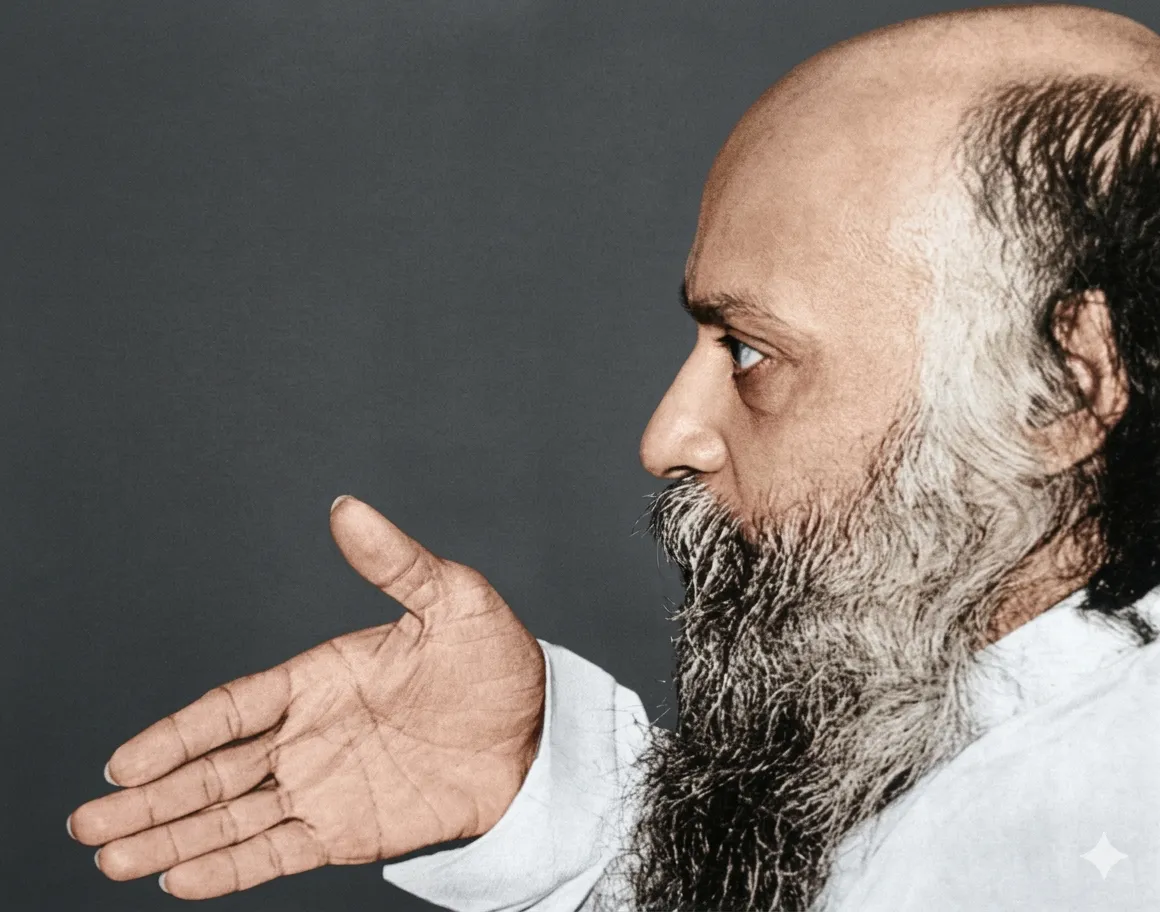
Osho's perspective on Sthita Prajna
When Osho Spoke About Sthita Prajna
Passages from the discourses where this theme comes alive.
Osho, you just spoke about Krishna’s choicelessness. But the Gita mentions that if death occurs when the sun is in Uttarayana, there is liberation. If it happens during Dakshinayana, does one face any difficulty? And about the sthitaprajna and the bhakta as spoken of in the Gita—what is the similarity or difference between the two? A sthitaprajna remains unperturbed in pleasure and unperturbed in pain; isn’t there a danger that in such a state his sensitivity will get blunted? If he does not take pleasure as pleasure and pain as pain, how can we call his sensitivity human?
For example, I love someone. Then there is the lover, and there is the beloved. But in love moments come when neither the one who loves remains nor the one who is loved; only a wave of love remains that touches both. One wave remains that has two ends: on one end the lover appears to be, on the other end the beloved appears to be. Only a wave of love remains. And in the deep moments of love, lover and beloved do not remain—only love remains. These are moments of nonduality. Similar moments occur in witnessing—moments of nonduality. Subject and object vanish; only consciousness remains, with two poles—one far, one near. The near pole is what we have been calling “I”; the far pole is what we have been calling “Thou.” But now they are the two ends of a single wave. The day this state is attained in…
ओशो, अभी आपने कृष्ण के अचुनाव के संबंध में कहा। परंतु गीता में उल्लेख है कि उत्तरायण का सूर्य हो तब जिसका अंत हो तो मोक्ष होता है। यदि दक्षिणायण का सूर्य हो तो क्या कोई तकलीफ पड़ती है? और स्थितप्रज्ञ और भक्त के विषय में गीता में जो बात कही है, इन दोनों में क्या समानता या भिन्नता है? स्थितप्रज्ञ मनुष्य सुख में अनुद्विग्न रहेगा और दुख में भी अनुद्विग्न रहेगा, तो ऐसी मुसीबत खड़ी होने की शक्यता नहीं है कि सुख-दुख दोनों में उसकी संवेदनशीलता, सेंसिटिविटी ब्लंट हो जाए? अगर सुख को सुख की भांति और कष्ट को कष्ट की भांति न ले, तो उसकी संवेदना को ह्यूमन कैसे कहेंगे हम?
जैसे कि मैं किसी को प्रेम करता हूं; तो प्रेम करने वाला है, प्रेम किया जा रहा है, वह है। लेकिन प्रेम में ऐसे क्षण आते हैं जब करने वाला भी नहीं बचता, जिसे किया जा रहा है वह भी नहीं बचता, सिर्फ प्रेम की एक लहर बचती है जो दोनों को छूती है। एक लहर रह जाती है जिसके एक छोर पर करने वाला होता है, एक छोर पर किया जाने वाला होता है। एक प्रेम की लहर रह जाती है। और प्रेम के जो गहरे क्षण हैं, उसमें प्रेमी और प्रेमिका, प्रेमी और प्रेम-पात्र नहीं बचते, प्रेम ही बचता है। वे अद्वैत के क्षण हैं। साक्षी में भी ऐसे क्षण आते हैं जब अद्वैत के क्षण होते हैं। सब्जेक्ट-ऑब्जेक्ट मिट जाते हैं, सिर्फ कांशसनेस रह जाती है, जिसके दो छोर रह जाते हैं--एक दूर वाला छोर, एक पास वाला छोर। पास वाला छोर, जिसे हम ‘मैं’ कहते रहे हैं; दूर वाला छोर, जिसे हम ‘तू’ कहते रहे हैं। लेकिन अब ये एक ही लहर के दो छोर हो जाते हैं। जिस दिन यह स्थिति पूर्णता को उपलब्ध हो जाती है और कभी नहीं खोती, उस दिन साक्षी मिट जाता है। …
Questioner: you explained to us this saying of jesus: "blessed are the meek, for they shall inherit the earth" there is another saying of jesus: "blessed are the pure in heart, for theirs is the kingdom of heaven." can you say something about it?
Yes, there is another saying of Jesus: "Blessed are the pure in heart, for theirs is the kingdom of heaven." But there is a small difference between the two sayings: "Blessed are the meek for they shall inherit the earth," and "Blessed are the pure for theirs is the kingdom of heaven." In fact, humility is the beginning and purity is the end, the attainment. To be humble is to be on the first leg of the journey to purity. The humble has yet to be on the first leg of the journey to purity. The humble has yet to be pure; he is on his way to it. One cannot be pure without being humble, because there is no greater impurity than ego. One who is full of ego can never be pure, but one who drops his ego, who is humble, who is surrendered, is on the path…
When no desire arises for objects worthy of being enjoyed, know this as the limit of nonattachment. When no I-ness arises, know this as the limit of knowing.
WHEN THE DISSOLVED DESIRES DO NOT ARISE BACK AGAIN, THIS IS THE LIMIT OF RELAXEDNESS, AND SUCH A STHITPRAGYA, A SEEKER, STABLE IN WISDOM, EVER REMAINS IN BLISS. HE WHOSE SELF IS ABSORBED ONLY IN BRAHMA, THE ULTIMATE REALITY, REMAINS DESIRELESS AND ACTIONLESS. WHEN PURIFIED BY ITS ONENESS WITH BRAHMA AND DROWNED IN THIS ONE SINGLE RAPTURE, THE ACTIVITIES OF MIND ARE CHOICELESS AND REMAIN ONLY AS THE CONSCIOUSNESS, THEN IT IS CALLED PRAGYA, THE WISDOM. HE WHO ALWAYS HAS SUCH A PRAGYA IS CALLED JIVANAMUKTA, THE ONE LIBERATED WHILE LIVING. ONE WHO HAS NO I-NESS FOR HIS BODY AND THE SENSES, AND NO MY-NESS FOR THE OTHER THINGS, IS A JIVANAMUKTA, THE ONE LIBERATED WHILE LIVING. WHEN NO DESIRE ARISES FOR OBJECTS WORTHY OF BEING ENJOYED, THEN KNOW THIS AS THE LIMIT OF NONATTACHMENT. ... WHEN NO I-NESS ARISES, KNOW THIS AS THE LIMIT OF KNOWING. ... People come to me
What are the qualities of a sthitaprajna?
definitionProfound Quotes on Sthita Prajna
Explore our structured collection of meaning-mapped quotes regarding Sthita Prajna.