
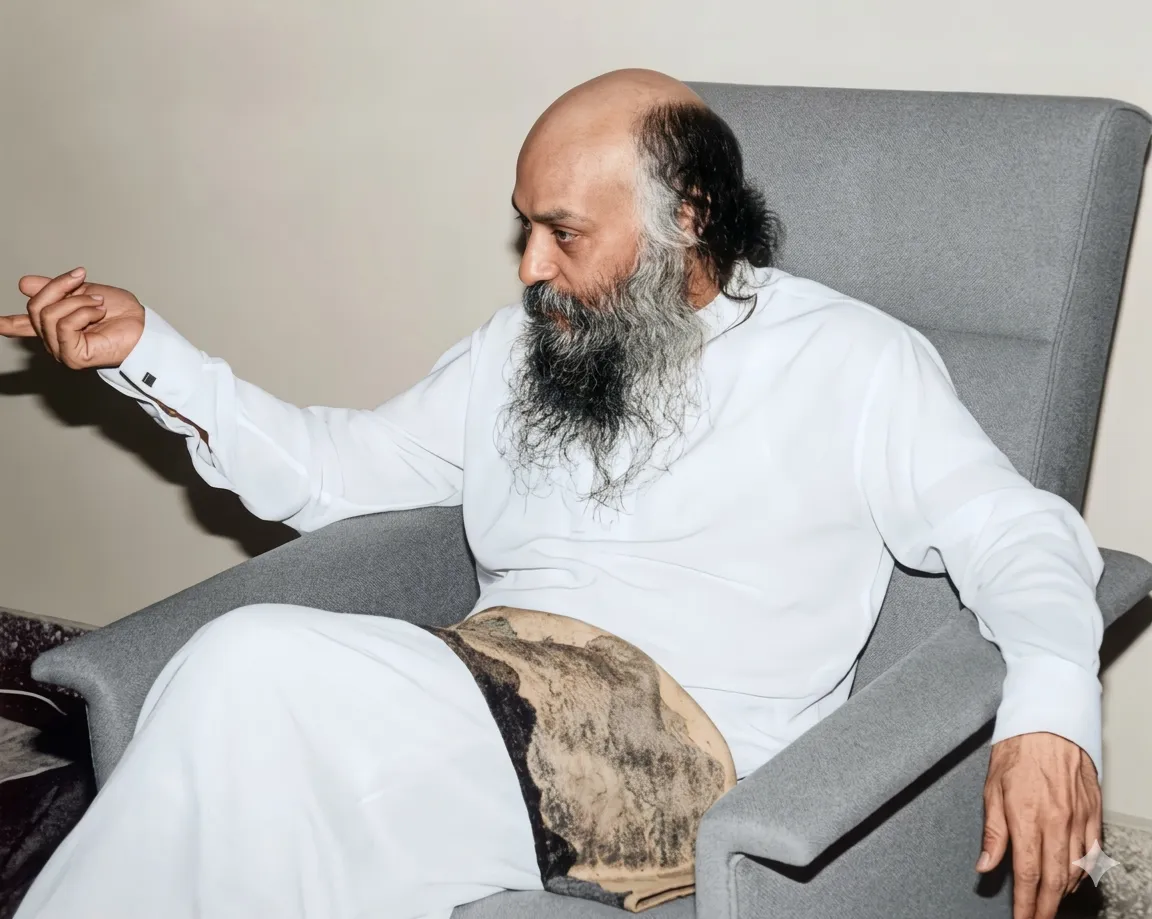
Osho's perspective on Rasavanti
When Osho Spoke About Rasavanti
Passages from the discourses where this theme comes alive.
Visarjan means dissolution, dissolution into the divine, immersion in the divine, the state of being lost.... One has to learn how to disperse oneself, how to come to a point where one is not. Only then god is. You and god cannot exist together; that's not possible. That's why so many people go on missing god -- because they are asking for the impossible: they want to remain themselves and they want to see god. God can be seen only when you are not. That nothingness can encounter god, not you. So the whole process of sannyas is the process of visarjan, dispersion. Slowly, slowly, one loses, goes on losing, goes on losing. The more one loses, the more one understands how beautiful it is not to be. Then more courage arises, a little bit more.
Osho, on the journey of awakening, are rasa, virasa, and sva-rasa merely waystations? Kindly explain.
Such a moment comes now and then in your life—at moments of love, or of prayer, or of meditation. If you have a deep love with someone, sometimes such an exalted peak arises within that neither the lover remains nor the beloved remains. Then Rasa ripens. Then Rasa showers. That Rasa is the Rasa of the Divine. Hence in love the first ray of the experience of God descends; or in some deep absorption of meditation, where the distinction of self and other dissolves and the sky of nonduality opens—there too, God showers. The questioner has asked rightly, but about rasa… He asks: Are rasa, virasa, and sva-rasa merely stages? Rasa is not a stage. Rasa is the source—and the final destination as well. For the ultimate destination can only be that which has also been the source. In the end we return to the source. The circle of life…
पहला प्रश्न: ओशो, बोध की यात्रा में रस, विरस एवं स्व-रस क्या मात्र पड़ाव हैं? कृपा करके समझायें।
ऐसी कभी-कभी घड़ी तुम्हारे जीवन में आती है--प्रेम के क्षणों में या प्रार्थना के क्षणों में या ध्यान के क्षणों में। किसी से अगर तुम्हारा गहरा प्रेम है तो कभी-कभी ऐसा उत्तुंग शिखर भीतर पैदा होता है जब न तो प्रेमी रह जाता न प्रेयसी रह जाती है। तब रस फलता है। तब रस झरता है। वह रस परमात्मा का रस है। इसलिए प्रेम में परमात्मा के अनुभव की पहली किरण उतरती है; या ध्यान की किसी गहरी तल्लीनता में जहां स्व-पर का भेद मिट जाता है, अभेद का आकाश खुलता है, वहां भी परमात्मा झरता है। तो पूछने वाले ने प्रश्न तो ठीक पूछा है, लेकिन रस...पूछा रस, विरस, स्व-रस क्या मात्र पड़ाव हैं? रस पड़ाव नहीं है। रस तो स्रोत है और अंतिम मंजिल भी। क्योंकि अंतिम मंजिल वही हो सकता है, जो स्रोत भी रहा हो। हम अंततः स्रोत पर ही वापिस पहुंच जाते हैं। जीवन का वर्तुल पूरा हो जाता है। जहां से चले थे, वहीं आ जाते हैं। या अगर तुम समझ सको तो जहां से कभी नहीं चले, वहीं आ जाते हैं। जहां से कभी नहीं हटे, वहीं पहुंच जाते हैं। …
A friend has asked: What does “ras-parityaga” mean? Does it mean that attention should not connect with any sense-born vibration? If so, then a ras-tyagi ought to go about with eyes, ears, etc., closed. The blind, the deaf, the mute would be the supreme renouncers. Is this what Mahavira and you think?
A room is empty. Lao Tzu said: a room is empty—you say “empty.” But you can also say: the room is full of itself, not full of things. You can say: it is filled with emptiness. Emptiness too is a fullness. But those who consider furniture to be fullness will find the room empty. The cause of seeing emptiness is not that the room is empty, but your definition of fullness. We have taken things as fullness. The soul has no things. Therefore the soul looks empty. So we try to fill it with things. Greed’s madness begins—never fullness. Mahavira says: one who goes within sees the soul is already full—full of itself, not of something else. The day you sense that fullness, greed disappears. With greed gone, the mad race to collect ends. Those who keep the habit of hoarding—whatever the object—are householders, not monks. What you hoard is…
Osho, the other day you said, “Raso vai sah” — that He is of the nature of rasa. This definition of the Divine is the one I love the most. The full verse from the Taittirīya Upaniṣad is as follows: Raso vai saḥ. Rasaṁ hyevāyaṁ labdhvānandī bhavati. Ko hyevān yāt kaḥ prāṇyāt, yadeṣa ākāśa ānando na syāt. Eṣa hyevānandayāti. “God is rasa itself. By attaining that rasa alone every creature experiences bliss. If that all-pervading element of bliss were not, like the sky, then who would live and who would strive for breath? In truth, that very element is the primal source of everyone’s joy.” Osho,
Just ask your mahatmas whether giving up wealth has brought them meditation. I have asked. And one of your mahatmas couldn’t answer. I tried on the mahatmas all the tricks they use on you—and I was amazed. I don’t know why you haven’t tried those tricks on them till now! They ask you, “Has food given you eternal bliss?” You ask them, “Has fasting given you eternal bliss?” At least with food you are healthy! At least the body has strength! At least you can get up and sit down! In the West there is an abundance of food, so people live longer. Today in Russia there are thousands of people a hundred and fifty years old—thousands, not just a few. If someone reaches a hundred and fifty in Russia, it doesn’t even make the newspaper. A report appeared only when a man reached two hundred. There are many at…
Profound Quotes on Rasavanti
Explore our structured collection of meaning-mapped quotes regarding Rasavanti.