
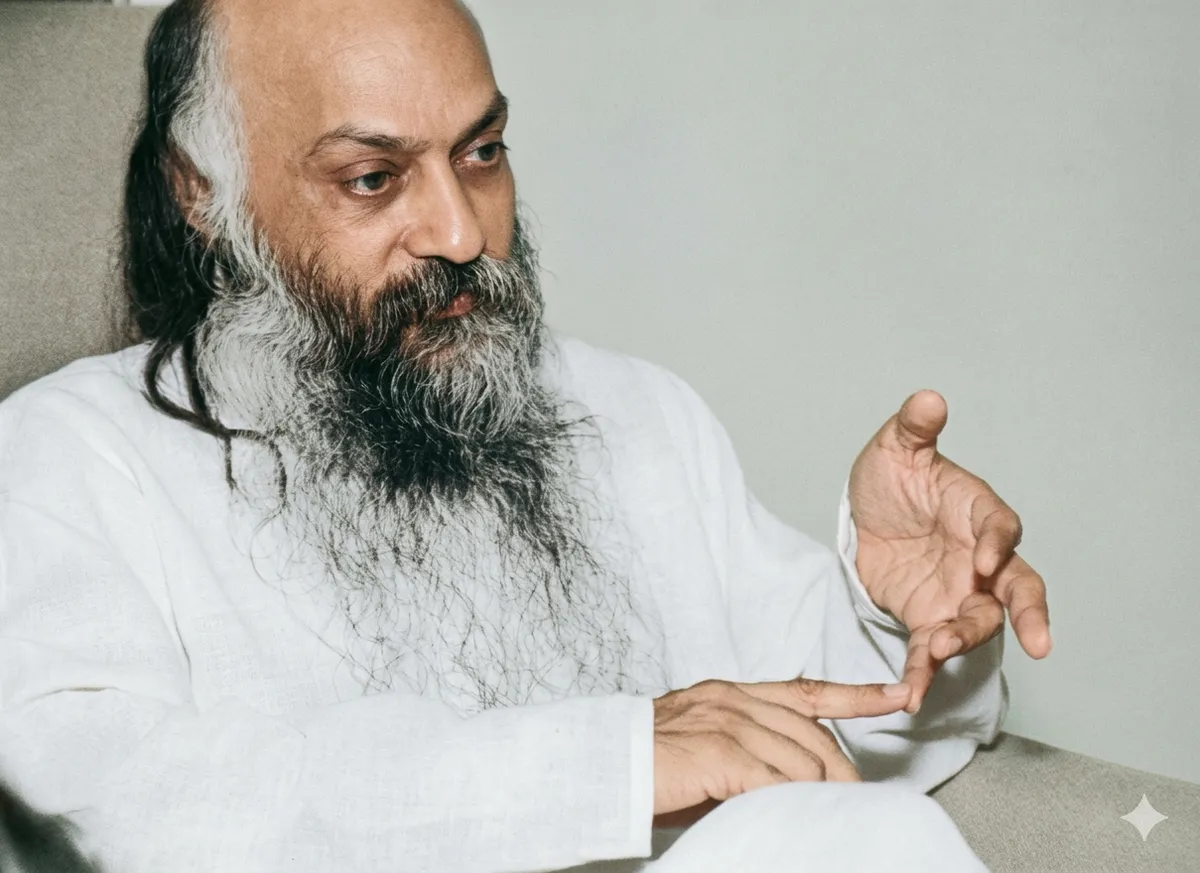
Osho's perspective on Guru Purnima
When Osho Spoke About Guru Purnima
Passages from the discourses where this theme comes alive.
Osho, what is the definition of God?
Words are very small. If you say God is light, then what of darkness? The scriptures have said that God is light. Suppose we accept this as a definition—then what about darkness? Where will darkness go? Darkness is too; in fact it is far more than light. Light sometimes is and sometimes is not; darkness is always, eternal. Where will you place darkness? If you say God is light, darkness is left out. If you say God is darkness, then light is left out. If you say God is both darkness and light, a contradiction arises: they cannot be together. Try to have both darkness and light in the same room. If you bring in light, darkness disappears; if you preserve darkness, you cannot have light. Then how can both be together? That becomes an impossibility. So you cannot say “both” either. Then the fourth device is to say: it…
पहला प्रश्न: ओशो, परमात्मा की परिभाषा क्या है?
शब्द तो बड़े छोटे-छोटे हैं। अगर कहो परमात्मा प्रकाश है, तो फिर अंधेरे का क्या होगा? ऐसा कहा है शास्त्रों में कि परमात्मा प्रकाश है। चलो मान लें इसे परिभाषा, फिर अंधेरे का क्या होगा? फिर अंधेरा कहां जायेगा? अंधेरा भी है, प्रकाश से कहीं ज्यादा है। प्रकाश तो कभी होता है कभी नहीं भी होता; अंधेरा सदा है, शाश्वत है। अंधेरे को कहां रखोगे? अगर कहा परमात्मा प्रकाश है, तो अंधेरा बाहर पड़ गया। अगर कहा परमात्मा अंधेरा है, तो प्रकाश बाहर पड़ गया। अगर कहो परमात्मा अंधेरा प्रकाश दोनों है, तो विरोधाभास होता है। दोनों एक साथ हो नहीं सकता। एक ही कमरे में अंधेरा और प्रकाश करके दिखाओ। प्रकाश करोगे, अंधेरा खो जायेगा; अंधेरा बचाओगे, प्रकाश न कर सकोगे। तो दोनों साथ कैसे होंगे? तब एक असंभव बात हो गई। तो यह भी नहीं कह सकते कि दोनों है।
Osho, on this sacred occasion of Guru Purnima, kindly accept our prostrations offered with deep love and gratitude by all of us disciples. Also, in the following guru-prayer verse the Guru is said to be the forms of Brahma, Vishnu, and Mahesh, but then he is further called “the very Parabrahman made manifest”! Please shower your grace and help us understand these diverse forms of the Guru. The verse is: gurur brahmā gurur viṣṇuḥ gurur devo maheśvaraḥ | guruḥ sākṣāt parabrahma tasmai śrī gurave namaḥ ||
A disciple is one ready to be annihilated. A student is busy polishing himself: more knowledge, more information, more degrees, more certificates, more medals. The student is engaged in self-decoration. The curious has just begun the journey—Brahma’s work has begun—the seed is sown; creation begins. The student moves a little ahead—two leaves unfold. The disciple is one ready to die, to be dissolved—who says, “I am ready to offer everything to the Guru.” From that readiness a disciple is born. Not every student is a disciple. A student’s eagerness is for knowledge; a disciple’s eagerness is for meditation. Knowledge feeds and polishes your ego; meditation kills and dissolves it. - The fourth state is the devotee. A devotee means one who has already dissolved. The disciple began; the devotee completed. The devotee knows the state of Parabrahman—the one who, before the Guru, has utterly dissolved; nothing remains even to say,…
पहला प्रश्न: ओशो, गुरु पूर्णिमा के इस पुनीत अवसर पर हम सभी शिष्यों के अत्यंत प्रेम व अहोभावपूर्वक दंडवत प्रमाण स्वीकार करें। साथ ही गुरु-प्रार्थना के निम्नलिखित श्लोक में गुरु को ब्रह्मा, विष्णु, महेश तीनों का रूप बताया है, परंतु इसके आगे उसे ‘साक्षात् परब्रह्म’ भी कहा है! कृपा करके गुरु के इन विविध रूपों को हमें समझाने की अनुकंपा करें। श्लोक है: गुरुर्ब्रह्मा गुरुर्विष्णुः गुरुर्देवो महेश्वरः। गुरुः साक्षात परब्रह्म तस्मै श्री गुरुवे नमः।।
शिष्य वह है, जो मिटने को तैयार है। विद्यार्थी वह है, जो अपने को सजाने-संवारने में लगा है। थोड़ा ज्ञान और, थोड़ी जानकारी और, थोड़ी पदवियां और, थोड़ी डिग्रियां और। थोड़े सर्टिफिकेट, थोड़े प्रमाण-पत्र, थोड़े तगमे! विद्यार्थी तो वह है, जो अपने को संवारने में लगा है। और जो कुतूहल से भरा है, उसने तो अभी यात्रा ही शुरू की; अभी तो ब्रह्मा का ही काम शुरू हुआ; बीज बोया गया। अभी सृजन की शुरुआत हुई। विद्यार्थी जरा आगे बढ़ा, उसमें दो पत्ते टूटे; अंकुर फूटे। शिष्य वह है, जो मिटने को तैयार है, मरने को तैयार है; जो कहता कि गुरु के लिए सब-कुछ समर्पित करने को तैयार हूं। उस तैयारी से शिष्य बनता है। सभी विद्यार्थी शिष्य नहीं होते। विद्यार्थी की उत्सुकता ज्ञान में होती है; शिष्य की उत्सुकता ध्यान में होती है। ज्ञान से तुम्हारा अहंकार भरता है और संवरता है। ध्यान से तुम्हारा अहंकार मरता है और मिटता है। और चौथी अवस्था है भक्त की। भक्त का अर्थ होता है: जो मिट ही चुका। शिष्य ने शुरुआत की; भक्त ने पूर्णता कर दी। …
The full-moon night has a very alchemical impact on the human consciousness. Buddha became enlightened on the full-moon night -- not only that, he was born on the same full moon night, he became enlightened on the same full-moon night, he died on the same full moon. His birthday, his death day, his enlightenment day, all fall on one day -- the full-moon night... the same month, the same night. The full moon has tremendous importance, so just do one thing: you can remain available, that's all. If it happens, good; if it doesn't happen don't feel worried about it. Next time again you try -- when the full-moon night comes, start at least five days before, sitting in the night, just waiting. Wait one hour every night for five days, then the full moon will come.
Why do Puranic, mythic tales gather around enlightened ones? Please explain.
The full moon is a symbol of fullness. Grasping that symbol, the Purana says: the Buddha was born whole—born on a full-moon night—born cool, radiant, with the complete beauty, carrying a unique ambrosia. Then, on a full-moon night, that hidden nectar within him flowed forth, blossomed, opened like a lotus—he attained. And on a full-moon night he departed, for even the death of a buddha is full, as his birth was full. Everything in the Buddha’s life is complete. To say this—that everything in the Buddha’s life is complete—we chose the symbol of the full moon. People choose different symbols, but the value lies not in the symbol itself; the value is in the meaning we pour into it. That is why Puranas arise around enlightened ones; mythic stories are created. Through the meanings hidden in those stories you can understand what buddhahood signifies. There are two kinds of fools…
चौथा प्रश्न: बुद्धपुरुषों के साथ पुराण कथाएं क्यों जुड़ जाती हैं। कृपा करके समझाइए।
पूर्णिमा तो प्रतीक है पूर्णता का। उस पूर्णता के प्रतीक को पकड़कर पुराण कहता है, बुद्ध पूरे पैदा हुए--पूर्णिमा की रात पैदा हुए--शीतल पैदा हुए, पूरी छवि से पैदा हुए, पूरे सौंदर्य से पैदा हुए, अपूर्व अमृत को लेकर पैदा हुए। फिर पूर्णिमा की रात्रि ही उनके भीतर छिपा हुआ यह अमृत बहा, प्रगट हुआ, स्फुटित हुआ, यह कमल खिला। फिर पूर्णिमा की रात को ही बुद्ध ज्ञान को उपलब्ध हुए, क्योंकि ज्ञान भी पूर्णिमा की रात्रि है। फिर बुद्ध पूर्णिमा की रात्रि ही विदा हुए, क्योंकि मृत्यु भी बुद्ध की पूर्ण होगी, जन्म भी पूर्ण होगा। बुद्ध के जीवन में सभी पूर्ण है। इस बात को कहने के लिए कि बुद्ध के जीवन में सभी पूर्ण है, हमने यह प्रतीक चुन लिया, यह पूर्णिमा की रात्रि। प्रतीक लोग अलग-अलग चुनते हैं, लेकिन प्रतीक मूल्यवान न होकर, प्रतीकों में जो हम अर्थ डालते हैं वह मूल्यवान है।
Profound Quotes on Guru Purnima
Explore our structured collection of meaning-mapped quotes regarding Guru Purnima.