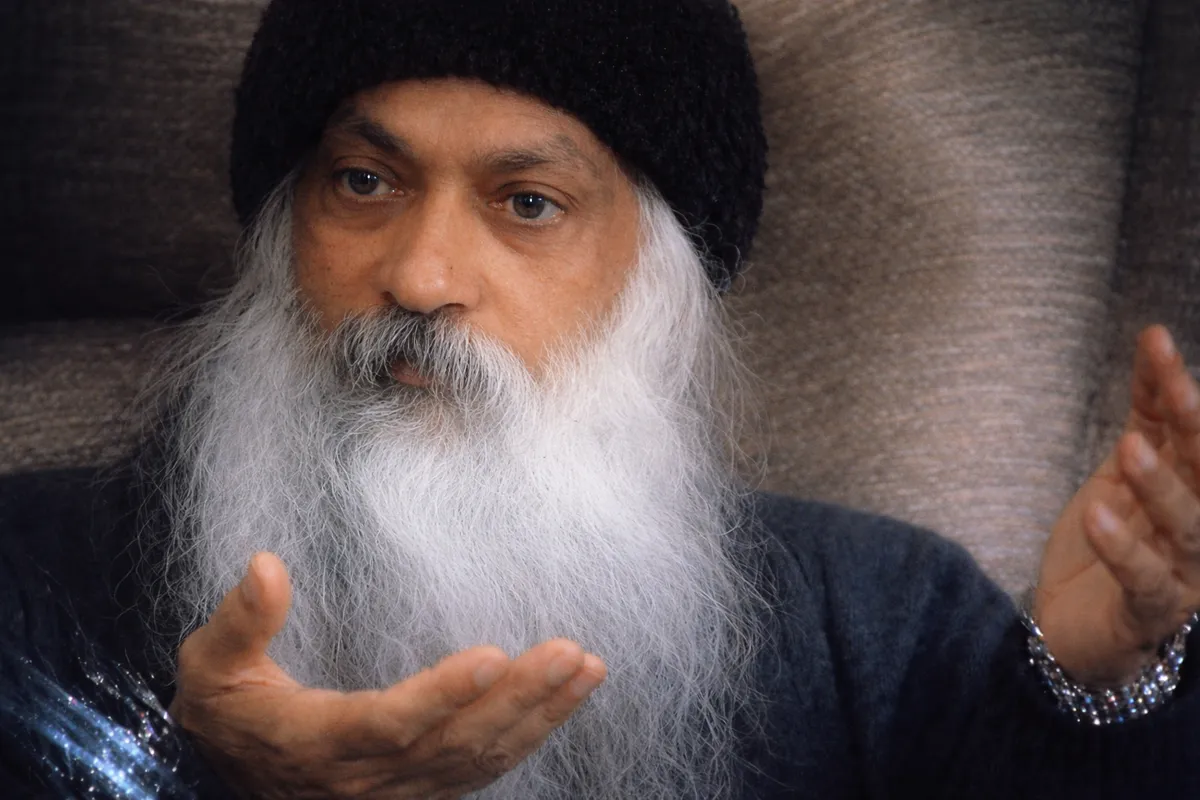
Browse an extensive collection of Osho's most profound quotes, curated semantically by topic and discourse source. Uncover transformative wisdom organized dynamically for deep contemplation.
In the dance of words, a profound resonance awakens the essence of our innermost reality, revealing a paradox where the seemingly new is but a gentle reminder of forgotten truths, echoing Osho's belief in the cyclical nature of self-discovery.
In the essence of Osho’s wisdom, the guru-disciple relationship transcends mere teaching, blossoming into a silent communion where the guru, embodying truth without ego, invites the disciple—through trust and reverence—to partake in a shared realization that defies the confines of thought.
In the embrace of let-go, a serene, thought-free state, witnessing flourishes like a blossoming flower; together, they cultivate pure awareness, transforming mere existence into a profound celebration of joyful presence—the essence of life itself.
Osho illuminates the idea that understanding flourishes in the embrace of opposition, where the friction of contrasts sharpens our awareness, revealing truths that remain obscured without the dynamic interplay of light and shadow, joy and sorrow.
In the dance of love and joy, fear becomes the shadow that tempts us to flee; yet, by embracing the ebb and flow of these emotions and cultivating inner awareness through meditation, we find that the urge to escape gracefully dissolves into trust and maturity.
In the essence of non-doing, one finds a profound rest in pure being—silent and egoless—as the boundaries of self dissolve, merging with the symphony of existence, where each moment transforms ordinary tasks into a creative dance infused with joy and wonder. Embracing this presence, even in stillness, allows life’s mysteries to flow through every action.
In the profound silence of the void, where words and thoughts dissolve into futility, one finds liberation not through method, but by ceasing to pedal against the current, allowing the mind’s momentum to unravel and reveal effortless openness.
Osho's philosophy celebrates self-expression as a revolutionary act that embraces our humanity, intertwining the joy of Zorba with the awareness of Buddha, where sacred living in the present reveals the depths of existence without the need for a promised otherworld.
Osho illuminates the notion that true sainthood transcends egoic labels, rejecting the divisive dichotomy of saints and sinners, and instead embraces choiceless awareness, recognizing that each individual is a sacred part of the unified consciousness.
Inspiration unfolds when the heart, in its quiet wisdom, embraces a budding faith that transcends the mind's skepticism, allowing doubt to gracefully evolve into a vibrant trust that anchors us in the present moment.
Homosexuality represents a natural stage in the evolution of sexuality, yet Osho emphasizes that true liberation lies not in clinging to any identity, but in transcending all sexual definitions to embrace love, awareness, and a spiritually fulfilled existence.
Equanimity blossoms when one recognizes that both joy and sorrow spring from the same source, inviting us to embrace each as a gift; sorrow, far from an adversary, refines our spirit and elevates us closer to bliss, transforming life's challenges into sacred steps toward the divine.
Ambition, often born from fear and an inferiority complex nurtured by a comparison-driven education, fades when true understanding emerges, allowing individuality to flourish and transforming the competitive mind into a garden of love.
In the mirror of self-reflection, one discovers not a fixed identity but a profound nothingness, where living awareness transcends ego and stories, allowing for a fresh, spontaneous encounter with each moment, free from the weight of validation.
In the dance of existence, both the slumbering and the awakened are mere vessels through which life flows; the former clings to the illusion of doership, while the latter embraces the profound clarity of non-doership, revealing that true alertness resides in awareness of the emptiness within.
The essence of Osho's wisdom reveals that the true struggle lies not in battling tobacco, but in recognizing the mind's craving for habit; by observing the urge and confronting the inner emptiness it conceals, we can dissolve these patterns with insight, free from guilt or substitutes.
True seeing unfolds in the embrace of patience, where the restless mind surrenders its desires, allowing clarity to emerge effortlessly from the stillness of the present moment, revealing the profound beauty that lies within.
Osho envisions business as a vibrant dance of life, where the true essence lies in liberating individuals from anti-life conditioning, fostering joy and love, and transforming the mundane into a sacred celebration of existence.
To embrace true fulfillment is to awaken to the realization that we are already what we seek, playfully navigating life without ambition or hierarchy, respecting each other as fellow travelers in this cosmic dance of existence, laughing together at the beauty of our shared journey.
Repentance, as Osho might suggest, unfolds as a rich tapestry of meaning—inviting genuine remorse for sins, a call to responsibility in the divine dialogue, and a return to one's true essence, reminding us that rigidity can obscure the sacred poetry of existence.
Sattvic actions illuminate the path to clarity and detachment, yet when the ego claims their fruits, they bind us; true wisdom, as Osho suggests, lies in embracing humble not-knowing, allowing sattva to be a transparent vessel that carries us across the river of existence, free from the chains of identification.
The Tirthankaras, starting with Adinath, embodied the essence of Aryan sages within the Shramana tradition, imparting wisdom on liberation through dedicated effort, while Mahavira ultimately crystallized their teachings into the distinct identity of Jainism, echoing Osho's belief in the transformative power of inner resolve.
In the spirit of Osho, raising both hands embodies a harmonious union of mind and body, transcending cultural biases; it invites a wholehearted affirmation where every gesture resonates with the entirety of one's being, reflecting an authentic, undivided yes.
Embracing the idea that the unconscious is not an adversary but merely a lesser state of awareness, Osho invites us to illuminate our inner depths through meditation and nonjudgmental observation, revealing that true freedom arises when clarity supplants compulsion.
The Mystery School of Pythagoras emerged as a vibrant conduit of wisdom, weaving together the experiential truths of Egypt and the lost Atlantean legacy, transcending mere sophistry and embodying the integrity of a consciousness that Osho might celebrate as a path to self-realization.
In the journey toward self-discovery, the true essence of one's original face emerges only when the illusion of the self dissolves, revealing an unclouded authenticity that radiates effortlessly into the world, inviting us to embrace our deepest being.
Population control flourishes not through coercion but by nurturing a profound sense of responsibility; as Osho suggests, dismantling fatalistic beliefs around procreation reveals the power of choice, empowering individuals to embrace contraception and thoughtful family planning.
The essence of fragrance is not a lingering trace, but rather the blossoming of meditativeness within; as you embody this sacredness, love, silence, and gratitude become your shadow, inviting others to share in the beauty of your being.
In the spirit of Osho's teachings, true dialogue blossoms not from incessant questioning but from a profound silence that allows us to listen deeply; it is in this stillness that genuine understanding unfolds, revealing answers from within.
Becoming is a mirage; true awakening lies in shedding the layers of imagination that obscure our essence, much like revealing the Kohinoor from beneath the mud, where clarity emerges as ego dissolves and reality unfolds in its purest form.
In the dance of impermanence, the essence of the eternal whispers through our senses, where words serve merely as metaphors guiding us inward; it is in this inner awakening that we feel the pulse of the deathless within the fleeting.
True renunciation springs from a place of choicelessness, where the desire to gain is relinquished; in this surrender, one discovers that mastery and genuine fulfillment emerge effortlessly, revealing that true freedom lies in embracing loss rather than pursuing it.
In the divine play of existence, or lila, the universe's striking regularity unfolds through God's adherence to His own rules, revealing a purposeless yet lawful dance that science observes, inviting us to dissolve anxiety and embrace profound peace.
In the stillness of the heart, beyond the mind's relentless chatter of indulgence and renunciation, lies a profound emptiness; here, clarity emerges, allowing the essence of the Whole to transcend dualities and illuminate our true nature.
Embracing the present moment invites us to become a mirror, practicing the art of witnessing meditation, where we observe thoughts of past and future drift by like currents in a river, allowing silence and clarity to unveil the divine reality of now.
The rebel transcends all existing categories, embodying a new essence of absolute freedom, love, and creativity; unbound by the past, he embraces the present and an open future, inspiring a transformative shift in humanity through his authentic existence.
A genuine technique reveals itself in an instant, as the observer within undergoes a profound shift; anxiety dissipates, replaced by a grace that elevates daily actions, leaving one feeling momentarily out of place in the old world before harmonizing on a higher plane.
In the essence of Osho's teachings, the sweetness of a saint's speech arises from the Divine, as they become hollow vessels—flutes through which God breathes—allowing nectar to flow and seekers to savor the reassurance of that living presence.
Regret, a product of ignorance, robs us of the vibrant present, binding us to an unchangeable past; by releasing self-reproach and embracing the richness of now, we truly awaken to life’s fleeting beauty, savoring each moment without the weight of what was.
Osho invites us to explore the intricate layers of self-perception, from the superficial social mask to the profound emptiness of our innermost being, urging mindful awareness and gradual maturity to unveil the silent core that transcends all images.
In the absence of realizing one's Buddha nature, another's presence reflects the ego's dance of superiority and inferiority; yet, in genuine love for the Master, this comparison fades, revealing the inherent perfection within and allowing gratitude to blossom in the space of dissolution.
In the spirit of Osho's teachings, the Upanishads unveil ultimate reality as a profound paradox—both distant and intimately close, transcendent yet immanent—revealing that when the ego dissolves, the witnessing consciousness awakens to its own essence, experiencing true darshan.
In the dance of existence, true unity emerges not from surrendering to the unconscious pull of the crowd, but from the awakening of the individual spirit; it is through this personal evolution that genuine oneness blossoms, transcending mere imitation.
In the embrace of uncertainty, when action eludes us, surrendering to stillness allows existence to unfold its wisdom, revealing clarity and effortless action, much like spring’s gentle awakening of life from the depths of winter.
In the essence of Osho's wisdom, the true power of mantras lies not in the words we chant but in the silent, eternal melody of the ajapa that resonates within, effortlessly connecting us to the Divine when all external sounds fade away.
True protection of a beloved teacher lies in our inward growth, where maturity and divine attunement flourish; it is through our transformed lives, vibrant love, and the cool flame of unconditional sharing that we embody and preserve the essence of their teaching.
In the dance of existence, where belief in an immortal soul intertwines with the shadows of fear and ignorance, humanity conjures ghosts, embodying our primal anxieties and the yearning for connection beyond death, as Osho might suggest, blurring the lines between reality and illusion.
In the dance of existence, Zorba's earthy vitality nurtures the roots of sensuality, while Buddha's blossoming awareness and compassion reveal the sacred unity of life; embracing both the seed and the flower transforms raw energy into love and insight, honoring the wholeness of being.
In the spirit of Osho, even opposition transforms into a blessing, as every word spoken—whether in praise or critique—serves to ignite curiosity and draw others closer, turning criticism into an unexpected invitation for deeper exploration.
Unconsciousness, as Osho might suggest, is a deep metaphysical slumber where one moves through life like a marionette, oblivious to the vibrant tapestry of existence, devoid of the inner presence that awakens true awareness and connection.
In the spirit of Osho's teachings, Krishna embodies a transcendent awareness where theism and atheism converge, revealing that profound seekers, regardless of their labels, ultimately grasp the same nondual truth, inviting us to transcend superficial debates and embrace the entirety of existence.
In the serene presence of a seer, the self-conscious ego gently recedes, and like a soothing breeze, his silent peace unveils the true essence of refuge, reminding us that in moments of forgetfulness—among birds or by a river—existence itself becomes our sanctuary.
Life unfolds as a vast dream for those still asleep, where even the Master's wisdom becomes mere illusion; yet for the awakened, reality shines with clarity, revealing the intrinsic light within, as his teachings serve as a gentle alarm clock urging us to awaken from our slumber.
Intensity emerges as the harmonious union of scattered desires converging into a singular flame, embodying a centripetal energy that transcends fragmentation; in moments of danger, love, or meditation, thoughts dissolve, allowing the individual to experience profound fulfillment and the divine.
In the spirit of Osho's teachings, one discovers that true spirituality lies not in renouncing possessions but in shedding the clinging attachment to them, embracing only what is essential for the journey while remaining unbound and ready to let go.
In the dance of spiritual practice, Osho reveals that while men often approach with assertive zeal, proclaiming God comes to me, women embody a grace of surrender, whispering I come to God, illustrating the harmonious interplay of inner attitudes that enrich our shared journey toward the divine.
In the dance of existence, where beginnings and endings intertwine, non-attachment emerges as a seed that, through conscious practice and the shedding of old patterns, blossoms into effortless spontaneity, inviting us to embrace the journey with a heart free of desire.
Possessiveness flourishes from our own sense of emptiness, as we mistakenly seek fulfillment in ownership rather than true being; through awareness and meditation, we learn to transform our attachments into utilities, allowing love to flourish as a genuine connection rather than a means of possession.
In the spirit of Osho's teachings, kirtan invites a surrender to the flow of existence, allowing images to rise and fade without attachment, as one melts into the ocean of oneness, where the ego and all forms dissolve into the boundless essence of being.
In the dance of decision-making, true freedom blossoms when you recognize that no external authority dictates your choices; instead, it is your own awareness and will that shape your path, liberating you from the chains of societal expectations and divine interventions.
Orgasm embodies the nonsexual essence of unity, where male and female polarities dissolve into a singular energy, transcending thought and time, revealing pure awareness; this insight mirrors meditation, allowing us to access that same timeless consciousness independently.
Sex energy, when expressed freely and without guilt, transforms into heightened consciousness; only after fulfilling this instinct can one sit in meditation, allowing that energy to elevate the spirit, while repression breeds obsession and turmoil.
Time unfolds as a linear journey from A to B to C, leading inevitably toward death, while eternity rises vertically, deepening the essence of A into a profound awakening; in that rare moment of meditation, the temporal and timeless converge, transforming mere existence into vibrant presence.
In the spirit of Osho's philosophy, literature transcends geographical boundaries, drawing from a rich tapestry of both Eastern and Western narratives, where the essence of truth is illuminated by the most vivid examples, regardless of their origin, inviting fresh perspectives to enrich understanding.
Utopia, as envisioned by Osho, emerges from our sacred discontent with the status quo, inspiring a relentless pursuit of better education, relationships, and social structures, while awakening us from the hypnosis of authority to embrace a more liberated and humane existence.
Embracing the divine experience requires a surrender to effortless awareness, where the pursuit of it only hinders our connection; by relinquishing the 'I' and immersing ourselves in egoless stillness, we find grace flows back to us naturally.
Osho illuminates that while religion and meditation may not drive economic prosperity, they cultivate an inner richness—awakening awareness and serenity that transcend superficial wealth, guiding us toward a more meaningful existence rooted in fulfillment rather than material gain.
Samskaras dissolve not by merely swapping bad habits for good, but through the awakening of the witness within, where one recognizes their separation from impulses; in this vigilant awareness, actions arise from mastery, leaving no new imprints and allowing one to navigate life’s tendencies with sovereign grace.
In the spirit of Osho, negativity embodies a relentless fixation on darkness that obscures beauty and possibility, while genuine questioning serves as a liberating force, inviting clarity, growth, and a deeper communion with life’s inherent light.
Ahimsa, as understood through Osho's lens, is not a distant ideal but a natural expression of recognizing life's inherent unity; when we truly perceive this oneness, nonviolence emerges effortlessly, just as water transforms into steam, each path to this realization uniquely beautiful yet fundamentally complete.
In the dance of existence, the ache of loneliness emerges from a yearning for connection, while true aloneness shines as a radiant state of self-contentment; embrace provisional comforts to soothe your journey, but ultimately, revel in the joy of your own company.
Swadharma, embodying one’s essence, reveals itself as nirguna—an unadorned potential—transforming into saguna through expression; much like the seed unfurling into a flower, it invites us to experience the unity of existence in moments of deep stillness.
Awakening to the truth that you have never truly left your source, like the Ganges flowing back to its origin or a seed becoming a tree, reveals that separation is but a dream of thought; in simple wakefulness, you discover you are the Buddha, present and whole.
Embracing the essence of enlightenment, one can thrive as either a king or a beggar, for true awakening transcends societal roles; choosing the regal path, he sought to embody the playful freedom of life’s untried possibilities, proving that liberation knows no bounds.
In the dance of language, where words weave an ideological tapestry, Osho reveals that true communication transcends mere concepts, inviting us to embrace the silent communion between thoughts, where authentic truth blossoms beyond the confines of ideology.
Desirelessness, as Osho suggests, does not impede progress; rather, it refines it, fostering a serene mind that embraces creativity and ethical abundance, where true wealth emerges as a natural byproduct of inner fulfillment rather than frantic pursuit.
Wholeness emerges not through relentless seeking or thought, but in the profound stillness of non-doing, where the ego dissolves and the self surrenders, creating a sacred space for the complete to reveal itself in the quiet embrace of emptiness.
In the embrace of stillness, one discovers that true tranquility arises not from striving or methods, but from surrendering to the present moment; when the relentless pursuit of achievement fades, silence naturally unfolds within.
Paradoxes serve as a masterful tool to confound the logical mind, guiding us beyond its confines into fleeting glimpses of the transcendental; in this space, the shattering of mental habits reveals a deeper understanding of our true essence.
Sincerity, as Osho beautifully illuminates, is the essence of true living; it calls for an unwavering heart in our words and actions, shattering the facade of pretense and nurturing authentic love, understanding, and vibrant existence.
In the dance of existence, forcing the river of life only breeds frustration, while surrendering to its currents reveals that even adversaries can be profound teachers; true victory emerges when we cease striving and allow ourselves to flow with the essence of being.
Neo-Sannyas embodies a vibrant affirmation of life, love, and sexuality, embracing all that heightens awareness and draws one closer to the divine, while steadfastly rejecting denial and anything that dulls the spirit, guiding seekers to include what enlivens and to shed what sedates.
Enlightenment, as Osho beautifully illustrates, is a personal journey that cannot be bestowed by even the wisest master; instead, it flourishes within the seeker, nurtured by the loving presence of a guide and the supportive energy of the community.
In the spirit of Osho's wisdom, true progress blooms from thoughtful reflection, as clarity and calm focus illuminate the path forward, while worry merely fragments our energy, stalling meaningful growth in the outer world.
A smile, as Osho might suggest, embraces the paradox of our word-bound existence, transcending the burdens of speech to reveal a profound silence; it emerges in the stillness between words, reminding us that true understanding lies beyond the confines of language.
Gandhi’s reliance on women as a protest against tradition, while noble in intent, reveals a misunderstanding of male-female dynamics; as Osho suggests, true honor lies in celebrating the unique strengths of each, rather than forcing them into unnatural roles.
In the spirit of Osho's teachings, color transcends mere attributes of objects; it emerges from the interplay of light, perception, and awareness, revealing that what we deem solid is a dynamic dance of consciousness, urging us toward humility and liberation from fixed notions.
Embracing the complexity of feeling ‘mixed’ reveals the intellectual's journey, where doubt serves as a conscious guide; thus, choosing techniques that resonate with the mind is essential, while avoiding borrowed beliefs fosters authenticity and clarity.
The Master embodies both the purifying fire of death and the essence of Brahman, dissolving the ego and false hopes, allowing the true, deathless self to emerge; in surrendering to this transformative process, one awakens to the radiant Great Life within.
In transcending the confines of the mind, the unknown transforms into the unknowable, inviting us into the sacred realm of existence where experience eclipses explanation, and the essence of being unfolds in a profound, wordless communion.
In the practice of pranayama, one discovers a sacred rhythm where each out-breath expands the spirit toward the infinite, while the in-breath gently guides us back to the profound emptiness, inviting us to dance gracefully between creation and dissolution, and ultimately awaken to the divine essence that unites them.
Embracing the essence of Osho's wisdom, one discovers that true liberation lies in the gentle acceptance of resistance itself; by witnessing it without struggle, we sever its lifeline, allowing it to fade away naturally.
In the stillness of samadhi, one savors the self-illuminating essence of the absolute, a state of pure awareness that exists independently, untouched by the fleeting nature of relativity, where hot and cold are mere comparisons to a light that needs no other to shine.
Embracing the title of Bhagwan invites us to acknowledge the singular divine reality within ourselves, where the choice lies not in becoming God but in awakening to our inherent divinity; by naming life as 'God,' we unlock growth and adventure, while labeling it 'matter' confines us.
In the dance of existence, Osho illuminates that while the 'masculine' mind flourishes in urgency and effort, the 'feminine' spirit thrives in surrender and playful receptivity; embracing your true nature without dilution leads to harmonious fulfillment.
True enjoyment emerges when we transcend the ego's demands for attention, for in the moment we release our attachment to self, joy blossoms effortlessly, unshackled from the childhood conditioning that equates misery with worth.
In the embrace of samadhi and brahmacharya, procreation transcends mere lust, evolving into a sacred act of love and awareness, where consciously invited children arrive as cherished souls, enriching life and alleviating the burdens of overpopulation.
Deconditioning unfolds not through affirmations, which merely reinforce existing beliefs, but through a relentless negation—neti, neti—discarding all notions until one reaches a profound emptiness, where the 'no-mind' emerges, free to explore without the weight of societal imprints.
In the dance of existence, where the world reflects our inner landscape, perceiving evil reveals only our own shadows; yet, through awareness, meditation, and love, we can transform our consciousness, discovering beauty in what once seemed threatening, much like Rinzai, who embraced the thief as a benefactor.
In the spirit of Osho, sannyasins embrace their essence by declaring 'Brahman' as their caste and 'Shunya' as their religion in the census, affirming that true seekers, free from societal labels, resonate with the soundless music of the divine within.
One tap — creates your free account, or signs you back in.
Already have an account? Login here
New here? Create a free account
Enter your account email and we'll send you a link to choose a new password.
Remembered it? Back to login