
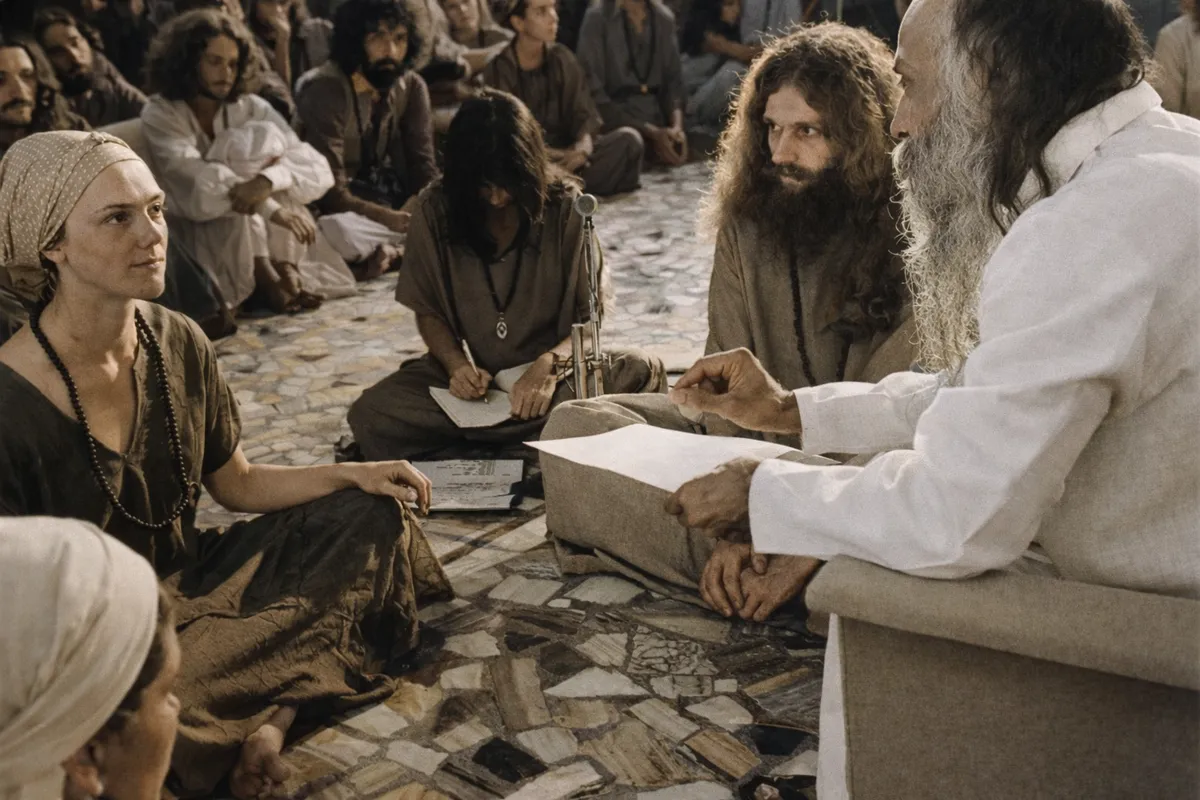
When you become calm, aware, and fully alive inside, your eyes naturally look bright because they show what’s happening in your heart.
From the Discourses
Passages where Osho speaks to this question — each links to the complete discourse.
Beloved Osho, yesterday a visitor to our house commented that we all have unusually shiny eyes. I have heard many others say the same. Why do your sannyasins have shiny eyes?
Because they are my sannyasins, they reflect my eyes, they reflect me. Their heartbeat reflects my heart. As you become silent, as you become more alert, your eyes will have a different shine; otherwise ordinarily people's eyes are just sleepy, no shine. Their faces look as if they are drugged or they are half awake. What they say does not seem to be coming from any authority. Their gestures are dead. Their whole life is partially lived. To be a sannyasin means to live life totally and intensely. In that intensity your eyes will be affected the most. In India, Jainism has two sects. The differences are very small but in some way very significant. One sect worships Mahavira's statue with eyes closed and the other sect worships him with eyes open. Now this is not so much of a difference that you should create different temples and fight continuously,…
Osho, sannyas was born in this land; it was granted the dignity of Gaurishankar (Everest). But today its honor has become merely superficial. Inside, the individual and society alike are afraid of it. Why have sannyas and the sannyasin lost their meaning? Please explain.
In my sannyas there is no prohibition—no “leave this, run from that.” Awakening is enough. Cowards run. Those who awaken remain where they are and are free there. My sannyas does not want to give you knowledge; it wants to give you meditation. Meditation means emptiness; it means: I do not know. Life is such an ultimate mystery that nothing definitive can be known about it. And I want to give sannyas a new posture—creativity. I will call him a sannyasin who sings a new song; who strikes a new music from the veena; who dances a new dance; who makes this world a little more beautiful, brings a little more blessedness to the earth. Then sannyas can regain its dignity. And I would have the sannyasin not imitate. Listen, understand, contemplate—but live from your own individuality. Therefore I give my sannyasins no codes of conduct—only processes to awaken the…
And the story is beautiful -- I don't think it is factual, it cannot be, but it is significant: Krishna becomes a window and Arjuna can see the vast universe, stars appearing and disappearing, the whole eternity. It is so vast that he becomes frightened. Its very vastness is frightening, is scary. He trembles, perspires and starts shouting, 'Close this window! I am absolutely convinced of what you are saying but don't show me this vastness -- this is too much. I cannot look at it any more.' And Krishna closes the window, he becomes again the same friend; he had disappeared and Arjuna had had a glimpse of the eternal process of existence. The parable is beautiful because that's exactly what happens between a disciple and a master -- but not literally; it is a beautiful metaphor, metaphorically it really happens. It is difficult to surrender to the whole.
In that very moment one passes through a radical transformation. Then life is no more the same again. When you are with closed eyes all is dark. When you are with open eyes life is all colour, all light. God is the experience of existence with open eyes. Those who deny god are simply saying that they are blind. Not only are they blind, they are stubborn too. They are insisting that they are not blind but that there is no god. Friedrich Nietzsche says god is dead. The reality is that Nietzsche is mad, that he is blind. If one keeps one's eyes closed, the sun may be there in the sky showering light but you live in darkness. Just a small curtain over your eyes is enough to prevent you from seeing the truth. Sannyas is a deliberate effort to open your eyes.
Osho, after sannyas it is as if everything has changed. I have changed, the world has changed. The birds’ voices have turned into music. The drops rising and falling in the fountain appear to dance. When I sit in Sufi meditation, it seems as if everything is happening to please me. Inside, an unprecedented bliss is felt. It seems the outer music is arising from within me. As if, become a goddess, I am seeing everything. Is this some new direction of madness, or tiny steps moving toward light? Please shed light!
Asha Satyarthi! When sannyas happens, of course everything changes. Sannyas is not just changing clothes. Sannyas is an inner transformation. It is a new way, a new method of seeing life. It is a new dimension of living. The old sannyas was anti-life. So it brought no benefit to the world. It harmed the world—certainly harmed it. Who knows how many homes were ruined, how many families destroyed. Who knows how many women became widows while their husbands were still alive. Who knows how many children became orphaned while their fathers still lived—fatherless. Surely, millions of children must have begged. And who knows how many women became prostitutes. The burden of all this lies on old sannyas. On the head of old sannyas is a large bundle of sins. And the irony is: in return for so much sin, what did old sannyas gain? Dry, shriveled people, devoid of the…