
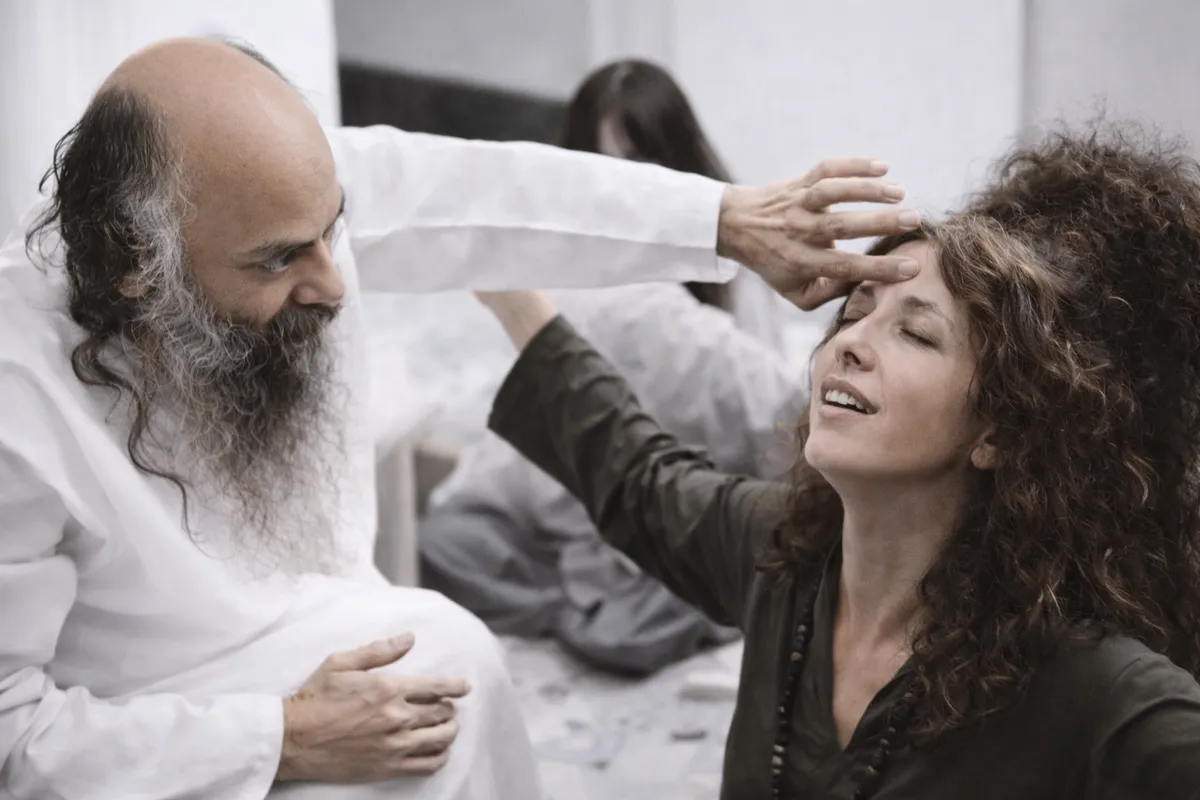
Those who’ve committed get to sit close so he can speak deeply in a quiet, trusting space; newcomers sit back until they’re ready.
From the Discourses
Passages where Osho speaks to this question — each links to the complete discourse.
Why do non-sannyasins have to sit behind the green line? It has been very difficult for me to see you, and this to someone who is only just learning about you is not helpful in feeling you. Actually I feel a little bit like a second-class citizen.
Elaine Santoz, the truth is you are a second-class citizen. I cannot help it, I cannot lie to you. Sannyasins are in a totally different relationship with me; they are privileged in every possible way. Non-sannyasins should feel grateful that at least they are allowed in, up to the green line. If you want to become a first-class citizen, become a sannyasin. You cannot become a first-class citizen without paying for it. In life you can't get anything unless you pay for it. Even if you can get something without paying, it will not have any value for you. The value arises only when you pay for it -- the more you pay, the more valuable it becomes. To come close to me, you will have to do something. And this arrangement -- sannyasins sitting close to me and non-sannyasins sitting a little further away -- has something else in…
Why did you give the order yesterday that only sannyasins would take part in the dance on Sambodhi Day? Why were others prevented from participating?
If you are not ready to participate in me, I am also not ready to participate in you. Slowly, gather courage. Only when you open the door of your heart to me can the door of my heart open to you. It is not that it is closed to you, but it will not be able to open. The key to my heart’s opening is hidden in the opening of your heart. So gradually I will remain only for those who are ready to dive. Only if you dive can you walk with me. I have no taste for crowds. I am not a politician to be excited by crowds. My interest is in those few who are truly eager to seek—and who have the courage to put something at stake. What does “sannyasin” mean? One who has staked something. You want to risk nothing and yet receive everything. Such…
Osho, even after arriving at the camp why does a divide still appear? Does the distance vanish the moment one takes sannyas? Is your blessing only for sannyasins? Is it not for all living beings?
Blessing is for everyone. But it is not that just because I give it you will receive it; you will receive it only if you take it. The river is flowing—flowing for all. Trees will drink, animals and birds will drink, humans will drink. But only the one who drinks will be quenched. If you stand stiff on the bank, the river will not jump into your cupped hands. You will have to bend, you will have to form your palms into a cup—only then will you be able to drink. If you do not drink, if the water is not drunk, then do not complain about the river. The river was flowing. But man is very upside down. If he does not receive blessing, he thinks the blessing must not have been given. But do you have the capacity to receive? Will you accept blessing? Blessing is not a…
Osho, for a long time I had the longing to meet you. So I came from Rohtak to your ashram for a ten-day camp. Yesterday I met Ma Yoga Laxmi and requested to see you. But she said that no non-sannyasin can meet you; if I take sannyas, then I can. May I know why the feelings of a non-sannyasin are rejected, when he has come from so far, with such hope and reverence, to meet Osho?
Yash Sharma! Crossing the distance between Rohtak and Poona will not help. The distance between you and me has to be crossed. The very name of crossing that distance is sannyas. Sannyas is not a formal ritual—it is the process of bridging two inner spaces. I understand, you must have felt hurt. You came from so far. But do you know, people here have come from very, very far! Rohtak is quite near. There is hardly a corner of the world from which people have not come. Think of Rohtak as a by-lane of Poona—not far at all. If meetings were arranged by distance, you would never get your turn. If the rule were: the farther one has come, the sooner he meets—then forget it, your number would not come. Coming from a distance will not do. There is another distance—erase that. Then even if you don’t come from Rohtak,…
Osho, why is there so much secrecy in the ashram?
The ashram is not a marketplace; it is not open to the crowd. Here I am available to those few who genuinely want to be transformed. Sightseers, passersby—there is no purpose in their coming here. The invitation is only for those who have truly come close to transformation, for that small number. Therefore there is privacy in every respect. And the privacy will increase. Because as I see that more of the unnecessary can be sifted out, I will sift them out—since they themselves gain nothing, and by their presence they do not let others gain either. I have remained open to all for a long time and have seen what happens. I found that the crowd of the pointless becomes so thick that the meaningful person gets no chance at all. The merely curious surround so much that the true inquirer is left standing at the back. The mumukshu—the…