
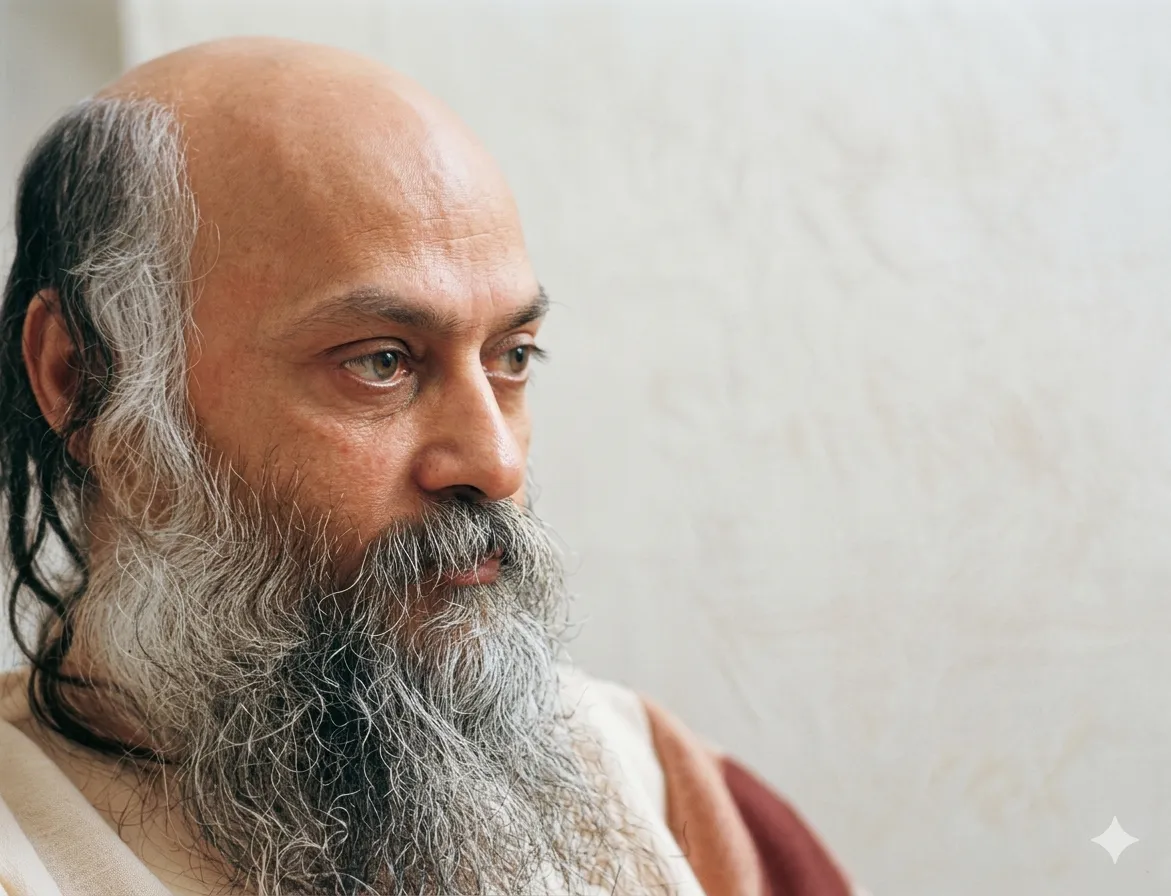
Don’t force yoga poses; relax, and your body will naturally move into the shapes that help you.
From the Discourses
Passages where Osho speaks to this question — each links to the complete discourse.
What is your view about asanas?
As far as asanas are concerned… no, there is no need for you to do them. In this, many asanas will start happening through you. If you do these processes for fifteen or twenty days, many asanas will begin to happen on their own. In the camp, while doing it, someone even went into a headstand. Because when one lets the body go completely, if the body begins to do a headstand, what is one to do? And all these asanas evolved in just this way; no one deliberately devised them. In such a state the body starts taking many forms, making many mudras, many asanas. There was a woman in this camp just now… (inaudible.) Almost all mudras happen through her hands—practically all of them. As many mudras as are discussed in the scriptures, they all manifested in her. Haven’t the photos come to you from there? A movie…
प्रश्न: आसनों के बारे में आपका क्या विचार है?
आसन के संबंध में...नहीं, जहां तक आपको करने की जरूरत नहीं है। इसमें बहुत से आसन आप से होने लगेंगे। ये प्रक्रियाएं अगर आप पंद्रह-बीस दिन करते हैं तो आपसे बहुत से आसन होने लगेंगे। अभी तो कैंप में कोई शीर्षासनों तक चला जाता था, करते-करते। क्योंकि जब शरीर को पूरा छोड़ता हो तो उसका शरीर शीर्षासन करने लगे तो वह क्या करे? और ये सारे आसन इसी तरह विकसित हुए हैं। इनको किसी ने विकसित किया नहीं। ऐसी अवस्था में शरीर कई तरह के रूप लेने शुरू करता है, कई मुद्राएं बनाता है, कई आसन बनाता है। अभी एक महिला थी इस कैंप में...(अस्पष्ट। करीब-करीब सारी मुद्राएं उसके हाथों से होती हैं, सारी मुद्राएं। जितनी मुद्राओं की चर्चा है शास्त्रों में, वे सारी मुद्राएं उसमें आ गईं। वहां से चित्र नहीं आए हैं आपके पास? वहां की मूवी भी बनाई है, और मूवी भी पंजाब में दस-पांच जगह दिखाई है। उस कैंप में ही बनाई थी। तो न मालूम कितने आसन में कोई चला जाएगा, कोई क्या होगा? पर जो आसन अपने आप बनता है वही आपके लिए फायदे का है। …
Is the practicing of traditional asanas helpful for meditation?
Why was Mahavira sitting in that position? Buddha's posture is all right, but Mahavira's posture is very absurd. He was not practicing it; it came. Something happened within him and his body took on a certain posture -- although a very absurd posture. If he had been practicing asanas he would have been sitting just like Buddha, because that was the traditional meditation posture. But he was in an attitude of letgo, and samadhi came and created a posture that was particularly required for his body and his individuality. Everyone will need to express himself individually. No person is like any other and no one can be. An individual is unique so that everything that flowers in him will flower in an individual and unique way. If you impose something from without, then it will be a generalized conception; it can never be fitting and harmonious to your situation. So…
Osho, at the Nargol camp you said that yogic asanas, pranayama, mudras and bandhas were discovered in meditative states, and that in different states of meditation different postures and gestures arise by themselves, from which one can tell the seeker’s inner condition. Conversely, if those postures and gestures are done deliberately, the same meditative mood can be created. Then can meditation be attained through the practice of asanas, pranayama, mudras and bandhas? What is their importance and use in meditation practice?
Then, if it begins within, it can be understood. Suppose a seeker is sitting in meditation and I feel that his crying wants to burst forth, but he is holding it back. I can see that if he cries for ten minutes, a movement will happen—a catharsis, a cleansing. But he is restraining himself so that the crying does not come out. If we tell this seeker, “Now don’t hold back—cry from your side; cry,” then for two minutes he will cry as if acting, but from the third minute his crying will become right and authentic, because crying wanted to pour out from within and he was preventing it. His act of crying will not bring crying; it will break the suppression, and what was flowing within will flow out. Similarly, a seeker may be in a state to dance but is standing stiffly. If we say to him,…
प्रश्न: ओशो, नारगोल शिविर में आपने कहा कि योग के आसन, प्राणायाम, मुद्रा और बंध का आविष्कार ध्यान की अवस्थाओं में हुआ तथा ध्यान की विभिन्न अवस्थाओं में विभिन्न आसन व मुद्राएं बन जाती हैं जिन्हें देखकर साधक की स्थिति बताई जा सकती है। इसके उलटे यदि वे आसन व मुद्राएं सीधे की जाएं तो ध्यान की वही भावदशा बन सकती है। तब क्या आसन, प्राणायाम, मुद्रा और बंधों के अभ्यास से ध्यान उपलब्ध हो सकता है? ध्यान साधना में उनका क्या महत्व और उपयोग है?
फिर अगर भीतर से शुरू होता हो तो समझा जा सकता है। अब जैसे कि मुझे लगता है.एक साधक ध्यान में बैठा है और मुझे लगता है कि उसका रोना फूटना चाहता है, लेकिन वह रोक रहा है। अब यह मुझे दिखाई पड़ रहा है कि अगर वह रो ले दस मिनट तो उसकी गति हो जाए--एक कैथार्सिस हो जाए, एक रेचन हो जाए उसका। लेकिन वह रोक रहा है, वह सम्हाल रहा है अपने को कि कहीं रोना न निकल जाए। इस साधक को अगर हम कहें कि अब तुम रोको मत, तुम अपनी तरफ से ही रो लो--तुम रोओ! तो यह दो मिनट तक तो अभिनय की तरह रोएगा, तीसरे मिनट से इसका रोना सही और ठीक हो जाएगा, ऑथेंटिक हो जाएगा; क्योंकि रोना तो भीतर से फूटना ही चाह रहा था, यह रोक रहा था। इसके रोने की प्रक्रिया रोने को नहीं ले आएगी, इसके रोने की प्रक्रिया रोकने को तोड़ देगी और जो भीतर से बह रहा था वह बह जाएगा।
Those who want to enter the domain of energy, those who want to go on a pilgrimage to the temple of the supreme energy, they will have to shed all fear, and if the body begins to tremble and shake or begins to dance, allow it to happen with ease and spontaneity. You will be surprised to know that all the techniques of yogic asanas -- body postures -- were discovered accidentally in meditation, in the various states of meditation. It is not that someone created them through thinking and deliberation. They were not created independently. In the state of meditation the body took different positions first, and then they were recognized as yogic postures. And gradually an association between the body and mind was revealed which said that when the mind is in a particular state, the body follows it with a particular posture of its own.
In the nargol meditation camp you have said that either the energy rises from within and reaches up to the divine or the energy of the divine descends and merges within. You said that the first is rising of the kundalini and the second is the grace of the divine. Then later on you have said that when the sleeping energy within meets the enormous energy of the infinite, an explosion takes place which is samadhi. Is the union of the awakened kundalini and grace absolutely necessary for samadhi? Or, is the evolution of the kundalini up to the sahasrar similar to the happening of divine grace?
As I said before, man is a ladder. Nietzsche's words in this context are very precious. He said, "Man is a bridge between two eternities." There is one eternity -- that of nature, which has no end -- and there is the other, of the divine, which is also infinite, limitless. Man is a bridge swaying between these two. Therefore man is not the resting place. One either goes forwards or backwards. There is no place to build a house on this bridge. Whoever tries to settle on it repents, because a bridge is not a place to have a house; it is only meant for crossing over from one end to the other. In Fatehpur Sikri, Akbar tried to build a temple of all religions. He dreamed of one religion, which he named Deen-e-Illahe -- the essence of all religions. So he had inscribed a sentence on the entrance…